
By Stephen Groves and Lisa Mascaro
Washington: An alleged drug boat destroyed in a lethal multiple US strike in the Caribbean this year was heading to Suriname, a small country east of Venezuela, to rendezvous with a larger vessel, according to two sources familiar with the operation cited by CNN.
According to US intelligence, the boat intended to “rendezvous” with the second vessel and transfer drugs to it, the US admiral overseeing the operation said during closed Senate briefings this week, but the military could not locate the second vessel.
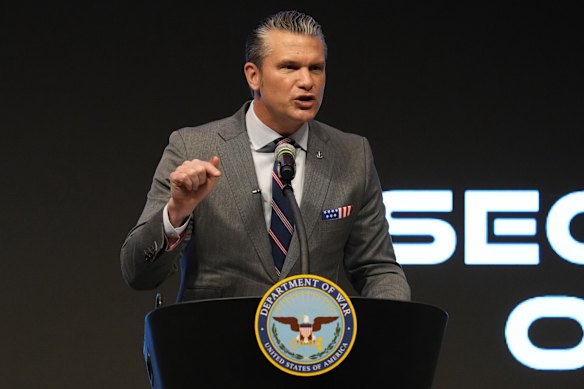
War Secretary Pete Hegseth is under scrutiny over the death of survivors of an alleged drug boat bombing.Credit: AP
The US military struck the boat four times – the first time splitting it in half, leaving two survivors clinging to a section of the capsized hull, CNN reported on Thursday. The second, third and fourth strikes killed them and sank the vessel.
The September 2 strikes were the first time the US military targeted vessels allegedly carrying drugs.
But this particular attack and the broader military campaign, which so far has destroyed more than 20 boats and killed more than 80 people, are under intense scrutiny from Congress, which is seeking to clarify its legal underpinnings.
Republicans have largely backed the military campaign in the Caribbean, which the Trump administration says is intended to deter the flow of drugs to the US. But lawmakers and military experts have said the recent sequence of events is alarming, potentially violating the laws of armed conflict that safeguard human rights and protect American troops.
Admiral Frank “Mitch” Bradley has stated that War Secretary Pete Hegseth did not issue a “kill them all” order on the survivors. But Democrats say the scope of the mission was clear – to destroy the drugs and kill the 11 people on board.
War Secretary Pete Hegseth defended the strikes on Saturday, saying President Donald Trump had the power to take military action “as he sees fit” to defend the nation.
“If you’re working for a designated terrorist organisation, and you bring drugs to this country in a boat, we will find you and we will sink you. Let there be no doubt about it,” Hegseth said during a speech at the Reagan National Defence Forum.
Last week, lawmakers overseeing national security committees heard from Admiral Bradley, who ordered the initial strikes, including the follow-up that killed the two survivors.
‘Deeply concerning’
Bradley told lawmakers that he ordered a second attack on the wreckage of a boat that was carrying cocaine because it was believed that bales of the drug were still in the hull of the boat, according to a person with knowledge of the briefing who spoke on the condition of anonymity because they were not authorised to discuss it.
For several minutes, two people, shirtless and at one point waving, had climbed on the piece of the boat that was still floating.
They were “drifting in the water – until the missiles come and kill them,” said congressman Adam Smith, the ranking Democrat on the House Armed Services Committee, adding that the killings were “deeply concerning”.
However, Senator Tom Cotton, the Republican chair of the Senate Intelligence Committee, said he believed the video shows the two people trying to flip over the piece of the boat. For him, that was enough of an indication that the survivors were trying to “stay in the fight” and were therefore still justifiable targets.
Bradley told the lawmakers that the rationale for the second strike was to ensure that the cocaine in the boat could not be picked up later by cartel members. Lawmakers had previously been told that the second strike was ordered to sink the boat.
According to CNN, the admiral also argued that the drug shipment could have ultimately made its way to the US from Suriname, and said that justified the strike on the boat even if it wasn’t directly heading to US shores at the time of the attack.
Lawmakers want to know under what orders and instructions the operation was conducted. What they learn in the weeks ahead, and how far they are willing to press the administration for answers, is likely to become a defining moment for the US military under Trump’s second-term command.
It is testing the scope of laws that have long governed soldiers on the battlefield and will almost certainly influence the course of the tense standoff between Trump’s White House and Venezuela.
Under the Trump administration’s legal opinion, drugs and drug smugglers en route to the US are essentially viewed as terrorist threats and can be targeted with the same rules that apply to the global war on terror.
That’s a dramatic shift from traditional practice that views drug-running as a serious criminal activity, but one to be handled typically by law enforcement, usually the Department of Homeland Security’s Coast Guard, rather than the military.
“The people in the boat, as a matter of the law of armed conflict, are not fighters,” said Michael Schmitt, a former Air Force lawyer and professor emeritus at the US Naval War College.
“All they are is transporting drugs.”
Democrats say the conclusions of the Trump administration’s legal argument are troublesome. “That incredibly broad definition, I think, is what sets in motion all of these problems about using lethal force and using the military,” Smith said.
That’s led lawmakers to call for the public release of the legal argument that undergirds the military campaign, a roughly 40-page opinion from the Justice Department’s Office of Legal Counsel.
“This briefing confirmed my worst fears about the nature of the Trump administration’s military activities,” Senator Jack Reed, the top Democrat on the Armed Services committee, said in a statement. “This must and will be only the beginning of our investigation into this incident.”
AP, Reuters
Most Viewed in World
Disclaimer : This story is auto aggregated by a computer programme and has not been created or edited by DOWNTHENEWS. Publisher: www.smh.com.au


