
George Brandis
Former high commissioner to the UK and federal attorney-general
John Faulkner, Labor’s respected former Senate leader and keeper of the Whitlam flame, once said to me that one of the biggest differences between Labor and the Liberal Party was their different attitudes to their own history – in particular, to past leaders. Liberals celebrate only their most successful leaders, said Faulkner, whereas Labor celebrates all its leaders – even the second-rate ones. The exception, of course, is the rats (although even Labor leaders who ratted still have their photographs hung in the caucus room).
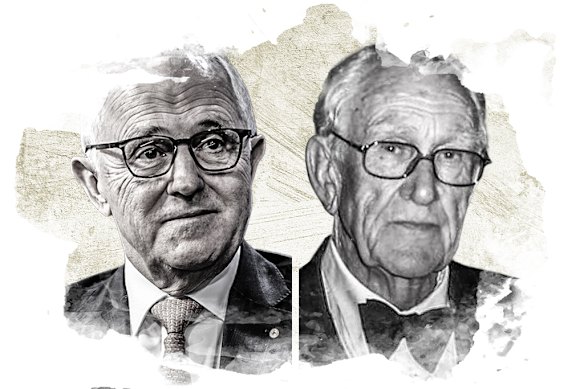
Forgotten and ignored and, worse, reviled by their own tribe: Liberal leaders Malcolm Turnbull and Malcolm Fraser.Credit: Michael Howard
One of the paradoxes of Australian politics is that the conservative side has so little sense of its own history, while the party of the left celebrates – indeed, shamelessly mythologises – its own. For instance, a prime minister as pedestrian as Ben Chifley has been enlarged into a beloved national icon – a pipe-smoking, cardigan-wearing old sweetheart who preferred the modesty of the Kurrajong Hotel to the stateliness of The Lodge. The catastrophes of his government – its disastrous attempt to nationalise the banks; the worst industrial conflict in our history, which put troops in coalmines – have been airbrushed away.
Chifley’s successor as Labor leader, H V Evatt – one of the most unfit national leaders in our history, whose political incompetence failed to avert the split that kept Labor out of office for two decades – is remembered by invariably sympathetic biographers as a passionate, if flawed, idealist. (Always beware that weasel word “flawed” in political hagiography – it’s usually a euphemism for a multitude of character defects.)
Labor honours its leaders in death, even if it stabbed them in life. At Simon Crean’s funeral two years ago, Melbourne’s St Paul’s cathedral was packed to overflowing. Crean may never have been given the chance to fight an election, but his farewell was a vast gathering of the tribes. How many of the Liberal tribes do you imagine would turn out for the two Liberal leaders who never got to fight an election – Brendan Nelson and Alexander Downer?
For every Labor prime minister whose government ended in failure, there’s always a villain to blame. In the case of James Scullin, it was the wicked Bank of England and its devilish agent Sir Otto Neimeyer; in Whitlam’s case, the scheming Sir John Kerr (in league, for loopier conspiracy theorists, with the Palace and/or the CIA); for the Rudd-Gillard-Rudd government, Rupert Murdoch and his evil myrmidons. It’s always someone else’s fault when things end badly. The fallen hero/evil villain narrative gives Labor history a vaguely operatic flavour that the boring old Liberal Party quite lacks.
Perhaps that is why Liberals are so uninterested in their own history – and woefully neglectful of their former leaders. Or perhaps it is because of the dominance in their imagination of Robert Menzies. For most of its existence, the Liberal Party was a one-hero party. John Howard has since joined Menzies in the Liberal empyrean. The rest – including seven prime ministers – are ignored, forgotten or even despised.
Last month, the 50th anniversary of the Dismissal prompted endless commemorations by Labor, and by its surrogates like the ABC. Predictably, they became Gough Whitlam tribute acts. Expect no Liberal Party commemorations for the anniversary next weekend of the denouement of the events of November 11 – Malcolm Fraser’s historic landslide on December 13.
Yet Fraser led the Liberal Party for eight years (all but eight months of them as prime minister), and was our fourth longest-serving prime minister. The Fraser government shaped modern Australia fundamentally and for the better, in particular by transitioning us to a multicultural society, the architecture of which was created by Fraser in collaboration with his adviser Petro Georgiou. It was distinguished by its welcoming of refugees (in particular, the Vietnamese refugees whom Whitlam, to his eternal shame, abandoned), and its human rights-focused foreign policy, reflected in Australia’s global leadership in ending apartheid in South Africa.
The same is true of the Liberal Party’s attitude to the other Malcolm. At the unveiling of Malcolm Turnbull’s official portrait the other day, only four of his cabinet were present: Julie Bishop, Sussan Ley, Christopher Pyne and me. Turnbull has essentially been written out of Liberal history.
It’s never acknowledged that he had at one stage been the party’s most popular leader ever: in November 2015, IPSOS recorded his approval rating at 69 per cent (nine points above Howard at the height of his popularity in 2001, during the Tampa affair), with an astonishing net favourability of +53. Australians initially loved Turnbull’s approach to what the Liberal Party could be. Things quickly went south when they perceived him to be too accommodating to the party’s right.
One of Turnbull’s priorities was the appointment of more women to senior government positions. Among professional women in particular, he was very popular. It is unimaginable that the breakthrough of the teals could have occurred on his watch.
Today, Fraser’s legacy is uncelebrated by the Liberal Party; his liberalism strikes no chord. Turnbull is openly reviled, in particular by the far-right commentariat. Such people reject Howard’s belief that the Liberal Party is strongest when it is a broad church of liberals and conservatives. They don’t pretend to be liberals (of course), but they are not conservatives either. Prejudice-mongering populism is about as far away from authentic conservatism as it is possible to get.
Real conservatives would take pride in the Liberal Party’s rich traditions and, like Labor, honour its past leaders – not just those, like Menzies and Howard, of the first rank, but all of them. After all, Malcolm Fraser brought the Liberal Party a lot more success than any of its recent leaders have done, while the main contribution to the party’s history of those who knifed Malcolm Turnbull was to drive it over a cliff.
George Brandis is a former high commissioner to the UK, and a former Liberal senator and federal attorney-general. He is now a professor at the ANU’s National Security College.
Most Viewed in Politics
Disclaimer : This story is auto aggregated by a computer programme and has not been created or edited by DOWNTHENEWS. Publisher: www.smh.com.au





