
Last week an image was posted on social media with the caption: “I just generated an image in the style of a Monet painting using AI. Please describe, in as much detail as possible, what makes this inferior to a real Monet painting.”
Hundreds of people piled on. “There is no cohesion to the depth and colour choices,” wrote one. “It’s high school level art 101,” said another. “It lacks the mess of humanity.” “It looks nothing like a Monet.”
Of course, the painting was a real Monet – one of his famous Water Lilies.
The experiment – posted by an anonymous conceptual artist who uses the pseudonym @SHL0MS – reveals something more interesting than human gullibility: it speaks to how confused we have become about what art is and why it matters.
Studies consistently find that people cannot distinguish AI-generated images from human ones and, despite often preferring AI art, show a strong negative bias towards it the moment they learn its origin. The water lilies are just one recent example of AI infiltrating the creative industries.
Late last year the band The Velvet Sundown racked up 900,000 listeners on Spotify before it was revealed the entire band and its music were AI-generated. Users who had genuinely enjoyed the music were suddenly disgusted by it – ashamed, perhaps, to have been moved by a machine.
In the wake of the backlash, Spotify has since introduced verification tools to distinguish AI-generated music from real artists as AI-generated content grows exponentially across all art forms.
The Monet experiment adds a new dimension to the philosophical debate surrounding authenticity. It reveals the question is not how well humans can distinguish AI art from human art, but whether they value it the same way once they know its origin.
I could buy a human-painted reproduction of any masterpiece from China for a few hundred dollars; you’d be unlikely to tell it from the original. Does that make it less meaningful?
Indeed, forgeries have existed as long as art itself, and despite often being visually indistinguishable, they are worth almost nothing.
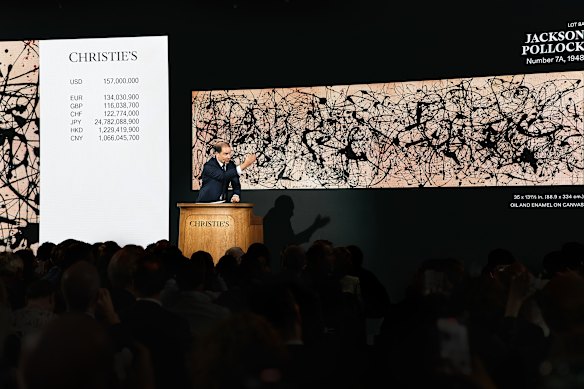
On May 20, a Jackson Pollock painting fetched $US181 million ($254 million) at auction – the fourth-most expensive work ever sold. It commanded that price not because it is technically superior to other paintings but because of what it represents. I could just as easily splatter some paint on a canvas and hang it in a modern art gallery.
But we don’t value art for its accuracy, resolution or technique. We value it because it is part of history – or, more accurately, it is history. Monet pioneered impressionism. Pollock pioneered abstract expressionism. They altered the course of human creativity and cultural history.
This is the crux of why AI art, however impressive, will never replace artists. Even if it produces something more beautiful than any human could paint, it is meaningless precisely because it carries behind it no human intention, just as a forgery does not sell for millions at auction.
Ants are not impressed by human architecture, even though it vastly surpasses anything they could build. They are wired only to care about other ants. Humans are no different: we are fundamentally wired to care about what other humans create, suffer through and mean.
AI cannot generate anything truly new. It is a collection of probabilistic outcomes derived from human-generated inputs. It is bound by what has already been created; it cannot break new ground. (That is, until we reach the elusive “Artificial General Intelligence”, where it equals or surpasses human capacity.)
In the meantime, artists whose work has trained these systems are increasingly demanding compensation, a debate already raging in journalism, music and publishing.
Yes, humans can use AI as a tool under their own creative direction, and some are doing so brilliantly. But the endless torrent of “AI slop” flooding our feeds – and growing backlash against it – is evidence enough of what happens when the human hand is removed from the equation entirely.
This month, researchers estimated that AI-generated text on the internet surpassed the volume of human-written content for the first time – a milestone that has triggered growing panic across journalism. But doomsayers can relax.
You may have already noticed the em dashes in this article — supposedly one of the dead giveaways of AI writing. Never mind that writers have used them for centuries; Emily Dickinson practically built a career on the things.
If I told you this article had been generated by an AI journalist, would it land the same way? Probably not, and that instinct is precisely my point. Humans will always care more about what other humans create.
There are no acclaimed AI artists, actors, authors or musicians because what we are really seeking in art is not beauty or technical perfection but evidence of another human consciousness, its struggle, joy, ambition, grief and mortality.
That is why the human Claude Monet will always matter more than a Monet by Claude the AI.
Will Bennett is a freelance writer.
Get a weekly wrap of views that will challenge, champion and inform your own. Sign up for our Opinion newsletter.
 Will Bennett is a freelance writer and a Cambridge masters graduate.
From our partners
Disclaimer : This story is auto aggregated by a computer programme and has not been created or edited by DOWNTHENEWS. Publisher: www.smh.com.au


