
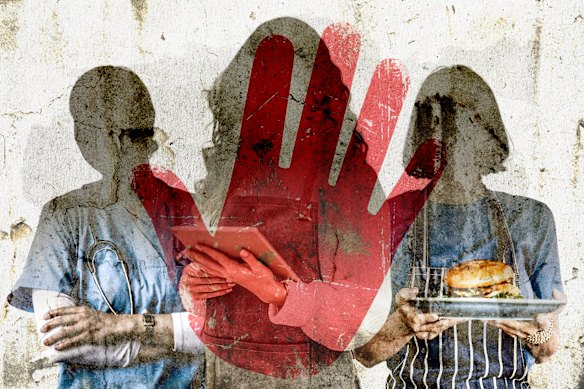

A customer has been ordered to pay tens of thousands of dollars in compensation and penalties for sexually harassing a worker, in a court case billed as a new frontier.
The Federal Circuit and Family Court decision confirms that customers and other patrons may be held liable for harassing workers such as hospitality staff.
In a decision published this month, Judge Salvatore Vasta found a male worker at a self-storage facility was sexually harassed by two men: a major customer of the business and a contractor.
It was “a very serious example of sexual harassment at work”, Vasta said. The gay man was subjected to sexualised and homophobic comments, including being referred to as “the gay boy” and “poof”, among more explicit remarks.
Under orders made by the court, the two men are jointly liable to pay $90,000 in compensation. Separately, they were ordered to pay penalties of $13,000 each.
Vasta said a Fair Work Act provision aimed at stamping out sexual harassment in connection with work covered all types of perpetrators. The identity of the perpetrator “really does not matter”, he said.
The Fair Work Act would protect a waitress harassed by a patron at a restaurant, Vasta said, “because the waitress would be a worker and the harassment occurred in connection with her being a worker”.
‘Huge financial consequence’
Sydney-based lawyer Justin Penafiel, principal of J Penn Co Lawyers, acted for the worker. He said the decision had implications for all public-facing workplaces, including retail, hospitality and health.
“It does help businesses make it clear to the community, or anyone who walks into their business: you will face not just legal but severe financial consequences if you harass our staff,” he said.
“It might actually help businesses better control customer [behaviour] and … ensure respect in their workplaces.”
Penafiel believed it was the first case to test the liability of a customer for sexual harassment under the Fair Work Act provision, introduced in 2023, and it resulted in a “huge financial consequence”. This was a “new frontier”, he said.
A new avenue
He said the decision demonstrated that “degrading jokes, homophobic slurs and sexualised comments in the workplace are serious breaches of workplace law, and you don’t have to be the employer to be liable”.
Businesses already have legal duties to their employees and must take “reasonably practicable” steps to eliminate or minimise risks, including those arising from customers.
But Penafiel said that “no business can be practically and fully responsible for every single customer that walks into their business”.
The Fair Work Act provided a new avenue for holding a customer directly accountable.An employer is also vicariously liable for the sexual harassment of a worker by another employee, unless they took all reasonable steps to prevent the employee engaging in the behaviour.
‘Harrowing’ evidence
Vasta said the descriptions of the harassment given in court by the worker were “quite harrowing”.
He said the evidence conveyed the “sense of isolation, the sense of degradation, the sense of being totally alone because it is always two against one, and, while this cannot be part of the award of damages, the fact that when he did get the courage to make the complaints, they were not listened to”.
In a separate case, decided earlier this year, the court ordered the director of a Canberra cafe to pay $50,000 in compensation and a $9390 penalty for sexually harassing a 23-year-old waitress, including by wrapping his arms around her from behind and kissing her on the lips.
‘Exciting’ decision
Senior employment lawyer Yuva Harish, acting principal solicitor of Sydney’s Inner City Legal Centre, said the decision was an “exciting” development in a “largely untested” area of the law.
“This kind of behaviour should have left the workplace decades ago and was never appropriate,” she said. “It shines a light onto modern-day workplaces and the experiences of young and queer workers.”
Harish said the ICLC assisted many LGBTQ clients, including workers in retail and service industries who were at a greater risk of sexual harassment.
Insecure and irregular employment arrangements made it difficult to speak out against harassment, and in some cases employers adopted a “customer is always right” approach.
She said the Sex Discrimination Act provided a separate avenue for seeking redress for workplace harassment, which would extend to third parties such as customers.
Harish said it was unfortunate the worker was forced to take legal action to stop the harassment but “I really do commend them for their courage”.
“Workers have a right to go and do their job in peace and not have to suffer this kind of behaviour, and also to be supported by their employer,” she said.
Start the day with a summary of the day’s most important and interesting stories, analysis and insights. Sign up for our Morning Edition newsletter.
From our partners
Disclaimer : This story is auto aggregated by a computer programme and has not been created or edited by DOWNTHENEWS. Publisher: www.smh.com.au


