
In 405BC, the Spartans under Lysander targeted the narrow passage now known as the Dardanelles, cutting off Athens from its major source of grain. The resulting starvation forced the surrender of an empire.
Such narrow chokepoints are a key vulnerability for global seaborne trade: as mariners navigate the tight waterways, they face risks from pirates to militants and major powers vying for control.
Now those vulnerabilities are being laid bare in the Strait of Hormuz, just 30 miles wide at its narrowest point, the sole seaborne route to the oil-rich Gulf. After the US and Israel attacked Iran in February, Tehran announced it had taken control of the strait. Washington has responded with its own blockade of Iranian ports.
The resulting energy shock has left companies and governments scrambling to identify other sea trade bottlenecks and assess their exposure.
Even before the Hormuz stand-off, disruptions at maritime chokepoints affected about $190bn of trade each year, causing economic losses of $14bn, according to estimates by researchers at Oxford university.
They defined the chokepoints as “strategic canals, passages, channels or straits” where “large flows of trade converge”. While some consist of slender channels of water, other examples in the Oxford study – such as the Cape of Good Hope – involve trade flows funnelling large numbers of vessels together on a narrow route.
Experts say growing geopolitical tensions are playing out in these vital sea lanes.
“Some of these trade routes have been weaponised to an extent that we have not seen before,” says Vincent Clerc, chief executive of Maersk, the world’s second-largest container shipping line.
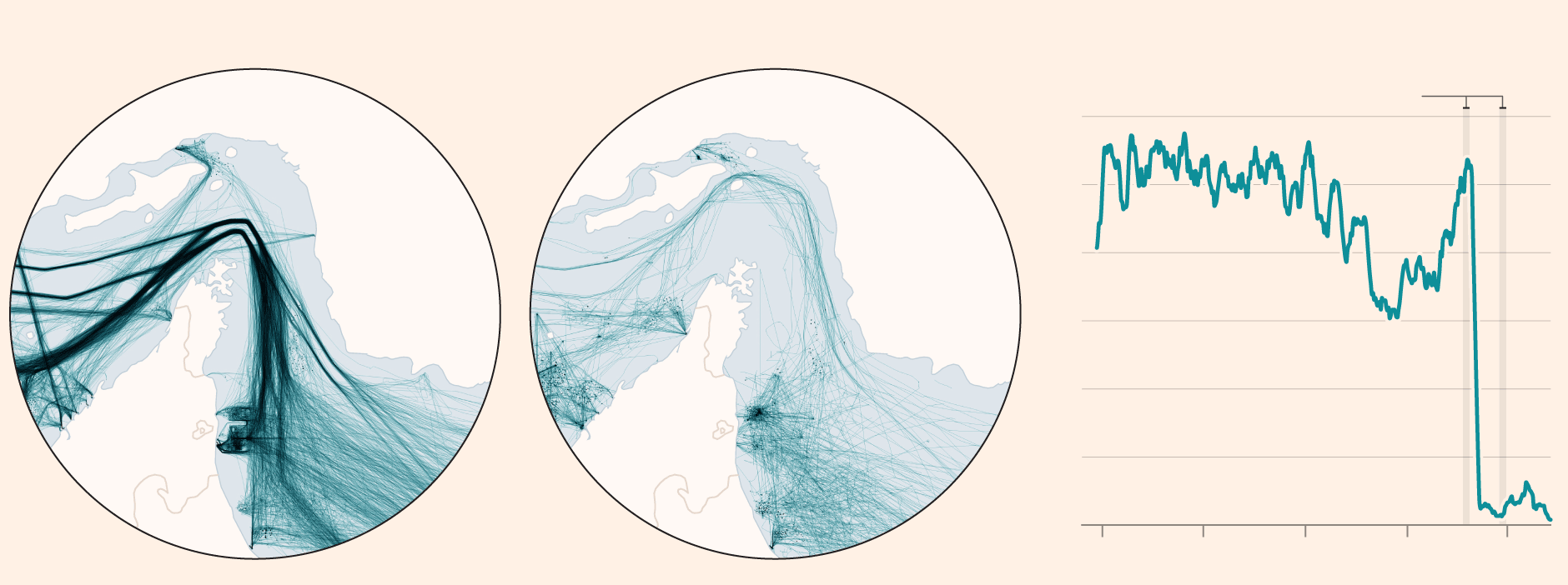
Conflict has left Hormuz traffic at a near standstill for weeks
Vessel routes through Strait of Hormuz during seven-day period


Graphic: Side-by-side maps and a line chart show ship traffic through Hormuz before and after closure, with daily transit calls dropping sharply to near zero.
US President Donald Trump has periodically threatened to take control of the Panama Canal. The threat, so far unfulfilled, could lead China to look again at proposals for a rival waterway through Nicaragua, says Lars Jensen, founder of consultancy Vespucci Maritime. “It goes way beyond shipping — it’s a long-term geopolitical play,” he says.
According to researchers at the think-tank Chatham House, another “chokepoint power play” was a joint Russian-Chinese naval exercise off South Africa’s Indian Ocean coast in January — a signal that pressure can be exerted on both global trade routes and the US.
The Indian Ocean is a pressure point between the US, China and Russia, with two-thirds of oil and one-third of global cargo transiting through, according to Chatham House. It said the countries that joined or observed the exercise – Egypt, Ethiopia, Indonesia, the United Arab Emirates and South Africa – “all sit near or along the Indian Ocean’s major chokepoints”.
Nitya Labh, a fellow at the think-tank, says China’s Belt and Road global infrastructure and investment programme “has always been about the US closing off the chokepoints” as Beijing seeks alternative supply lines in case of disruption.
“As trade and security become more closely linked, control over these routes could define the future of the international political economy,” she says.
The long way round
The consequences of blocking a waterway depend on how much trade travels through it; whether it is used for fuel supplies; how much particular countries depend on using it; and, crucially, whether other routes are on offer.
Lasse Kristoffersen, chief executive of Wallenius Wilhelmsen — a Norwegian shipping group that specialises in transporting vehicles — says his vessels have rerouted thousands of miles around South Africa’s Cape of Good Hope rather than taking the Suez Canal because of Yemen’s Houthi militants, who began attacking vessels in the region in 2023. The company will not compromise safety, he says.
“It’s not that it’s physically closed, it’s the fear that something can happen . . . it’s a psychological effect more than physical effect,” says Kristoffersen.
Vessels can reroute thousands of miles to reduce chokepoint risk


Graphic: Two maps compare shipping routes from East Asia to Europe: on the left, the BYD Shenzhen travels via the Suez Canal through multiple chokepoints, while on the right the Manon takes a longer route around the Cape of Good Hope, avoiding narrow straits but adding significant distance.
Diverting tankers and container ships such as Kristofferson’s to avoid the Houthis caused a spike in freight prices, but shipping companies adapted by rearranging schedules and sending their ships around the Cape of Good Hope.
In contrast, some Chinese vessels take the shorter route via Suez and are not attacked, although there is no evidence of an official agreement with the armed group, analysts at Lloyd’s List say.
A tentative return to the Bab el-Mandeb strait in the Red Sea took place early in 2026, but many shipping companies remain cautious, worrying that the Houthis could be inspired by Iran to attack again. In a sign of that strait’s strategic importance, Djibouti – whose coastline runs along the waterway – is home to military bases of several major countries, including the US, Italy, France, Japan, and the sole People’s Liberation Army base outside China.
The Bab el-Mandeb strait is among several trade chokepoints that, when blocked, require vessels to travel more than 8,000 miles. These also include the Strait of Gibraltar and the Suez and Panama Canals.
Yet Audun Halvorsen, head of readiness for the Norwegian Shipowners’ Association, says the existence of an alternative route is vital, even when it involves an epic journey. “As long as you have a real alternative, it can be mitigated,” he says. Shipping costs are a small part of the final price of goods, he says, so even if the cost of transport doubles or triples, consumers notice only a small impact.
The knock-on effects of a blockage can be much more significant where there is no alternative route to fall back on, as with the Strait of Hormuz, the Øresund between Denmark and Sweden, and the Turkish straits, comprising the Dardanelles and the Bosphorus, which act as the gateway between the Black Sea and Mediterranean.
With the Hormuz strait, says Jasper Verschuur, co-author of a study into the risks of the world’s 24 narrow straits, “there is no alternative for 80 per cent of the trade”.
Even countries with no direct Middle East links are being affected. Economists suggest west African nations could be among the hardest hit as fertiliser shortages threaten harvests and sustain higher food prices into next year.
Artem Abramov, head of oil and gas at research group Rystad, says Red Sea disruption in 2023 added $2 to $3 per barrel of oil, not enough to affect inflation. But prices have risen by more than $40 since February in the Strait of Hormuz crisis.
Consequences can ripple through supply chains and energy systems to hit food security and manufacturing. Björn Vang Jensen, head of ocean at EasySpeed International Logistics, says there is a “rule of thumb” that for every week the Strait of Hormuz is closed, “you can expect a month of disruption”.
Parts of the world are more exposed to chokepoints than others, with some countries relying on just one or two such routes to get their goods in and out.
How vulnerable are countries to chokepoint disruption?
Select a country to compare
For China, the Taiwan Strait is the most important maritime chokepoint, with 41% of goods passing through it. The country has two chokepoints that each handle more than 25% of its seaborne trade. Oil and petroleum products are among China’s most exposed imports and exports — the majority of which pass through the Taiwan Strait.
Establishing back-ups to usual routes in case of crises is hugely expensive, says consultant Jensen. “In normal times, nobody would use them,” he adds.
Weather and other mishaps
The Houthis are not the only force to have curbed traffic through a key chokepoint in recent years. Also in 2023, drought affected passage through the Panama Canal, which connects the Pacific Ocean with the Caribbean Sea. But shipping returned to normal flows after a few months as rain returned.
Weather experts expect another occurrence of El Niño, the cyclical warming effect that caused that drought, later this year. “It is increasing on our radar screen,” says Kristoffersen, whose company has already secured slots for its vessels and has emergency rerouting plans.
Even small blockages such as the six-day closure of the Suez Canal in 2021 — caused by the grounded Ever Given container vessel — can have ripple effects. That closure caused temporary furniture shortages for flatpack giant Ikea for months.
“We are considering these risks constantly,” says Kristoffersen.
The Ever Given grounding led to a temporary pause in Suez canal traffic
Vessel routes through Suez Canal during five-day period


Graphic: Side-by-side maps and a chart show Suez Canal traffic before and during the Ever Given blockage, with daily transit calls plunging before recovering.
While the Ever Given’s blockage of the Suez Canal caused only a brief halt to traffic in 2021, flows through the canal and the Bab el-Mandeb strait have fallen more persistently since Houthi attacks in the region intensified in late 2023.
With many European shipping companies choosing to reroute around the Cape of Good Hope, average daily transits by that route rose by 77 per cent in 2024 from a year earlier.
Yet global trade absorbed the impacts of these incidents, and some observers say that made policymakers complacent.
“These dependencies have been known about for quite a long time,” says Verschuur. “But a lot of governments forgot about them, because nothing seemed to have gone wrong for a very long time.”


Graphic: Side-by-side satellite images show a zoomed-in view of the Suez Canal with the container ship Ever Given lodged diagonally across the narrow waterway and a wider coastal view of the Panama Canal entrance showing many ships scattered offshore in the Pacific Ocean, waiting to transit.
It has become much harder to forget since the effective closure of the Strait of Hormuz.
Hundreds rather than the usual thousands of vessels have passed through the strait since March 5.
“This really feels like a global crisis, a little similar to what happened with Covid-19,” says Rystad’s Abramov. Gasoline and diesel prices have surged, and jet fuel and fertiliser are already in short supply; food prices are expected to rise, while the next phase of the crisis is likely to lead to fuel rationing and industrial shutdowns, experts have said.
Policymakers are debating when recession may set in. “The word on everyone’s lips is stagflation,” a senior European industrialist says. “The longer this goes on, the more I worry about it.”
As the disruption has stretched on for months, companies have been forced to find radical workarounds. Some are trying to transport goods via land — either through existing oil pipelines or using trucks.
Danish logistics group DSV, market leader in the Middle East, is moving cargo through Saudi Arabia and Turkey. “When everything is flowing, you don’t consider your job vital. But if you can’t get cargo in, the people there can’t eat,” says Jens Lund, the company’s head.
Lorries, however, can replace only a small share of the capacity provided by large container and cargo ships, while border crossings and challenging terrain can further slow their transit.
Battle for control
Western countries have traditionally worried about routes in the Middle East, fearing that any regional conflict could limit access to the Red Sea, Suez or the Bosphorus.
But Trump has placed the Panama Canal at the heart of his vision of hemispheric defence – accusing China of trying to control the waterway, and threatening to take control of it himself. A Hong Kong-based conglomerate previously ran two ports on the canal, until Panama annulled its contracts earlier this year. China has called the US president’s claims groundless and said it wants to keep the canal neutral.
Nonetheless Trump’s moves may encourage Beijing to “rekindle building a Nicaragua Canal”, says Jensen, referring to a concession granted to a Chinese businessman in 2013 to develop a new rival waterway – though little came of it.
Following Trump’s threats and the cancellation of the port contracts, China has increased inspections of Panamanian-flagged vessels, leading to reports of ships reflagging, he adds. China’s foreign ministry said in March that its inspections were in accordance with laws and regulations.
A Chinese academic in Beijing, who asked not to be identified, says Panama’s move on the ports “would not be forgotten in Beijing, which would improve its projection of hard power to ensure that this did not happen again in other important strategic chokepoints”.
“Right now, the cost is very limited [for countries like Panama], but I think in the future, this is not going to be tolerated,” he says.
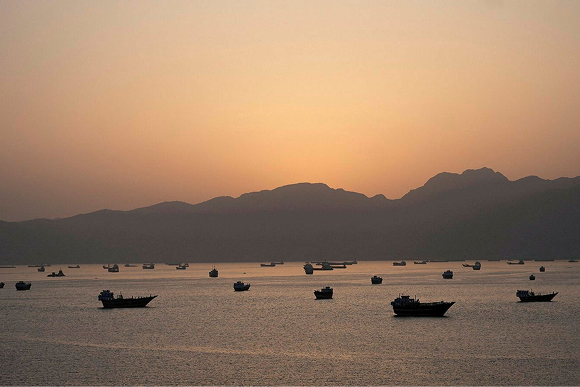
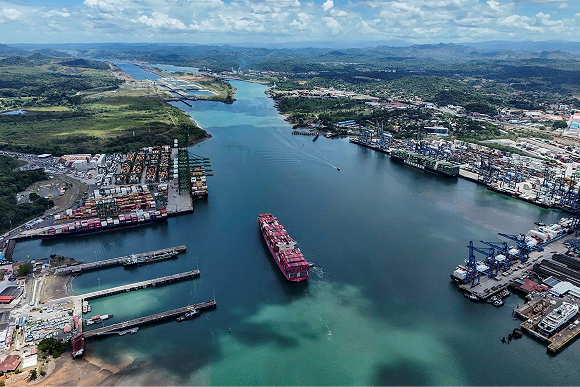
Beijing sees the Panama Canal “as a potential risk for their energy security” too, says Abramov, who adds that the Atlantic Basin looks relatively attractive to China for future oil exploration.
China ordered several local companies and research institutions in late April to look into ways of safeguarding a number of trade corridors, including asking shipping group Cosco and Shanghai Jiao Tong University to examine the effect of chokepoints on supply chains.
Key Asia-Pacific corridors, such as the Malacca and Taiwan Straits — vital for Chinese trade and the country’s military reach, while forming the default corridor connecting east Asia with the west — have also become a theatre for US-China competition.
Some Iran-linked “shadow fleet” vessels, which seek to evade western sanctions, have this year begun taking non-standard routes on voyages to China and other Asian markets, such as diverting through Indonesia’s Lombok Strait rather than the shorter way through Malacca.
Analysts link this shift to increased scrutiny: Washington and its partners have increased patrols in the area in an effort to disrupt illicit shipping and block sanctioned oil flows.
Such behaviour is not the “typical pattern”, says Dimitris Ampatzidis, senior risk and compliance analyst at Kpler, but can be explained by US Navy vessels patrolling the area. “They [the shadow vessels] are trying to avoid being detected as they’re crossing the Malacca Strait — trying to arrive in China.” More recently the vessels have struggled even to leave the Strait of Hormuz as the US launched its own blockade.


Graphic: Map showing the route of an Iranian supertanker heading past Sri Lanka, highlighting its disappearance, reappearance near Indonesia and later detection in the South China Sea.
Some analysts even argue that nascent Chinese interest in the Northern Sea Route — which passes over the top of Russia through the icy Arctic — is not just about reducing journey times to Europe, but also about cutting its exposure to trade bottlenecks.
Events in Hormuz could spur this along, says Oxford study co-author Verschuur, adding that the northern route would “circumvent five or six major chokepoints”.
Still, a viable Arctic shipping route is decades away, according to most experts, and entry to the Northern Sea Route is through yet another chokepoint: the narrow Bering Strait between Russia and the US.
The search for alternatives risks creating new dependencies. “You build redundancy but every single route can be choked in one way or another,” says Maersk’s Clerc.
Chatham House’s Labh argues recent disruption to sea routes could become the new normal, with the world entering a period when trade is optimised for “resilience rather than efficiency”.
“In this way, maritime chokepoints are a barometer for global peace and stability.”
For many business executives, a worst-case scenario would be a conflict between China and Taiwan, which would almost certainly lead to the closure of the Taiwan Strait, through which a fifth of global maritime trade passes.
Vessels would only have to divert a short distance to circumvent the strait – but the perils of such a conflict would lie in the likely far broader economic and geopolitical disruption it would cause, analysts said. The same would be true of any conflict in the South China Sea, where Beijing has territorial disputes with a number of neighbours.
“Navigationally, you could get around it, but the implications of any disturbance there would just be so big,” says Halvorsen, of the Norwegian Shipowners’ Association.
In the meantime, other countries or rebel groups may learn from Iran and the leverage it has gained through control of the Strait of Hormuz. Experts say the Middle East, and in particular the Red Sea and Suez, are most vulnerable to copycat actions.
“The cost of posing the threat is very low,” said Abramov, but “the cost of guaranteeing full safety is very high.”
Additional reporting by Joe Leahy in Beijing.
Image of the Manon vessel carrier by Jackie Pritchard. Vessel traffic density data from Global Maritime Traffic and shows cargo ships for September 2024. Data on maritime trade through individual chokepoints and country-level chokepoint dependency provided by Jasper Verschuur, Johannes Lumma and Jim W Hall, authors of Nature Communications paper Systemic impacts of disruptions at maritime chokepoints. Shipping routes during periods of disruption from MarineTraffic.
Disclaimer : This story is auto aggregated by a computer programme and has not been created or edited by DOWNTHENEWS. Publisher: ft.com



