
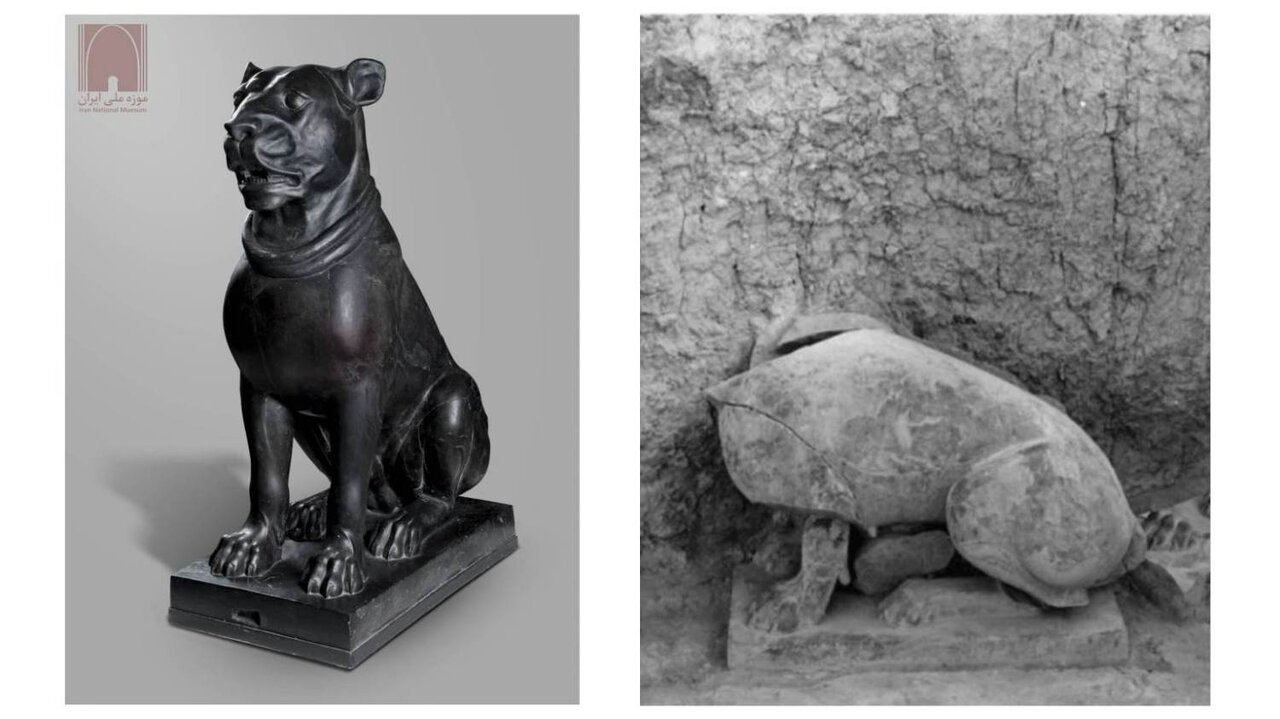
Being kept at the National Museum of Iran, the pictured sculpture, is a remarkable artwork which dates from the Achaemenid era (c. 550-330BC).
The object carved from a single block of polished, dark gray limestone, depicts a life-sized guard dog in a seated posture atop a rectangular base. The surface of the stone has been meticulously smoothed and polished, reflecting a high level of craftsmanship typical of Achaemenid stonework.
The local dark gray limestone takes a high polish and was widely used at Persepolis.
The dog’s head was already missing when the statue was discovered during Erich Schmidt’s excavations in the 1930s. The head now seen on the sculpture is a modern restoration. Pre-restoration photographs show the headless body and reveal additional canine features, such as untreated nails on the paws.
Based on the raised contours remaining around the neck area, the animal likely wore a collar. Its robust physique, heavy shoulders, thick legs, and large paws identify it as a mastiff – the ancient ancestor of today’s Sarabi dogs.
Renowned for their strength and loyalty, mastiffs were widely employed in antiquity for guarding and hunting and appear frequently in Assyrian bas-reliefs.
According to the National Museum, the statue, together with its base and the surviving fragments (paws) of a second, largely destroyed dog sculpture, was unearthed in the vestibule of the southeastern tower of the Apadana, the grand audience hall of the Persepolis complex. A third, unfinished dog found east of the Tachara of Darius – now in the Persepolis Museum – confirms that these sculptures were produced locally. Archaeological evidence indicates that the pair originally flanked an entrance, serving as symbolic guardians of the royal palace.
Despite its canine identity, the sculpture exhibits subtle lion-like traits – including a heavy, compact chest, a barrel-like rib cage, and prominent, carefully modeled claws – which enhance its apotropaic (protective) function. In Zoroastrian belief, dogs were honored for their courage, faithfulness, and their role as links between the living and the dead. Thus, the choice of canine imagery carried a cluster of beneficent and protective meanings for an Iranian audience. Dogs appear rarely in monumental Iranian art before the Achaemenid period, making these sculptures a distinctive and significant example of Achaemenid royal iconography.
The artistic style, meticulous finish, and powerful realism of these works stand out as exceptional within the sculptural tradition of Persepolis. Unlike the formalized reliefs on the palace stairways, these freestanding guardian figures display a naturalistic attention to musculature and posture, highlighting the importance of protective imagery in ancient Persian architecture and belief.
AM
Disclaimer : This story is auto aggregated by a computer programme and has not been created or edited by DOWNTHENEWS. Publisher: tehrantimes.com



