
Next week, there will be two high-level meetings in Europe that could add another dimension to the global trade wars.
On Monday, G-7 leaders will hold their annual summit in Évian in France, with global trade imbalances a key and potentially inflammatory element of the agenda.
Immediately after that two-day meeting, European Union leaders will hold their own summit in Brussels, weighing up measures to diversify supply chains in sensitive sectors of their economies – which will have a particular relevance to the bloc’s relationship with China.
Europe finds itself vulnerable to a swelling tide of cheap imports from China as a result of the trade wars Donald Trump has instigated against the rest of the world and the impact of the tariff wall he has built around America, which is redirecting China’s exports towards the EU.
One of the measures the EU is looking at is legislation that would force companies in sensitive sectors to reduce their over-reliance on single suppliers, notably Chinese suppliers.
It is considering directing them to have at least three different sources of “critical supplies” to shield them from supply chain disruptions and government policies such as the export controls China has erected around rare earths and semiconductors.
Had Trump co-opted Europe into a joint trade war with China, America and the EU — combined by far the largest markets for China’s exports – would have been in a far stronger position to force China to change its ways.
Other potential step are a broadening of export and import quotas and tariffs for imports from China to protect Europe’s car, chemicals, metals and green technology industries, and accelerating processes to prevent product dumping practices and unfair subsidies.
The EU’s current anti-dumping and anti-subsidy investigations (about 75 per cent of them involving imports from China) can take a year or more to be completed.
The EU wants to raise manufacturing’s share of the bloc’s GDP from last year’s 14.3 per cent to 20 per cent over the next decade, which would inevitably have to involve protecting its domestic industries from cheap imports.
And it’s not just manufacturing Europe wants to protect.
The EU also recently unveiled a long-term plan to boost its domestic technology supply chains and reduce its reliance on the US and Asia, particularly China, when it comes to artificial intelligence, data centres, semiconductors and cloud computing.
It wants to encourage the construction of data centres within Europe and could require EU governments to store their data on regionally-owned cloud platforms.
Europe’s cloud sector is dominated by US companies – Amazon, Microsoft and Alphabet’s Google – so a move to promote and protect European sovereignty over critical technologies could create another point of friction in the uneasy trade relationship with America. The EU has only recently formally agreed to implement the terms of the trade framework Trump imposed on it last year.
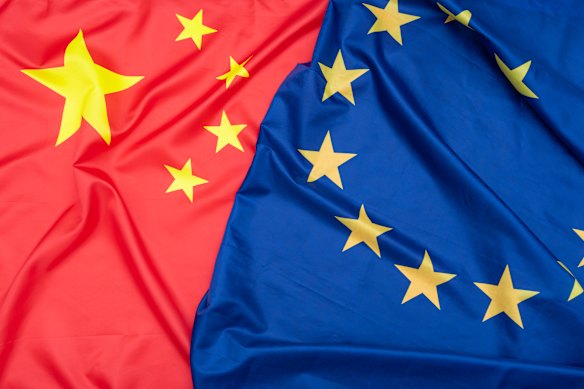
But the larger, or at least more pressing issue, and the one that could cause a new flare-up in global trade tensions, is Europe’s trade relationship with China.
Last year, China had a record €360 billion ($589 billion) goods surplus with the EU, with another €98 billion surplus racked up in the first quarter of this year.
The Europeans see those Chinese imports as an existential threat to some of their most important industries, even as China’s tighter restrictions on imports to its own economy is exacerbating the imbalance in the trade relationship.
While the Europeans have been rushing around the world signing trade deals with Canada, India, Mexico, a grouping of South American countries and Australia (and are seeking deals in South-East Asia), those deals will have modest impact compared to the significance of the relationship with China.
Fuelling the EU scramble to respond to the perceived assault on its industrial base is a report on trade subsidies earlier this month from the OECD. It found that industrial subsidies have now reached their highest levels since the 2008 financial crisis – and that industrial companies in China have received, on average, between three and eight times more government support than firms within the OECD, which the report said was a conservative estimate.
Renewable energy equipment, semiconductors, aluminium, steel and shipbuilding were the five largest recipients of subsidies, and enterprises with state ownership of more than 25 per cent were significantly more subsidised than private competitors.
Around 22 per cent of the global market share gains of companies that grew between 2005 and 2023 could be explained by the subsidies they received and, in the case of Chinese businesses, almost 60 per cent of their market share gains could be explained by the subsidies received, it said.
The report covered the period up to 2024. Since then, with Trump reigniting the trade war with China that he started in his first term (and widening it to the rest of the world), China’s export volumes have accelerated, and its trade surpluses have swollen to more than $US1 trillion ($1.4 trillion) a year. At the start of this decade, its trade surplus was about half that.
President Xi Jinping has doubled down on China’s mercantilist economic strategy as the country’s domestic economy and domestic demand for goods have weakened, with the now five-years-long pall cast by the implosion of its property sector weighing heavily on the economy.
With Trump’s tariff wall reducing direct exports to the US (there appears to be significant trans-shipping of goods or their components emanating from China), Europe has been increasingly targeted as the major destination for China’s exports and investment.
Attempts to curb China’s exports of electric vehicles have been circumvented by Chinese EV companies, who have ramped up their sales of cheap hybrid cars, constructed their own plants within Europe and, in a few instances, acquired European carmakers. Similar destruction has occurred within Europe’s green technology sector.
Any serious attempt to stem the flow of Chinese imports is going to trigger a Chinese response.
China has already warned the EU that discrimination against its exporters would lead to countermeasures by China to safeguard its own interests.
China has created a raft of new export controls and other measures that would enable it to retaliate against foreign companies, individuals and their governments should they try to restrict its trade.
Its most powerful sanction, as the US discovered when it threatened punitive tariffs on imports from China last year, is its stranglehold on the entire supply chain for rare earths and other critical minerals that are essential to most advanced manufactures and technology stacks.
It’s also aware that Europe isn’t united when it comes to the trade issue. Germany, with an export-oriented economy and far more two-way trade with China than the other major European economies, doesn’t want to upset the Chinese and see its exports – and supply chains –threatened.
The EU, however, has reached the point where it is convinced that its current trade and investment settings and relationship with China are unsustainable, and will only worsen if it doesn’t do something to address the flood of Chinese products swamping its markets and industries.
Had Trump co-opted Europe into a joint trade war with China, rather than targeted it in his trade wars on everyone, America and the EU — combined by far the largest markets for China’s exports – would have been in a far stronger position to force China to change its ways.
He didn’t, and so the EU, already under pressure from his tariffs, will have to confront China on its own.
The Market Recap newsletter is a wrap of the day’s trading. Get it each weekday afternoon.
 Stephen Bartholomeusz is one of Australia’s most respected business journalists. He was most recently co-founder and associate editor of the Business Spectator website and an associate editor and senior columnist at The Australian.Connect via email.
From our partners
Disclaimer : This story is auto aggregated by a computer programme and has not been created or edited by DOWNTHENEWS. Publisher: www.smh.com.au


