
Brought to you by BULLS N’ BEARS
Rowena Duckworth
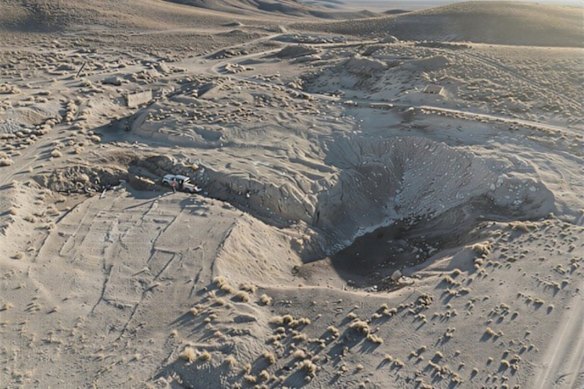
Viking Mines has uncovered a potentially valuable source of near-surface tungsten at its Linka project in Nevada, with sampling confirming a historic stockpile left behind by previous operators still carries grades comparable to those mined during the project’s heyday.
The company collected 41 samples across the Linka stockpile, returning an average grade of 0.4 per cent tungsten trioxide with peak values of up to 1.1 per cent tungsten trioxide.
Importantly, when a 0.1 per cent tungsten trioxide cut-off is applied, the average grade then lifted to 0.5 per cent tungsten trioxide – matching the historical average mined grade reported from the Linka operation.
For a surface stockpile of previously mined material, that’s a meaningful validation. The pile is neither diluted waste nor a statistical outlier but something that looks very much like run-of-mine ore sitting above ground.
‘The sampling confirms we have identified a surface stockpile of mineralisation at comparable grades to the historical average mined grade.’
Viking Mines managing director and chief executive officer Julian Woodcock
Linka is a classic skarn deposit in which the calcium tungsten mineral scheelite formed at the contact between Ordovician limestone and granitic intrusive rocks. The mine produced tungsten ore from the 1940’s through to the mid-1950’s, when the US Government buying programme ended.
What Viking is working with now is the legacy of that earlier mining: stockpiled material that was left behind when the economics of the day no longer justified processing it.
The results provide fresh support for Viking’s strategy of advancing two parallel opportunities at the project. The first is to extract near-term value from historical surface material while testing the broader resource potential through maiden drilling.
And in a market where tungsten prices continue to hover near record highs, Viking’s strategy of processing stockpile material to produce a bulk concentrate sample for offtake assessment effectively turns a historical artefact into a near-term commercial pathway.
The company has already moved to the next stage, dispatching samples from both the Linka stockpile and the nearby Conquest open pit to ore-sorting specialist TOMRA in Germany. The test work will assess whether the tungsten-bearing material can be upgraded prior to processing, potentially improving project economics and reducing downstream processing costs.
As the world’s leading ore sorting technology provider, TOMRA’s test work carries credibility. Using high-speed, sensor-based technology to sort the ore, the process analyses and separates valuable minerals from waste rock at the level of individual particles. By rejecting barren rock before grinding, it can upgrade the mill feed while saving massive amounts of water and energy.
Viking is also waiting on assay results from a second rock stockpile at Conquest, identified during last month’s surface sampling campaign, adding another potential inventory item to the equation.
Longer term, the company says its project pipeline is filling up quickly. Previous metallurgical test work has already delivered a scheelite concentrate grading 62.5 per cent tungsten trioxide at 59.8 per cent recovery–a saleable product by any measure.
Meanwhile, Mineral Technologies has been engaged to undertake a concept processing study, delivering CAPEX and OPEX estimates for a 300,000-tonne-per-year facility. Tailings dam sampling is also underway to assess residual tungsten from the 1950s processing operation.
And to cap it all, a maiden drill programme, which, surprisingly, will be the first drilling at Linka since the 1970’s, has all permits approved and site preparation scheduled to begin in the June quarter.
Viking Mines managing director and chief executive officer Julian Woodcock said: “The sampling results confirm that we have identified a surface stockpile of mineralisation at comparable grades to the historical average mined grade from the Linka Mine. Having access to this previously mined mineralisation presents an opportunity to process the material to generate a future bulk concentrate sample for offtake assessment.”
Beyond the Linka project, Viking retains a sprawling footprint of additional tungsten ground in Nevada with strategic tenure across the Alpine, Long, Ragged Top, Terrell and Victory project areas.
This broader regional portfolio provides exposure to some of the most prolific and historic tungsten-mining jurisdictions in the US. Viking appears to be chasing several plays to unlock value from these historic American tungsten fields at a time when Western supply of the critical metal is attracting renewed attention.
And it is noteworthy that the company has moved from grassroots acquisition to a credible multi-strand development story in a relatively short time.
As the global tungsten trioxide pricing hovers near record highs of US$3100 (A$4395) per metric tonne unit, Viking’s timing to develop into a critical onshore supplier for Western defence and industrial manufacturing markets seems near perfect.
Is your ASX-listed company doing something interesting? Contact: mattbirney@bullsnbears.com.au
From our partners
Disclaimer : This story is auto aggregated by a computer programme and has not been created or edited by DOWNTHENEWS. Publisher: www.smh.com.au


