OpenAI confidentially filed IPO papers with the SEC yesterday, setting the stage for yet another massive tech company float later in the year. You can read OpenAI’s statement here. It’s very short. Here is the entire thing, verbatim:
- “We recently submitted a confidential S-1. We expect it to leak so we’re just announcing it. We have not decided on timing yet; it may be a while because there are things we want to do that are likely easier as a private company. But it’s a complicated set of tradeoffs and this gives us the option to go public sooner if that ends up being best.”
The most interesting aspect of that statement are the words “we expect it to leak,” which suggest the company was rushed into making the statement—or at least didn’t want to be rushed into making it and thus got its retaliation in first, so to speak.
The valuation is expected to be greater than $1 trillion, per the FT. It was most recently valued at $852 billion.
That would make it the third $1 trillion-plus IPO expected this year, following SpaceX ($1.78 trillion) and Anthropic (last valued at $965 billion). The Wall Street Journal has a great story about the vast firehose of money pouring into AI right now. $159 billion in bond funding this year alone, for instance, including some really offbeat vehicles such as Google’s 100-year bond, at a yield of 6.05%, denominated in British pounds sterling.
Will investors be willing to swallow three $1 trillion-plus IPOs at once?
OpenAI, Anthropic, and SpaceX are all asking investors a similar question: Are you willing to buy stock in our massively valued, unprofitable, speculative business models, which rely on a ton of assumptions about the future that have yet to be borne out? Some on Wall Street are saying no. Fortune received an email this morning from one CEO at an asset investor with $1 billion-plus under management who says he wouldn’t touch ‘em for six months. (Presumably that’s to watch for the effect of the end of the executive lockup periods, after which insiders will be allowed to sell their stock.)
“Markets face the test of yet another superheavyweight firm listing to test demand for these highly-valued companies that promise to reshape not just the investing landscape, but the entirety of human society,” IG’s Chris Beauchamp said in an email. “The parallels with the early 2010s when the previous wave of loss-making tech [companies went public] are clear, but this time the stakes are much higher and the risks much greater.”
Investors should worry about “the increased circularity of the whole [AI] thing,” AllianceBernstein says
Clients are asking whether “the upcoming wall of issuance from mega cap IPOs” will be too much for investors to absorb, thus dragging down the market, according to Inigo Fraser Jenkins of AllianceBernstein. SpaceX’s valuation is $1.77 trillion, after all. OpenAI will be another $1 trillion-plus. “Is this, we are asked, one of those events one will look back on and ask why it wasn’t an obvious sell signal at the time?” he said in a note to clients seen by Fortune.
That’s not what traders should worry about, he argues. Only a fraction of SpaceX’s stock is being offered to the public, about $75 billion worth. That’s less than the rate at which corporate America buys back its own stock, removing it from the market to boost the price.
Instead, investors should worry about the business models of Anthropic and OpenAI, he wrote: “The other worry is … the increased circularity of the whole thing. Roughly one-third of tech sector earnings derive from cross-holdings in companies such as the ones hoping to IPO, such as Alphabet’s holding in Anthropic. Neither of these aspects should be things that investors can countenance with equanimity.”
THE MARKETS
After the tantrum, cooler heads prevail
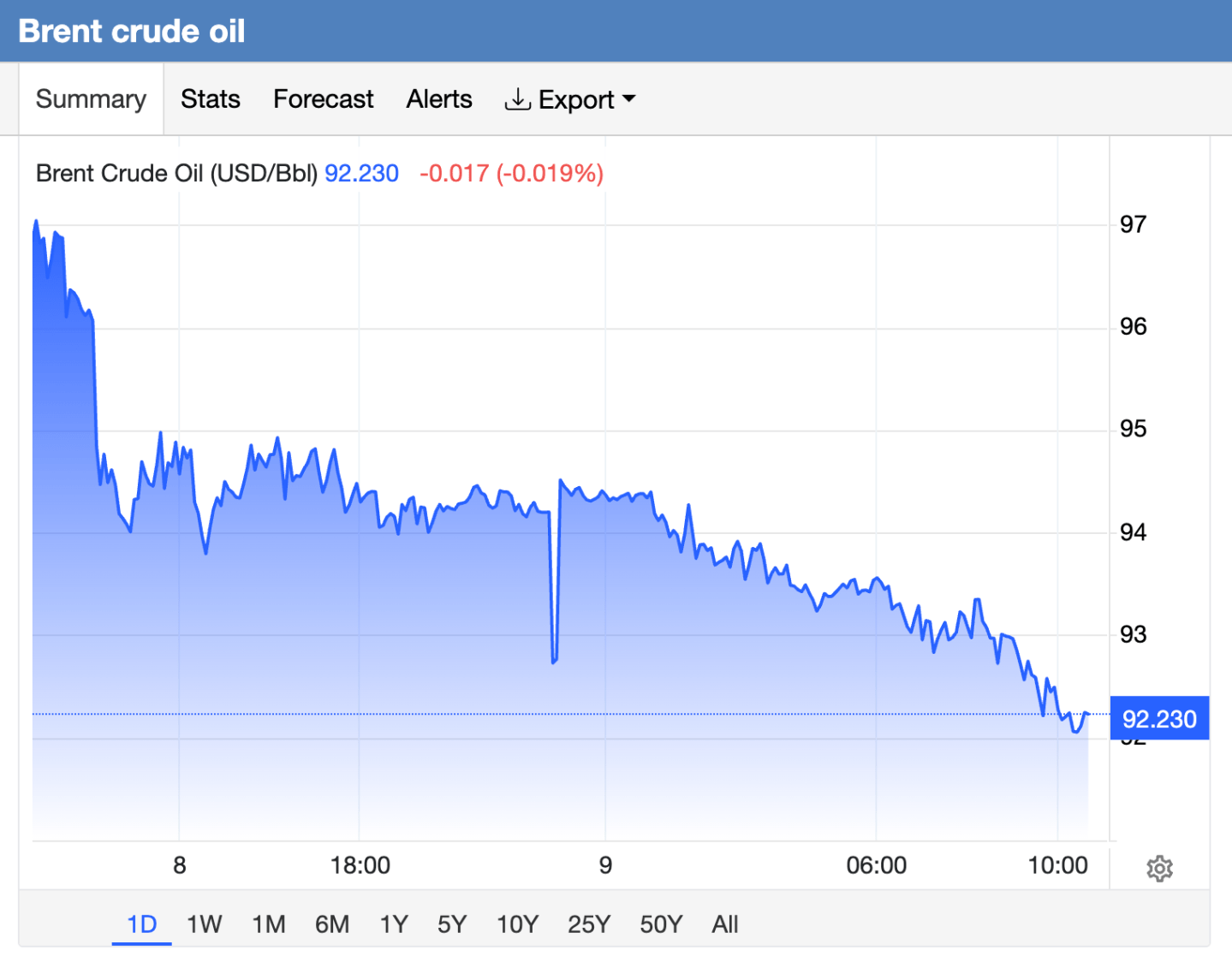
After throwing a tantrum on Friday and early Monday morning, global stock markets largely rose in Asia and Europe today after the S&P 500 closed up yesterday. Traders seem to be pinning their hopes on President Trump’s insistence that a peace deal with Iran is imminent, and Iran’s promise to stop attacking Israel. Oil prices sank on the news. Israel, however, is continuing to strike positions in Lebanon it believes are occupied by Hezbollah, the Iranian proxy terror group.
- S&P 500 futures were up 0.42% this morning. The index rose 0.3% yesterday.
- In Europe, the Stoxx 600 was up 0.54% in early trading and the U.K.’s FTSE 100 was down 0.4% before lunch.
- Asia: South Korea’s KOSPI was up 8.18%. Japan’s Nikkei 225 was up 2.17%. India’s Nifty 50 was up 0.49%. China’s CSI 300 was up 1.87%.
- Brent crude fell to $92 per barrel this morning.
- Bitcoin was $62.7K.
Bank of America: “6% downside from here”
Seven out of 10 red flags that signal impending bear markets have now been triggered, according to Bank of America’s Savita Subramanian. That’s the average number that were triggered prior to previous bear markets. Those red flags include things like surveys showing overconfidence in stocks and technical measures of tightening credit conditions. “Our S&P 500 year-end target of 7100 suggests 6% downside from here,” she told clients.
IRAN
Trump urges peace as oil stocks dwindle globally
The price of Brent crude oil fell sharply over the last 24 hours and was sitting at $92 per barrel this morning, after President Trump insisted (again) that a peace deal with Iran was imminent that would open the Strait of Hormuz “immediately upon signing” in two or three days. Here’s what he’s saying on social media:
- Both sides, Israel and Iran, are looking to do an immediate CEASEFIRE! Final negotiations on “Peace” are proceeding, subject to ignorance or stupidity getting in its way. The Blockade will remain in place, and in full force and effect, until a “Final Deal” is reached. Things should move quickly. Thank you for your attention to this matter!
- Israel and Iran must immediately stop “shooting.”
The hidden oil crisis: China’s reserves are running dry
The conflict with Iran caused the price of oil to rise but it has not produced a physical scarcity of oil, at least in Europe and the U.S. That may be about to change, according to two sets of Wall Street analysts. Until recently, the world was relatively well-cushioned against a negative oil supply shock because global inventories were well supplied. The U.S. has continued to export oil. And releases from various strategic petroleum reserves (SPRs) mostly matched the losses from the Gulf, Lisa Shalett and her team at Morgan Stanley said in a note this week.
It has also been helpful that high prices have cut demand for the black stuff by about 4 million or 5 million barrels per day, roughly 4-5% of pre-war supply, according to Goldman Sachs’ Daan Struyven.
The situation in China is about to change, however. “China was especially well inventoried” before the war, even though its oil imports have been cut from 13 million barrels per day to about 7.5 million today, according to Shalett. The Chinese have bought little oil on the international markets since the war began but as their stocks decline, “there is a meaningful chance that Chinese crude buyers will return to the market for the September delivery.” “If the strait is not reopened by the time of this ‘SPR cliff,’ the market could tighten meaningfully,” she advised. “The asymmetric risk of this stagflation scenario is not fully priced.”
“Operational floor”: At Macquarie, Thierry Wizman and Gareth Berry argue that “the U.S. administration would want to reopen the Strait of Hormuz by force at some point, presumably as the global visible inventory of crude oil depletes below threshold viable levels. … there is an operational floor level for inventories — the level needed to be sustained to ensure that pipelines are functioning and refineries are operating. According to most estimates, operational depletion could be reached in H2 2026.”
- Context: The U.S. midterm elections are scheduled for November 3, 2026. Conceivably, the White House would want to deliver declining oil prices before then.
MORE FROM FORTUNE
How Michael Saylor’s preferred stock gamble could trigger a death spiral for Strategy – Shawn Tully
Gen Z hiring manager says CEOs are right about her generation’s ‘attitude’ problem after a candidate took the interview from her phone – Orianna Rosa Royle
Anduril CEO Brian Schimpf says economic warfare is the ‘new normal’ for military conflicts—and the U.S. needs to get serious – Lily Mae Lazarus
Twitch CEO: Social media has become ‘antisocial’ and can’t match the shared, human connection of livestreaming – Sebastian Herrera
Your career needs a ‘gym membership’ to keep up with continuous AI advancements, says Campus founder Tade Oyerinde – Amanda Gerut
Anthropic’s Boris Cherny, creator of Claude Code, says there are days he manages tens of thousands of AI agents at once – Sharon Goldman
The global airline industry’s profits could be cut in half as it braces for its worst year since the pandemic – Marco Quiroz-Gutierrez
CHART OF THE DAY
Drinks ranked by calories
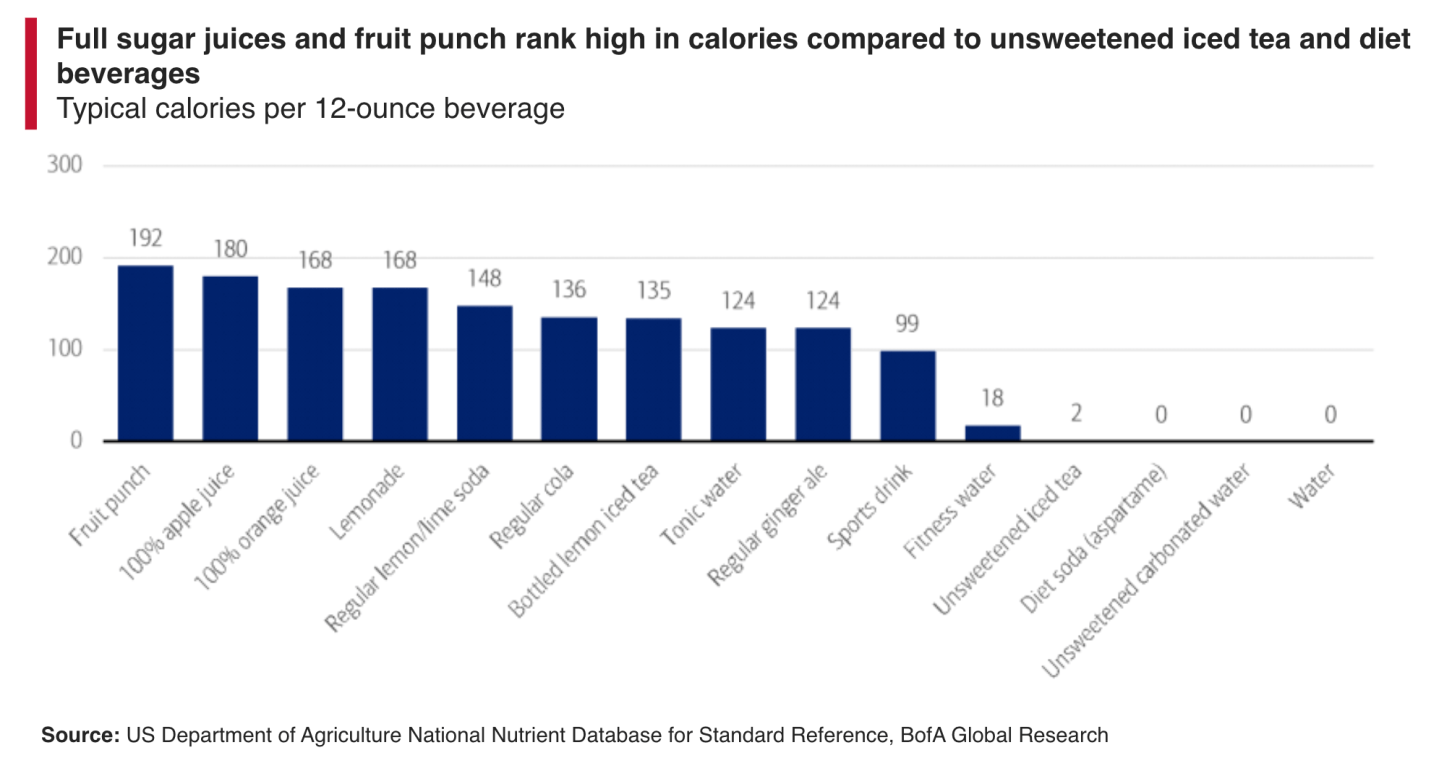
One of the most confusing dietary contradictions is that eating fruit is good for you but drinking fruit juice is bad for you. Whole fruit contains a lot of fibre and pulp (good), whereas juice strips all that out, leaving you with a glass of sugar and calories (bad).
The Bank of America Institute ranked drinks by calorific content to show that fruit juice is probably a worse choice than full-fat cola.
NUMBER OF THE DAY
Less than 1%
The percentage of applicants Goldman Sachs accepted into its summer internship program this year, according to Fortune’s Nick Lichtenberg. This year, the class of 2,500 interns comes from more than 500 universities, includes over 90 nationalities, and speaks 70-plus languages.
THE FRONT PAGES TODAY
Behind the scenes: How Israel and Iran nearly pulled Trump back to war – Axios
Trump Wants to Call the Shots. But in Iran, He Keeps Hitting His Limits – NYT
The Fight to Break China’s Rare-Earth Dominance Moves to a New Front in Brazil – WSJ
What Rolling Back Brexit Would Mean for the UK Economy – Bloomberg
Pima County Sheriff issues alert for kidnapping suspect 7 miles from Nancy Guthrie’s home – NY Post
Somali referee Artan barred from entering US – BBC
ONE MORE THING
The brains of Gen Z college students, rewired by doomscrolling, have left them with “an inability to read sentences”

Gen Z students—digital natives who grew up on vertical video—are now arriving at college-level classrooms unable to complete the assigned reading, reports Fortune’s Preston Fore. One shocked professor said some young adults show up to class unable to read a single sentence. “It’s not even an inability to critically think,” Jessica Hooten Wilson, a professor of great books and humanities at Pepperdine University, told him. “It’s an inability to read sentences.”
Nearly half of all Americans did not read a single book in 2025, with the habit plunging some 40% over the last decade. Americans ages 18 to 29 read, on average, just 5.8 books in 2025, according to YouGov. The solution: universities are changing the way they teach literature, hand-holding students at first until they’re capable of digesting the traditional 25 to 40-page reading assignments that were common prior to the internet.
Disclaimer : This story is auto aggregated by a computer programme and has not been created or edited by DOWNTHENEWS. Publisher: fortune.com