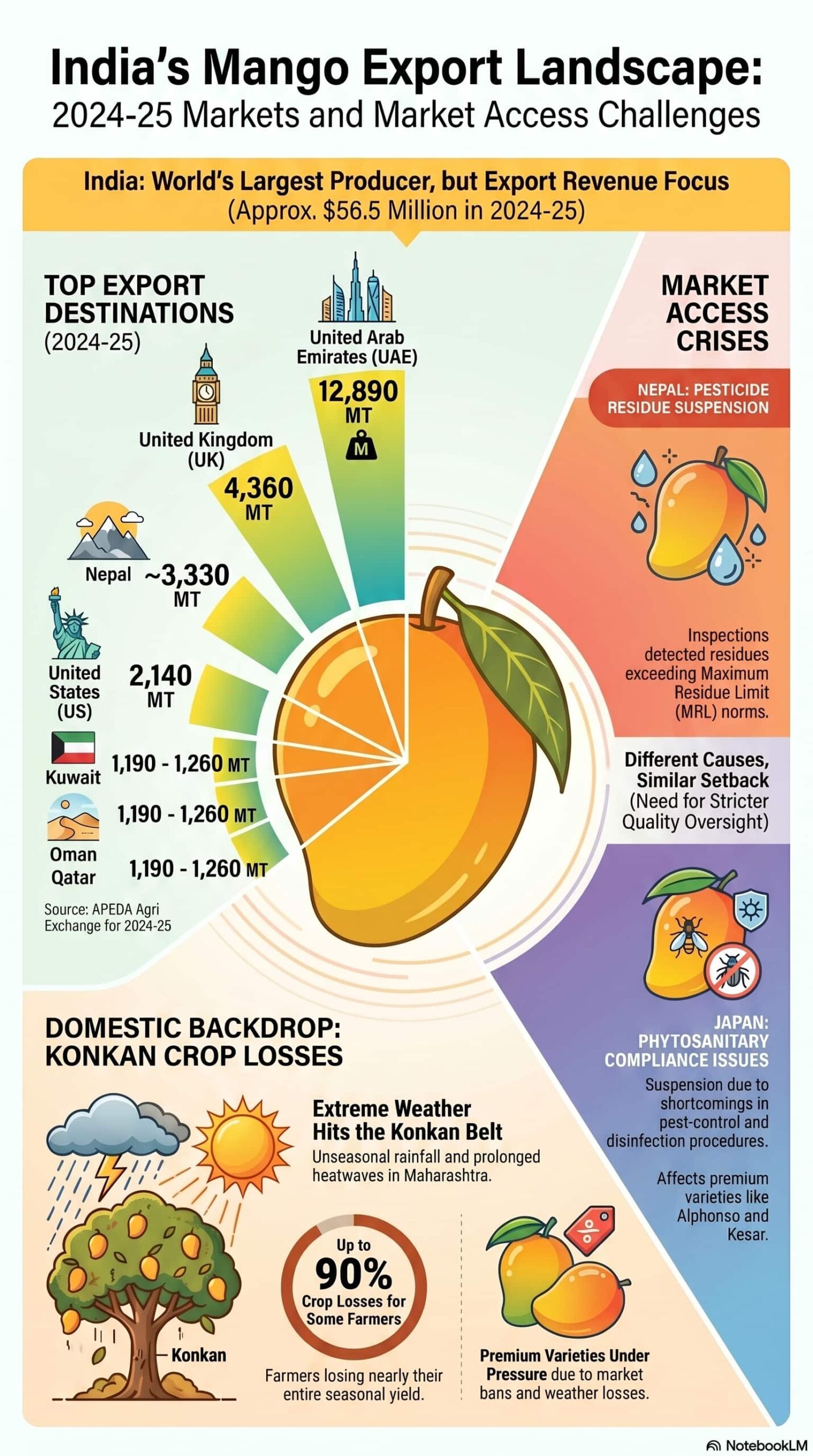
- Nepal suspended Indian mango imports over pesticide residue.
- This follows Japan’s recent import suspension over pest control.
- Nepal a key market, growers face challenging season.
Just days after Japan tightened restrictions on Indian mango imports, Nepal has temporarily suspended incoming consignments from India over concerns related to pesticide residue levels. While the move has once again put India’s export quality standards under the spotlight, the bigger question is whether the latest restriction could materially affect India’s mango trade and the livelihoods of growers already battling a difficult season.
The answer is nuanced.
Nepal is not among India’s largest agricultural export markets overall, but it remains one of the most important overseas destinations for Indian mangoes. The suspension comes at a time when exporters are already dealing with heightened scrutiny from international buyers and when mango growers, particularly in Maharashtra’s Konkan region, have suffered significant crop losses due to adverse weather conditions.
A Second Setback For Indian Mango Exports
The Nepal restriction follows closely on the heels of Japan’s decision to suspend imports of Indian mangoes over phytosanitary compliance concerns.
While the two actions stem from different issues, together they have renewed attention on India’s export ecosystem.
According to Nepalese authorities, the latest suspension was triggered after quarantine inspections reportedly detected pesticide residues exceeding prescribed Maximum Residue Limit (MRL) norms in some consignments. Officials have maintained that the measure is temporary and aimed at strengthening monitoring mechanisms rather than disrupting bilateral trade.
Before the restriction took effect, around 15.8 metric tonnes of mangoes worth nearly Rs 1 million had already entered Nepal through authorised border checkpoints.
Japan’s concerns, meanwhile, were unrelated to pesticide residues. Authorities there reportedly identified shortcomings in pest-control and disinfection procedures designed to prevent the spread of fruit flies and other agricultural pests. The action affected popular Indian varieties including Alphonso, Kesar, Langra and Banganapalli.
For exporters, the timing is particularly uncomfortable. Japan may account for a relatively small share of India’s mango exports, but it is regarded as a premium market where Indian fruit commands higher prices because of strict quality requirements.
Also Read : Can You Buy SpaceX Shares? Everything To Know About Elon Musk’s $1.8 Trillion Mega IPO
Where Does Nepal Rank Among India’s Mango Buyers?
Although Nepal is not India’s largest export destination, it remains a significant market for fresh mango shipments.
According to APEDA Agri Exchange data for 2024-25, the United Arab Emirates remains the biggest overseas buyer of Indian mangoes, importing approximately 12,890 metric tonnes.
The United Kingdom follows with around 4,360 metric tonnes, while Nepal ranks among the leading destinations with imports of nearly 3,330 metric tonnes.
The United States imported roughly 2,140 metric tonnes during the same period, while Kuwait, Oman and Qatar each purchased between 1,190 and 1,260 metric tonnes, as reported by Forbes.
The strong demand is largely driven by Indian diaspora populations, seasonal consumption patterns and the popularity of premium varieties such as Alphonso and Kesar.
While Nepal trails the UAE and the UK in volume terms, its proximity, lower logistics costs and long-standing trade links make it an important market for exporters.
India Still Dominates Global Mango Production
Despite the recent export setbacks, India’s position as the world’s largest mango producer remains unchallenged.
The country produces nearly 24 million metric tonnes of mangoes annually, according to industry estimates. Most of the crop is consumed domestically, with only a small fraction exported to overseas markets.
During FY2024-25, India exported nearly 29,938 metric tonnes of fresh mangoes worldwide, generating around $56.5 million in export earnings, reported The Economic Times.
Export destinations include the UAE, the US, the UK, Kuwait, Qatar, Oman and Japan, among others.
Fresh and processed mango exports to Japan alone were valued at around $1.54 million in 2025-26, with Gujarat’s Kesar mangoes accounting for a substantial share.
The figures underline an important reality: while individual market restrictions can create temporary disruptions, India’s mango industry remains heavily dependent on domestic consumption.
Also Read : How The US-Iran Conflict Forced IRCTC To Cook Meals On Trains Again
Why The Ban Matters Beyond Trade Numbers
The significance of Nepal’s move extends beyond export volumes.
Industry observers note that restrictions linked to pesticide residues raise broader concerns about quality control, traceability and farming practices within the production ecosystem.
Unlike Japan’s phytosanitary concerns, Nepal’s decision touches directly on chemical residue management, an issue that could attract closer scrutiny from other importing countries if not addressed quickly.
For exporters seeking access to premium markets, maintaining compliance with varying international standards has become increasingly important.
The latest developments may therefore prompt regulators, exporters and growers to revisit monitoring systems, pesticide usage practices and supply-chain oversight.
A Tough Year For Mango Growers
The export challenges come amid an already difficult season for mango farmers.
In Maharashtra’s Konkan belt, growers of the prized Alphonso variety have been grappling with severe weather disruptions. Unseasonal rainfall and prolonged heatwave conditions reportedly damaged crops across several districts, with some farmers estimating losses of up to 90 per cent.
Against that backdrop, any disruption in overseas demand adds another layer of uncertainty.
Although Nepal’s temporary suspension is unlikely to have a major impact on India’s overall export earnings, it could affect traders and exporters operating in specific regional markets.
Demand For Indian Mangoes Remains Strong
Despite the recent restrictions, global appetite for Indian mangoes remains robust.
Premium Indian varieties continue to enjoy strong demand across West Asia, Europe and North America, where consumers actively seek Alphonso, Kesar and other regional favourites during the summer season.
Reflecting that demand, Air India recently reported transporting more than 1,000 tonnes of Indian mangoes to international destinations. For now, exporters are hopeful that both Nepal and Japan will eventually resume imports once compliance concerns are addressed.
The bigger challenge may be ensuring that India’s reputation as the world’s mango capital is matched by consistently high standards across the export chain.
Before You Go
BREAKING NOW: Indore fire tragedy as EV short circuit triggers deadly explosions
Disclaimer : This story is auto aggregated by a computer programme and has not been created or edited by DOWNTHENEWS. Publisher: abplive.com