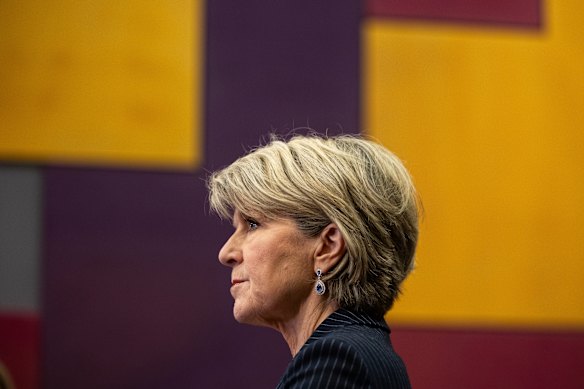

Julie Bishop has blamed “coercive threats” and “increasingly contemptuous intervention” in the Australian National University’s affairs by the university regulator for forcing her to quit as chancellor.
In her resignation letter tendered to parliament this week, Bishop said the unprecedented intervention by the Tertiary Education Quality and Standards Agency (TEQSA) meant she could no longer continue in the role.
The former foreign minister commenced as ANU chancellor in 2020 for a three-year term, and was then reappointed to continue until the end of 2026; last month, she quit the role seven months early, a move welcomed as a chance for the battered institution to rebuild and move on from the controversy that defined her leadership.
Along with former vice-chancellor Genevieve Bell (who in September last year also resigned early from her role), Bishop presided over an ill-fated money-saving program, Renew ANU, that led to a vote of no confidence in the duo’s leadership. In Bishop’s first six weeks as chancellor, the 2020 Black Summer bushfires shuttered the campus, a hailstorm caused $100 million worth of damage to buildings and the coronavirus pandemic began.
A scathing audit office report last week concluded that Renew ANU was not justified by the state of the university’s finances, with “no clear evidence” that it was needed.
On April 28, the regulator announced that it had accepted a “voluntary undertaking” from the besieged university that would allow it to effectively control the recruitment of Bishop’s replacement.
Bishop’s resignation letter has cast doubt on how voluntary that undertaking was, as she called TEQSA’s actions a “continued and increasingly contemptuous intervention”.
“The overreach in recent actions and expectations conveyed by TEQSA has, in my view, grievously constrained my capacity to discharge my responsibilities and legal duties,” she wrote on May 7.
“TEQSA has moved to substantially take over the governance of the university in the context of what I perceive to be coercive threats.”
Bishop says that she received one letter from TEQSA in her first four years in the role; since Renew ANU began in 2024, she had almost 60 pieces of correspondence needing her personal input.
“The persistent, unreasonable and arguably vexatious requests for information and the requirement to produce vast amounts of documentation has consumed considerable university resources, with the volume and intensity of interactions also placing substantial demands on me beyond what I can reasonably be expected to sustain,” she wrote.
Regulatory overreach was also mentioned in the resignation letters of ANU council members including Western Australia’s former chief justice Wayne Martin and Padma Raman. Tanya Hosch cited a lack of commitment to Indigenous leadership, while Robert Whitfield blamed “dysfunctional behaviour by council members and senior leadership” for his departure.
The dramas over the past few years have cost the university $100 million in reputational damage, acting vice-chancellor Rebekah Brown told Senate estimates on Friday.
Start the day with a summary of the day’s most important and interesting stories, analysis and insights. Sign up for our Morning Edition newsletter.
From our partners
Disclaimer : This story is auto aggregated by a computer programme and has not been created or edited by DOWNTHENEWS. Publisher: www.smh.com.au