If it takes the immigration office months or even years to reach a decision on a citizenship application, people in Germany can sue over its ‘failure to act’. This year, Berlin’s immigration authority faced a record number of lawsuits.
Some people applying for German citizenship in Berlin see their applications processed within a matter of months, thanks in part to a digitised application process that was rolled out at the start of 2024. But Berlin’s immigration authority, the Landesamt für Einbürgerung (LEA), is still severely backlogged, and meanwhile a wave of new applications continues to pour in.
The result is that the Berlin Administrative Court has seen a record number of “failure to act” lawsuits brought against the LEA for excessively long naturalisation procedures this year. Each of these lawsuits represents an applicant for German citizenship who did not receive a decision on their application for at least three months – in many cases for far longer.
According to a report by RBB, this year there were 33 times more lawsuits brought for this purpose than in 2022.
Meanwhile, similar processing delays affecting residence permit applicants and refugees has a direct impact on whether or not people can work, or even remain in Germany.
Here’s what to know about delays at the LEA, and what you can do about it.
‘Failure to act’
When dealing with German administrative procedures, you can file an Untätigkeitsklage, or a “failure to act” lawsuit, when an administrative authority does not respond to you within a reasonable timeframe.
Under German law, authorities are expected to be able to make an initial decision on a naturalisation case within three months. So an applicant who has heard nothing back from the immigration office within this time frame may bring an Untätigkeitsklage, typically with the help of a lawyer.
In successful cases, the immigration authority is then ordered by the court to make a decision on the case, and would be responsible for reimbursing the legal fees incurred by bringing the Untätigkeitsklage as well.
READ ALSO: How can German citizenship applicants in Berlin avoid ‘two-year’ waiting time?
Berlin’s Administrative Courts have recorded a surge in “failure to act” cases brought against the LEA for citizenship applications in recent years.
Up until 2022, around 60 such lawsuits were received each year on average. In 2023 the number of cases jumped to 430.
Then in 2024, the same year that Germany’s citizenship law was overhauled to relax the residency requirement for naturalisation and allow dual-citizenship for non-EU nationals, the number of cases soared to 1,684.
As of the end of October, 1,997 cases had already been filed so far in 2025.
One factor that explains the explosion in the number of legal challenges brought against the LEA is that there has been a wave of naturalisation applications since the country’s citizenship laws were changed in June 2024.
From January 2024 to October 2025, almost 75,000 new applications were registered in Berlin alone, according to RBB. That’s on top of a backlog of some 40,000 old paper applications that the LEA had previously said it was in the process of digitising and processing in the background.
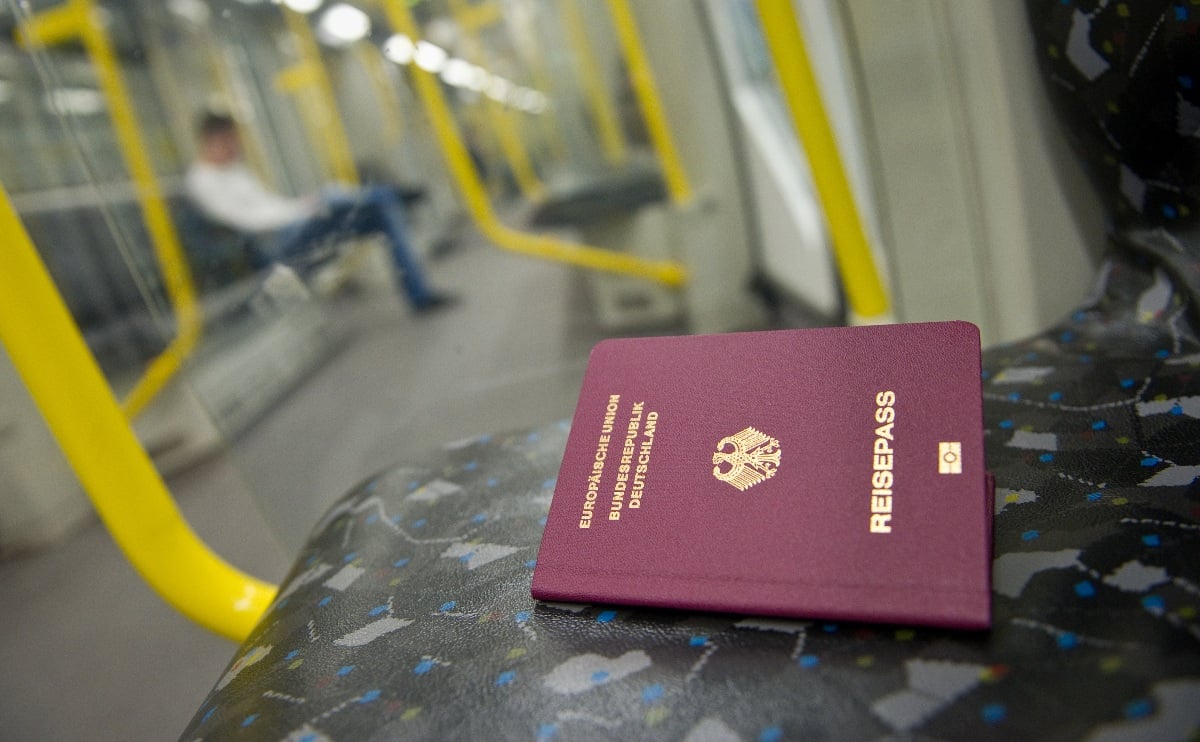
A German passport on public transport. Photo: picture alliance / dpa | Christoph Schmidt
As the LEA has transitioned to a new digital naturalisation process, waiting times for applications have become highly case-dependent, with some recent applicants getting a response in just a few months and others still waiting for years.
READ ALSO: How many applications for German citizenship are still pending?
Harsh consequences for temporary residents
Of course long-term residents on-track to naturalise as German are not the only group which is affected by delays at the immigration office. In fact, it is refugees and people with temporary residence permits who often have more to lose when immigration authorities fail to act promptly.
A spokesperson for the Berlin Migration Council and the counselling centre (CUSBU) told Taz that up to 80 percent of their clients have had problems getting an appointment with the LEA on time.
For people on temporary stay permits, delays at the immigration office can result in losing employment, having crucial benefits cut or even losing the legal right to remain in Germany in some cases.
For example, in the report linked above, Taz cites a student who graduated from a university in Berlin, and was therefore eligible for an 18 month long residence permit for job-seeking. But the student couldn’t take up work for a year while waiting for the LEA to respond.
Note that if your residence is expiring soon, it’s important to keep a print-out of your application for a new residence permit (as submitted to the LEA).
EXPLAINED: How to apply for a residency permit online in Berlin
This, along with your expired residence permit, effectively becomes the proof that you have the right to remain in the country until the LEA has decided on your application.
The LEA portal gives the option of downloading your application after you’ve filled out the contact form for this purpose. But you’d be advised to additionally save the document as a PDF on your own computer first, and then print it out – ensuring that you have a copy which is time-stamped with the date.
Do I dare challenge the state?
If you have been left waiting for months, or even years, for a response to your application for naturalisation or for a residence permit, you may be wondering if it’s worth taking legal action.
Many immigration lawyers do suggest that in some cases filling an Untätigkeitsklage is the best way to move forward, but basically only when you are confident that your case is rock solid.
A Chemnitz-based immigration lawyer previously told The Local that in many cases, merely starting the process to bring a “failure to act” case can spur an immigration office to quickly make a decision on an application.
READ ALSO: When to consider legal action for your German citizenship application
Fabian Graske, immigration lawyer and founder of legal service provider Migrando, had similar advice: “If you fulfil all the requirements, and you’ve waited [on an application] for a minimum of six months, in my opinion, you should do it.”
“But a lot of people forget the first part of that statement,” he added. “If you don’t obviously fulfil all of the requirements, or if it’s not clear or you can’t quite prove that every requirement is met, then you have to think about it.”
The risk is that the legal challenge could also result in a prompt rejection, and you’d then be left with a bill for the legal fees incurred as well.
Disclaimer : This story is auto aggregated by a computer programme and has not been created or edited by DOWNTHENEWS. Publisher: thelocal.de