In Jaisalmer, mornings begin long before the sun settles over the sandstone. By the time the city awakens, 24-year-old Veenu Kawar has already swept the courtyard of her home, finished cooking, readied her elder son for school and checked her younger son, who is fast asleep.
The rhythm of her day, at first glance, is no different from that of the women around her. Household work comes first. Responsibilities do not pause.
“My mother-in-law tells me to go do my work. She manages the house,” Veenu says. It is a small sentence. In this part of Rajasthan, it carries weight.
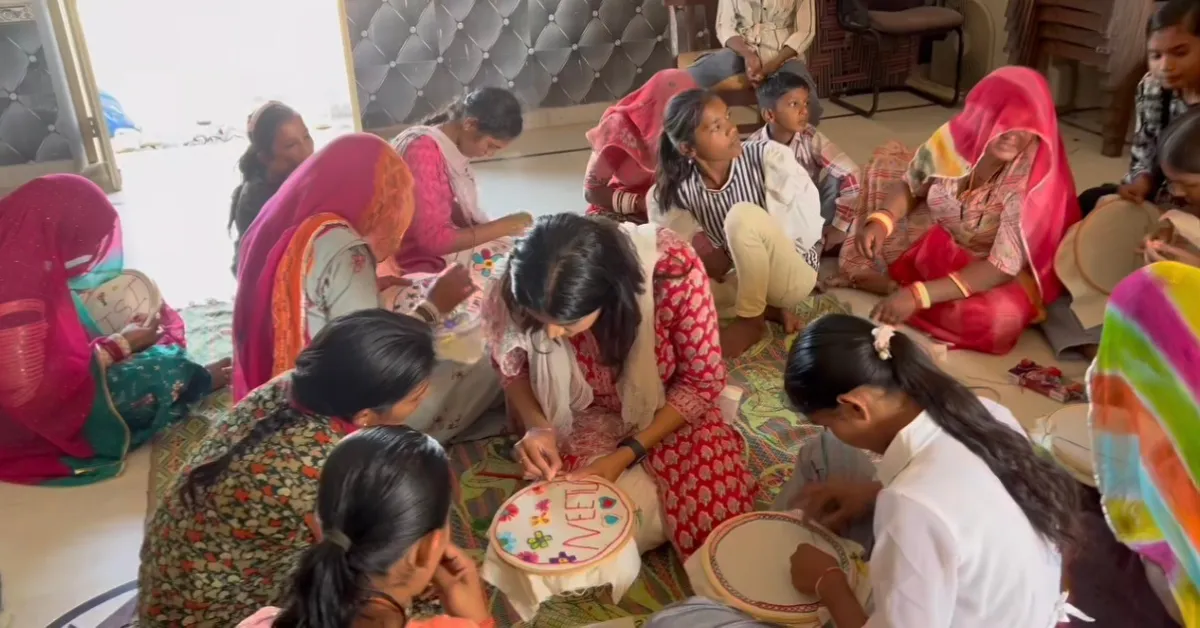
By mid-morning, she steps out and heads to Chundi village, where around twenty women are already waiting. A year ago, she was one of them — sitting, learning, stepping out for something that felt unfamiliar. Before that, even this step did not exist.
“Before this, I didn’t do anything. I was a housewife and had no particular interests,” she says.
The distance between those two versions of her life is not measured in kilometres. It is measured and intertwined with the story of many other women such as Veenu, who live in the depths of a literal desert.
What lies beyond the city of gold
Jaisalmer, known as the Golden City, draws visitors from across the world. Its 12th-century sandstone fort rises dramatically from the desert floor. Its havelis are carved with the kind of precision that makes them look spun rather than built.
Every October through March, the city fills with destination wedding parties, luxury desert camps, and tourists chasing the particular magic of the Thar. India’s destination wedding market, with Jaisalmer among its most sought-after backdrops, is now valued at over Rs 16 billion.
But just forty-five kilometres from the city, the desert, which spans 200,000 sq.km, looks very different.
Villages are scattered across the Thar, sometimes only five or six families within a kilometre of each other.
Access to education, healthcare, and livelihood remains limited in these remote pockets. Schools in many villages go only up to Class 8. For anything further, a girl would have to travel outside, something families here rarely permit.
The purdah system, which has shaped life across Rajasthan’s villages since the 15th century, is not a relic here, but a daily reality.
Rajasthan falls squarely within what researchers identify as India’s “purdah zone,” where female seclusion, covering, and mobility restrictions remain deeply embedded in community life. The ghoonghat is not occasional — it defines movement, visibility, and voice.
“A typical woman’s day in these villages follows a pattern so fixed it has almost become invisible: wake up, milk the cattle, cook, collect firewood, cook again, milk the cattle once more in the evening. There is constant work but no income or moment that belongs only to her,” says Kritigya Champawat.
This is the world that Kritigya drove into after her marriage. And this is the world she decided to change.
Seeing beyond the sand dunes
Kritigya is an engineer, previously placed in Bengaluru’s IT sector after completing her degree. She describes her life there as comfortable, urban, insulated.
But marriage soon brought her to the Jaisalmer region. “Before you live here, you only see the sand dunes and the travel side. You do not see the reality,” she says.
So what she encountered unsettled her.
Women who had never crossed their own threshold, girls whose education stopped before it could become anything, and in some areas, female infanticide continuing to be a part of the region’s present reality.
/filters:format(webp)/english-betterindia/media/media_files/2026/05/22/avantika-featured-image-template-2026-05-22-19-13-36.png)
She found her calling. Kritigya soon set t work. Under her family’s existing NGO, she launched ‘Thar Ki Udaan’, translating to ‘Wings of the Thar’. The initiative is run as a project under that registered organisation, allowing it to operate formally across villages while remaining rooted in the community it serves.
“This place needs a women empowerment project more than any other place. I knew we could make real change for these women,” she says.
Building access where none existed
The model Thar Ki Udaan built rests on a single practical truth: if women cannot step out easily, the opportunity has to come to them.
Training centres were set up in villages with women-only spaces close enough that a family might say yes. But the first obstacle was not geography.
It was trust.
“When we go there, we are outsiders. Raising trust isn’t that easy,” Kritigya says.
Every new village required the same slow work — meetings with husbands, fathers, and community elders. Framing the centres carefully as women-only, enclosed and safe. And then waiting for time and visible results to do the rest.
The centres were also designed to be more than training rooms from the start, with games, shared conversations, and celebrations woven into the weekly rhythm. The idea was to make women want to return, not just feel they ought to.
“When we are celebrating women there, they enjoy it. That trust and camaraderie eventually develops,” Kritigya says.
/filters:format(webp)/english-betterindia/media/media_files/2026/05/22/3-2026-05-22-19-14-40.png)
Logistics required solving too. In a desert where villages are spread thin and distances between them are significant, transport is not a small thing. Thar Ki Udaan arranges its own vehicle, picking women up from their homes and dropping them back, because distance could quietly become the reason someone stops coming.
What happens inside
Today, three active training centres operate under Thar Ki Udaan in Chundi, Moolsagar, and Rewant Singh ki Dhaani — each holding 15 to 20 women at a time. Earlier batches have completed training and moved on, but many of those women remain connected to the initiative, continuing to earn through the skills they built.
In total, around 700 to 800 women have come through the programme.
Training runs for roughly three months per batch. The skills taught are deliberate and market-linked: stitching and tailoring of Rajasthani suits and garments, kasida embroidery — the intricate hand-embroidery that has been part of the region’s craft tradition for centuries — mehendi application, candle making, and incense making.
/filters:format(webp)/english-betterindia/media/media_files/2026/05/22/3-2026-05-22-19-32-09.png)
These are not skills invented for the programme. They are crafts the region already produces and for which there is genuine demand, particularly through Jaisalmer’s booming hospitality and wedding industries.
The teachers are local housewives and trainers such as Veenu who learnt from the initiative and soon rejoined as trainers themselves. “The women who are not able to go out but have some skills, some talent — they are getting paid for it now and they are working as tutors with us,” Kritigya says.
Products are sold through hotels, wedding planners, tourism operators, and direct WhatsApp orders. Jaisalmer’s peak wedding and tourism season — October through March — is when demand is highest, and the women’s output finds its readiest market.
The city’s forts and desert camps host ceremonies that can cost upwards of Rs 30 lakh; elaborately handcrafted decor, embroidered fabrics, and intricate mehendi work are not incidental to these events — they are central to them.
/filters:format(webp)/english-betterindia/media/media_files/2026/05/22/5-2026-05-22-19-15-10.png)
A single wedding project can bring in around Rs 2,000 for the women who complete it. Those who develop multiple skills — stitching, kasida, mehendi — can earn between Rs 15,000 and Rs 18,000 a month during the peak window.
Off-season, work slows. But for many women, even partial, seasonal income can make a world of difference.
The centres are also spaces where women talk about health, family disputes, and other things that have no other room in their daily lives. Topics like menstruation and menopause remain taboo in many of these villages; women sometimes reach menopause without understanding what is happening to their own bodies. Thar Ki Udaan brings doctors in for awareness sessions. Women also come to the team with harder things: domestic violence, family conflict. They come because the centre is one of the only spaces where being heard is possible.
“It is a space where they feel free,” Kritigya says.
The initiative also runs basic education programmes that include boys — because changing how gender is understood in a community means reaching the whole community, not only its women.
Nijara, 35
Nijara Devi was married at fifteen or sixteen. Her own schooling stopped at Class 5 — the next school was simply too far. She has six children. Two of her daughters are currently in Classes 9 and 12.
She has been coming to the centre every day for seven months, fitting it in after the household work is done. She stitches dresses — earning Rs 250 per piece, up from Rs 200 when she first began.
“We use it for children’s copies, pens and household items,” she tells The Better India.
/filters:format(webp)/english-betterindia/media/media_files/2026/05/22/4-2026-05-22-19-15-39.png)
The sentence is quiet. What it contains is not. A woman who stopped studying in primary school is now spending her own earnings to keep her daughters in secondary education and plans to keep them there.
“We want to educate our daughters so they can do something in their future,” she says.
Manisha, 19
Manisha Goyal finished Class 8 and came home. In Chundi, that is where most stories pause. “After school, there was only housework. Nothing else,” she says.
She has been at the centre for seven months. She stitches Rajasthani suits and is learning embroidery alongside it. She has made friends here — women from the same village she may never have sat beside before.
/filters:format(webp)/english-betterindia/media/media_files/2026/05/22/2-2026-05-22-19-32-39.png)
Her total earnings to date is rs 1,000 and it is sitting in a piggy bank. “I’m beginning to save for my wedding,” she says. “So my parents don’t have that expense.” She is nineteen, but judiciously planning ahead.
Across the centres, the team has noticed the same pattern emerging, women who spent years working without receiving income are beginning, carefully, to spend on themselves. Clothes. Makeup. Small personal things, chosen by themselves for the first time.
The gap between demand and capacity
Calls come in from distant villages asking Thar Ki Udaan to open centres there. The demand is genuine. The capacity to meet it is not yet there.
The work remains entirely self-funded from Kritigya’s own resources. Every expansion into a new village means the same slow process of trust-building, transport, and time — at personal cost, across difficult terrain.
Government grants are being sought to expand across the full district, reaching three cities. Until that funding arrives, growth is constrained.
/filters:format(webp)/english-betterindia/media/media_files/2026/05/22/2-2026-05-22-19-16-05.png)
“We cannot do that as we also have some limitations,” Kritigya says. “But today, if you visit these villages in person, it will seem like there are too many situations behind what is happening in the current world.”
The Thar Desert covers over 264,000 square kilometres. The vision is proportionate to that scale. “We want that no woman remains unseen or unsupported,” she says.
Change in the flesh
Veenu’s mornings have not changed. The same courtyard swept before dawn. The same cooking, the same sons to check on before she heads out.
What changed is what comes after.
Today she stands at the front of the room in Chundi, teaching stitching and cutting to twenty women. She earns Rs 5,000 to Rs 6,000 a month — more than she has ever earned, doing work she chose and now even enjoys, she says.
“I enjoy it. My mind stays engaged, and I get to meet new people,” she says.
She steps out every morning not as someone asking for permission, but as someone twenty women are waiting for. For the women sitting in front of her — still learning, still taking their first steps outside a world that tried hard to keep them inside — that distinction is everything.
Because in a place where stepping out was once unthinkable, her presence at the front of that room is not incidental.
It is the whole point.
/filters:format(webp)/english-betterindia/media/media_files/2026/05/22/1-2026-05-22-19-33-04.png)
Every purchase, collaboration, and contribution can go a long way in helping the women of the Thar Desert build independent, dignified livelihoods through their craft. If you’d like to support them, you can donate to help the initiative continue training and empowering local women artisans while keeping Rajasthan’s rich handmade traditions alive.
Readers can also support directly by discovering and sharing the artisans’ work, placing orders, or connecting with Thar Ki Udaan on Instagram (@thar.ki.udaan) and helping their stories travel beyond the desert.
Photos courtesy of Thar Ki Udaan
Disclaimer : This story is auto aggregated by a computer programme and has not been created or edited by DOWNTHENEWS. Publisher: thebetterindia.com