GOA – A recent Reuters investigation citing internal Israeli military assessments offers an unexpected snapshot of post-war Gaza administration – one that complicates the official narrative of Hamas’ dismantlement.
This is a snapshot of post-war Gaza administration. Hamas poses a structural contradiction at the heart of Washington and Tel Aviv’s political narrative.
For over a year, the stated objective of Benjamin Netanyahu’s government has been the dismantling of Hamas’ governing capacity. Yet the Israeli military assessment cited by Reuters concedes something far more inconvenient: Hamas is “advancing steps on the ground” to preserve its grip “from the bottom up.” That phrase alone deserves to be quoted – because it reveals that the erosion of Hamas has not translated into political displacement.
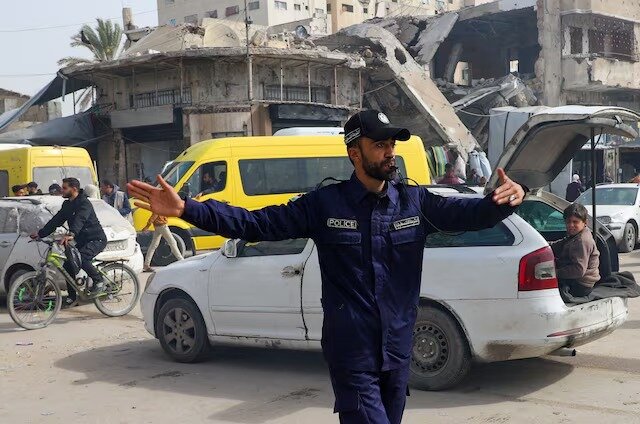
The military document acknowledges that at least 14 of Gaza’s 17 ministries are now functioning, compared with five at the height of the war. Thirteen of twenty-five municipalities have resumed operations. Taxes are being collected. Salaries are being paid. Governors – some linked to the al-Qassam Brigades have been appointed. Police stations have reopened. Markets are being regulated.
This is not the language of eradication. It is the language of administrative recovery.
Even more striking is the Israeli military’s own forward-looking assessment: “without Hamas disarmament and under the auspices of the technocrat committee, Hamas will succeed… to preserve influence and control.” That is not a Hamas claim. That is Israel’s internal analysis. It undercuts the official assertion, delivered anonymously by an Israeli official, that “Hamas is finished as a governing authority.”
An organization cannot be “finished” while simultaneously collecting taxes on cigarettes, batteries and mobile phones; integrating police into a proposed new force; paying public servants; and reconstituting municipal structures. Political science teaches a simple lesson: governance is not rhetoric. It is control over territory, revenue, security, and administration. By those metrics, Hamas remains embedded.
This reality exposes the fragility of the external alternative now being promoted by Donald Trump — the so-called Board of Peace.
The Board, holding its inaugural meeting in Washington, is meant to supervise transitional governance. But unlike Hamas, it commands no territory. It has no tax base. It possesses no administrative workforce inside Gaza. It does not exercise police authority on the ground. It depends entirely on Israeli permission to function and on foreign commitments that remain largely declaratory.
Even the US-backed National Committee for the Administration of Gaza (NCAG), headed by Ali Shaath, has complained it cannot operate “without the full administrative, civilian, and police powers necessary” to implement its mandate. In other words, the committee lacks sovereignty, capacity, and coercive leverage. One Gaza source captured the paradox memorably: “Shaath may have the key to the car… but it is a Hamas car.”
The contrast is stark. Hamas governs from within a shattered enclave of two million people. The Board of Peace governs from a conference table in Washington.
Hamas collects shekels in taxes on smuggled goods; the Board has no independent revenue stream.
Hamas integrates 10,000 police personnel into proposed structures; the Board must still wait for countries to commit personnel to a stabilization force.
Hamas appoints governors and mayors; the Board awaits reports.
Legitimacy in conflict zones does not arise from diplomatic announcements. It emerges from embedded networks — however controversial or coercive — that provide order, services, and security. The Reuters report notes that looting and robbery have subsided, that markets are being organized, that traffic police are active. One Israeli official admitted: “There is no opposition to Hamas within the yellow line now.”
This is the uncomfortable implication: despite overwhelming military devastation and staggering human loss — over 72,000 Palestinians killed according to Gaza’s health ministry, and some 1,200 Israelis killed in the October 2023 attack — the political architecture inside Gaza has not been replaced. It has reconstituted itself.
The Board of Peace, by contrast, risks becoming what might be called performative governance — an initiative that signals intent without possessing instruments of enforcement. It has neither broad regional backing with binding commitments nor credible Palestinian political endorsement across factions. Its stabilization force is prospective, not present. Its police reform is aspirational, not operational.
More importantly, it attempts to impose a “post-Hamas” framework without resolving the structural conditions that sustained Hamas in the first place: prolonged blockade, territorial fragmentation, and the absence of Palestinian sovereignty. Military campaigns can degrade capacity, but they rarely eliminate movements that are intertwined with social, political, and economic life. History across multiple conflicts demonstrates that insurgent-political hybrids mutate under pressure rather than dissolve.
The Reuters account shows Hamas exploiting the ceasefire not only to regroup militarily but to harden administrative entrenchment. It is a cementing influence through bureaucracy — appointments in the economy and interior ministries, tax departments, and health administration. This is the “bottom up” consolidation Israel’s own assessment describes.
Meanwhile, the Board of Peace depends on a chain of contingencies: Israeli withdrawal, Hamas disarmament, foreign troop commitments, UN authorization, and police retraining.
Each step requires cooperation from actors who mistrust one another. Each delay, as analyst Reham Owda warns, “leads to the imposition of a de facto reality.”
That de facto reality is not the Board. It is Hamas.
The larger implication for your analysis is this: political authority cannot be externally engineered while an internally embedded actor remains structurally intact. To speak of a “new Gaza” while Hamas ministries reopen is to mistake aspiration for transformation. To convene a board in Washington while taxes are collected in Gaza City is to confuse diplomatic theater with sovereign control.
The irony is profound. Israel’s stated war aim was the dismantling of Hamas’ governing capabilities. Yet its own military document concedes that, absent disarmament, Hamas will preserve control even under a technocratic umbrella. The war has produced devastation beyond measure — but not the political vacuum that external planners assumed.
If anything, the Reuters report suggests a harder truth: governance flows to whoever can organize daily life amid ruins. At present, that actor is not the Board of Peace.
It is Hamas.
And unless the structural conditions of occupation, blockade, and political exclusion are fundamentally altered, replacing it will require more than declarations in Washington. It will require legitimacy rooted inside Gaza — something no external board can purchase, impose, or supervise into existence.
About the author
Dr. Ranjan Solomon is a veteran social justice activist and writer who has long supported global movements, particularly those advocating for Palestinian freedom.
(The article reflects the author’s opinions and not necessarily the views of the Tehran Times.)
Disclaimer : This story is auto aggregated by a computer programme and has not been created or edited by DOWNTHENEWS. Publisher: tehrantimes.com