TOKYO, Dec 05 (News On Japan) –
A growing number of families across Japan are choosing to close ancestral graves, and concerns over long-term upkeep have become a widespread source of anxiety. Now, even one of the country’s most storied lineages has begun confronting both the end of its line and the closure of its grave.
[embedded content]
The program “It!” interviewed MikI Yamagishi, the great-great-granddaughter of Tokugawa Yoshinobu, the final shogun of the Edo shogunate, who now serves as the fifth head of the Tokugawa Yoshinobu family established in the early Meiji period. Yoshinobu returned political authority to the imperial court in 1867 through the Taisei Hokan and resigned as the 15th shogun. When he was later granted the title of duke, the highest rank among the new peerage, a branch distinct from the Tokugawa main family was formed around him.
The fourth head of the family, Yoshitomo, died eight years ago. Yamagishi, his niece, inherited the family’s assets after caring for Yoshitomo during his illness.
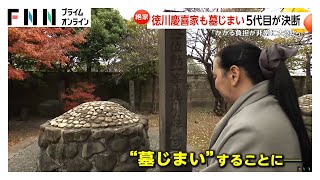
Yamagishi showed the program the Tokugawa Yoshinobu family grave, explaining that Yoshinobu and his wife Mikako are interred there, along with a concubine further inside, and that the front gate bears the Tokugawa family crest. The grave, usually kept locked and inaccessible to the public, was opened for a special visit.
Although Yamagishi now lives in Nagoya, she manages the family grave in Tokyo, a plot measuring about 300 tsubo (roughly 990 square meters). She said that maintaining such a large site far from her current residence has become increasingly unrealistic. The carved inscriptions bearing Yoshinobu’s name have worn down, and part of the surrounding wall has collapsed. Repairing the wall alone would cost an estimated 30 million yen.
Confronted with the burden, Yamagishi decided that her generation will close the grave. She noted that while many families possess ancestral plots, they can become “negative inheritances” when maintenance demands exceed what descendants can reasonably manage. She said that transferring ownership to the proper institution would allow future generations to be freed from responsibility.
According to Yamagishi, Yoshitomo had also consulted experts before his death, saying he hoped the difficulties would end with his generation. But the inheritance Yamagishi received includes far more than the grave. About 6,000 historical materials remain in the family’s possession, including calligraphy and oil paintings written or painted by Yoshinobu himself.
Yamagishi described her role as “turning family history into Japan’s history.” While the grave remains deeply personal to her, she noted that Yoshinobu’s status as the last shogun gives the site an additional public dimension. Visitors continue to come, and she sees it as her responsibility to ensure that what belongs to history transitions from the private sphere into public stewardship.
Looking ahead, she plans to donate the historical materials to an appropriate institution and work with relevant parties so the burial site can continue to be preserved even after the family relinquishes ownership.
Source: FNN
Disclaimer : This story is auto aggregated by a computer programme and has not been created or edited by DOWNTHENEWS. Publisher: newsonjapan.com