- Operation Sindoor targeted Pakistani facilities linked to nuclear infrastructure.
- The 88-hour conflict concluded with a ceasefire last year.
Although a year has passed since Operation Sindoor, global discussions about India’s military capabilities continue. The latest report by the Stockholm International Peace Research Institute (SIPRI), a leading global think tank that monitors nuclear weapons, has once again highlighted India’s military strength while drawing attention to Pakistan’s strategic vulnerabilities.
According to SIPRI’s latest assessment, several Pakistani airbases and missile facilities targeted by India during Operation Sindoor were linked, in some capacity, to Pakistan’s nuclear weapons infrastructure.
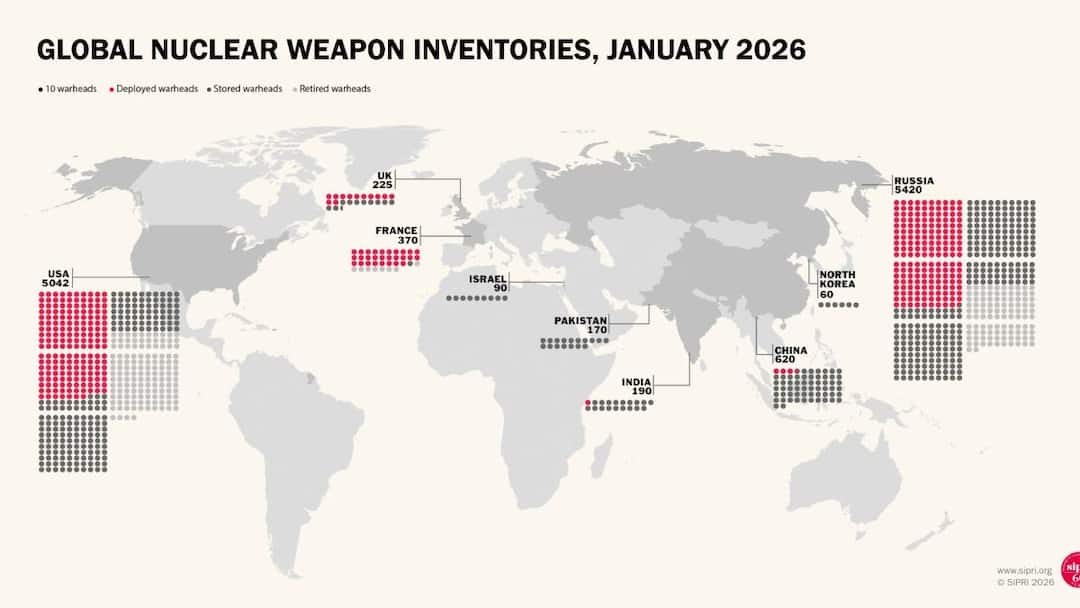
The report states that India currently possesses 190 nuclear warheads, while Pakistan has 170. However, SIPRI also noted that despite the military confrontation during Operation Sindoor, neither India nor Pakistan escalated the situation into a nuclear crisis.
Notably, soon after Operation Sindoor, Prime Minister Narendra Modi had asserted that the Indian armed forces had effectively dismantled Pakistan’s “nuclear bluff” and attempts at nuclear blackmail during the conflict.
Also Read: TMC Leader Sabyasachi Dutta Held In Extortion Case; Protesters Hurl Eggs Outside Court
During Operation Sindoor (May 7–10, 2025), videos emerged showing bombing in Pakistan’s Kirana Hills region.
Kirana Hills is believed to house a Pakistani nuclear facility. The Indian Air Force also reportedly targeted Pakistan’s nuclear command and control center located at Noor Khan Airbase in Rawalpindi during the operation.
India Deploys 12 Nuclear Warheads For First Time
India has deployed nuclear warheads in peacetime for the first time, signalling a notable shift in its nuclear posture, according to the latest assessment by the Stockholm International Peace Research Institute (SIPRI).
In its Yearbook 2026 released on Monday, SIPRI estimated that India now possesses 190 nuclear warheads, up from 180 a year ago. Of these, 12 are believed to be operationally deployed — the first time the global arms research institute has classified any portion of India’s arsenal as deployed rather than entirely stockpiled.
The assessment marks a significant departure from India’s long-held practice of keeping nuclear warheads separate from delivery systems such as ballistic missiles during peacetime.
“It has long been assumed that India stores its nuclear warheads separate from its deployed launchers during peacetime. However, the country’s recent moves towards placing missiles in canisters and conducting sea-based deterrence patrols suggest that India could be shifting in the direction of mating some of its warheads with their launchers in peacetime,” SIPRI said.
Previous SIPRI assessments had not listed any Indian nuclear warheads as deployed. The latest findings suggest an evolution in India’s nuclear readiness and operational posture, even as it maintains a larger arsenal than Pakistan, which SIPRI estimates at 170 warheads.
What Was Operation Sindoor?
Operation Sindoor was launched in the early hours of May 7 last year in retaliation for the deadly terror attack in Pahalgam on April 22.
Indian armed forces carried out precision strikes targeting multiple terror launchpads and related infrastructure in Pakistan and Pakistan-occupied Kashmir.
Pakistan also launched offensives against India, triggering nearly four days of military confrontation. India’s counter-operations were also conducted under Operation Sindoor.
Ceasefire Reached After 88-Hour Conflict
The military confrontation between the two nuclear-armed neighbours lasted nearly 88 hours before both sides reached a ceasefire understanding on the evening of May 10.
Also Read: US Army Apache Helicopter Goes Down Near Strait Of Hormuz; Crew Rescued As Cause Remains Unclear
According to the Indian Army, the understanding was reached after Pakistan’s Director General of Military Operations contacted his Indian counterpart requesting a ceasefire.
Before You Go
Breaking: SP Leader Sparks Row, Claims Suryakumar Yadav Lost T20 Captaincy Due to His Caste
Disclaimer : This story is auto aggregated by a computer programme and has not been created or edited by DOWNTHENEWS. Publisher: abplive.com