TOKYO, Dec 09 (News On Japan) –
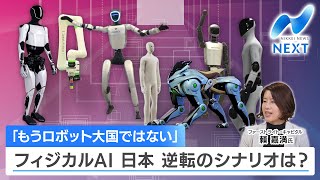
Artificial intelligence capable of autonomously controlling machines in the real world—known as Physical AI—is rapidly reshaping the global robotics market, with the United States and China accelerating development of humanoid robots equipped with such systems and raising concerns that they could eventually overtake the industrial robots where Japan has long held a competitive edge; to explore how Japan might mount a comeback, the program invited Firstlight Capital’s Rai Jia-man as guest commentator.
[embedded content]
A major focus of leading global logistics companies today is AI-powered robots, and Physical AI represents a new market that the industry association NDIA expects could reach a scale of 7,700 trillion yen, prompting renewed debate over where the technology is headed and whether Japan—once considered a robotics superpower—still has a path to victory. Joining the discussion was venture capitalist Rai Jia-min, an expert on Physical AI developments.
Rai explained that, unlike conventional robots, Physical AI refers to systems capable of perceiving their environment, making decisions, and executing actions independently in the physical world, noting that the service robots commonly seen in restaurants do not yet fall under this definition because they simply move within predefined areas without performing tasks that require autonomous judgment.
Asked how Physical AI differs from factory automation, Rai said traditional industrial robots follow fixed routines programmed under stable conditions and cannot alter their behavior when the environment changes, whereas Physical AI handles non-routine tasks—such as folding laundry with different shapes and materials—using real-time perception and intelligence similar to a system like ChatGPT applied to the physical world.
On the question of what work Physical AI could take over, Rai pointed to logistics and manufacturing as early areas of adoption, with robots likely to handle assembly tasks that are difficult to automate on production lines as well as repetitive duties such as cutting cardboard, replacing roles long performed manually.
Regarding concerns about labor displacement, Rai said occupations involving dangerous or heavy work—such as disaster-response operations or tunnel maintenance—are relatively easy to replace, whereas caregiving remains difficult due to robots’ limited dexterity and inability to read human emotions, making the field “still premature” for full deployment.
The discussion turned to why humanoid robots are already used in factories in China, which Rai attributed to national strategies in both the United States and China. Washington is pushing to rebuild domestic manufacturing and is backed by abundant private investment in next-generation AI, while Beijing promotes an AI-plus-manufacturing strategy in its five-year national plan, with the government and private sector jointly supporting humanoid development through substantial funding.
Japan, by contrast, has few real-world examples of Physical AI or humanoids in operation. Rai argued that this is because Japanese industrial robots remain extremely advanced and profitable, making companies less inclined to make aggressive investments in an unproven frontier like Physical AI. High labor costs in the United States—equivalent to roughly 5,000 to 6,000 yen per hour—are also pushing American firms toward automation as they face worker shortages, immigration constraints, and communication issues on the factory floor, further incentivizing adoption of robots that “work without complaint.”
Footage from the American startup Physical Intelligence showed a humanoid robot already working smoothly alongside humans, illustrating how the U.S. and China have pulled ahead. Funding data supplied by Rai indicated that both countries dominate investment in Physical AI, though official Chinese figures may understate scale due to classification differences; more recent estimates suggest combined government–industry investment of around 2 trillion yen.
Asked which country is likely to lead, Rai said Chinese startups with supply chains concentrated in Shenzhen may outpace competitors in the short term, particularly in producing large volumes of humanoids, but in the long term the United States could hold the advantage because the key component of humanoids—the AI foundation model that serves as their “brain”—is where U.S. companies remain strongest. Ultimately, he said, the decisive factor will be which country secures high-quality real-world data first.
As for why the United States and China are investing so heavily, Rai said current AI systems such as ChatGPT represent only the digital frontier, and the next stage is AI capable of operating in physical space, where both countries face severe labor shortages and see strategic value in controlling both the digital and real-world layers of technology.
While China and the United States are racing ahead, Rai argued that Japan still has an opportunity to compete, particularly if it can leverage its strengths in precision manufacturing and industrial robotics to feed high-quality data into future Physical AI systems.
The program concluded by noting that as the global Physical AI race intensifies, the question remains whether Japan can convert its strengths into a viable path to recovery.
Source: テレ東BIZ
Disclaimer : This story is auto aggregated by a computer programme and has not been created or edited by DOWNTHENEWS. Publisher: newsonjapan.com