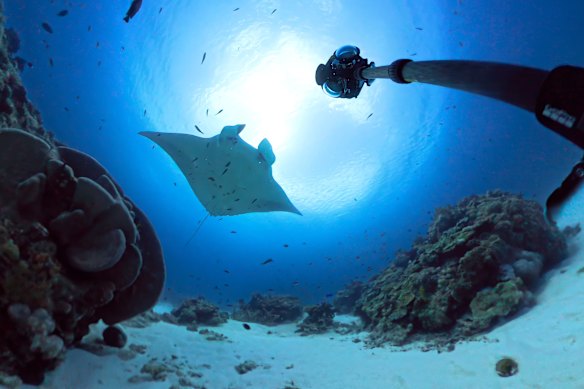
Agiant manta ray hovers overhead, manoeuvring its vast bulk down towards the sandy ocean floor – and me – with all the precision of a valet car parker. The looming sight is not frightening; the ray’s four-metre wide underbelly is the backdrop for a comical dance by wrasse fish as they spot-clean its white expanse of skin. I’m tempted to reach up and touch the elegant, winged giant and its bevy of janitors.
My Great Barrier Reef visit is a virtual-reality experience, not an actual one, but the 360-degree VR immersion headset I’m wearing makes it feel as if I’m there. I can tilt my head down to admire pink polyps peeking from orange-purple coral fingers. If I turn to look behind me, the vivid clusters of reef coral extend across the ocean floor.
Before long, I’m flying in a helicopter that lands on a sandy atoll, where a scientist explains why climatic events far inland are impacting even this spot. Then I’m dangling in the treetops of the Daintree rainforest, one source of sediment in streams that flow out to sea. Back at the reef, a scuba diver and I plunge underwater to glimpse a perky dolphin chasing its fish dinner.
Removing my headset, I place it on the desk and contemplate what worlds have opened up. Naturalist David Attenborough, who turned 100 last month and once steered an underwater submersible on the Great Barrier Reef, would surely applaud.
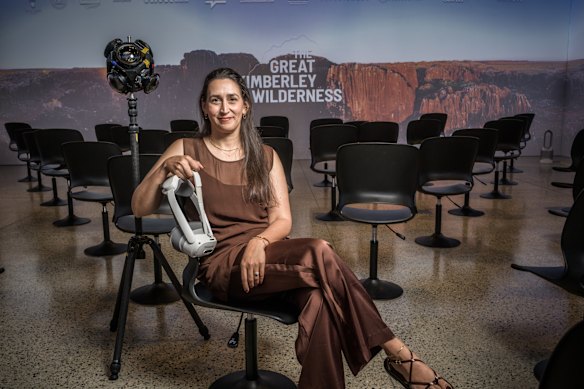
The film is Life in the Great Barrier Reef, and its producer-director Briege Whitehead is one of Australia’s new breed pioneering VR films in aid of nature. After my viewing at the new Perth Film Studios, Whitehead greets me just down the corridor from behind her desk and introduces me to her husband and co-partner in White Spark Pictures, Benn Ellard, who is sitting at another workstation. The pair, in their mid-30s, are a dynamic duo – she’s a producer, director, writer and interviewer, while he’s a qualified accountant who keeps the company books but doubles as an accomplished film drone pilot.
Their team is tiny, but their track record is already impressive. Life in the Great Barrier Reef is their new VR video which will have its global premiere at the National Museum of Australia in Canberra this week. White Spark has already brought other inaccessible places to millions of people – The Antarctica Experience, The Great Kimberley Wilderness and Beyond the Milky Way, which explores Australia’s largest space project in remote north-west Australia.
“VR is still an emerging technology, but we’ve been doing it successfully for a while,” Whitehead tells me. The Antarctica Experience has grossed $1.85 million and The Great Kimberley Wilderness more than $1.5 million at the Australian box office, both in the all-time top 10.
Whitehead’s current project has required deep dives, literally, into the living heart of the world’s largest reef system. But filming underwater posed challenges that had to be overcome. “There’s no camera currently that can film high-quality underwater scenes in 360 degrees,” she explains. “It’s because light refracts differently underwater.”
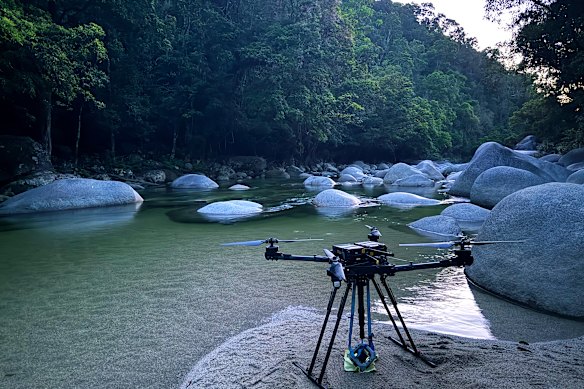
With a tight budget, they had to come up with their own solution. White Spark’s chief technology officer Tom Morrell and Ellard built a 3D-printed rig for multiple camera lenses to give the overlap they needed, and then wrote the software to run it.
“We started with 12 cameras and we tested that in an aquarium,” says Whitehead. “That was too much trying to synch them, so we’d try with half the cameras. On a lot of early mornings, you’d find me and Benn swimming in the ocean to test it, getting footage and then stitching all the content together.” It sounds simple, until Whitehead explains that making a 360-degree film is “like taking a flat map of the world, only you have to wrap it seamlessly around a globe.”
Filming on the reef began last October. When they handed their custom-built rig to Richard Fitzpatrick, a Cairns-based marine biologist and experienced underwater cameraman, he was ecstatic.
“Richard went down and put the camera on the ocean floor so that you saw the massive manta ray come down to get cleaned by all the reef fish. He was like, wow, because he’s never filmed a manta ray from that perspective.”
In December, the team captured the second and final part of the annual largest reproductive event on Earth, when trillions of sperm and eggs were simultaneously released from reef coral under a full moon. “We’re very pleased to have filmed the first ever live-captured coral spawning in 3D virtual reality.”
Another extraordinary sight was captured on Lady Elliot Island on the southernmost edge of the reef. “There’s a resident dolphin there that everyone knows as Bubbles. He was diving after trevally and using his sonar to ping individual fish and work out which had the fullest belly. Then Bubbles would lock on to that fish and chase it until, eventually, it would vomit up its stomach contents because it was so dizzy. Then the dolphin would eat the vomit, not the fish!”
I admit to feeling mildly nauseous about Bubbles’ dietary tastes. Whitehead is unfazed. “We got all that incredible behaviour on film for 45 minutes. There were 20-odd scientists on the island and they were saying, ‘We’ve never seen anything like this.’ ”
The last time Whitehead and I met was in 2018 when, at just 26, she had pulled off an extraordinary coup. We were standing in the Western Australian Museum, where she was launching the world’s first 360-degree film of Antarctica, called The Antarctica Experience. It was the stuff of dreams as wild as the landscape it portrayed.
Whitehead described herself back then as a filmmaker from the tiny wheat-belt town of Bruce Rock, who grew up watching TV nature documentaries. “I was inspired as a primary-school kid by March of the Penguins, a [Academy Award-winning] documentary narrated by Morgan Freeman,” she told me.
Propelled by an intense desire to visit “the mysterious place at the bottom of the globe”, she won the support of the Australian Antarctic Program to travel to Antarctica in February 2018. Then she approached Warner Bros’ and Dolby’s sound experts to help realise her dream to make The Antarctica Experience. “I knocked on the doors of the best in the business,” Whitehead said, admitting that the line “Hello, I’m Briege from Bruce Rock” might not have inspired confidence. “But I thought the worst they could do is say no.”
They said yes, perhaps reassured by Whitehead’s credentials as a writer, camera operator and producer of factual series for Netflix and National Geographic, even if some had titles like 72 Cutest Animals.
As a rank novice at shooting virtual-reality films, she sought out as her co-director Phil Harper, a BAFTA-winning director whose credits included directing David Attenborough in that underwater submersible on the Great Barrier Reef.
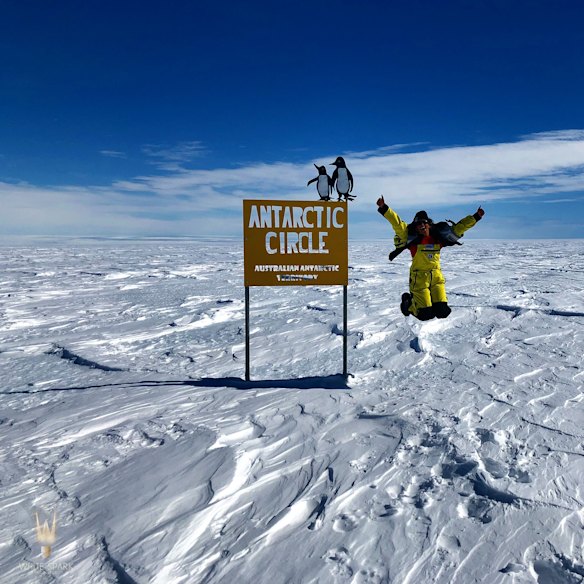
Harper and Whitehead travelled to Antarctica for a gruelling two-week shoot, lugging 160 kilograms of equipment. They used a six-lens virtual-reality camera to capture high-resolution scenes – walking among Adélie penguins, skirting icebergs in a boat and tailing scientists around Davis Station and in the field. “Our shared aim was for immersion – we could say, ‘Look behind you, there’s a seal,’ and the audience could turn around and see it.”

In a number of world-firsts, the pair captured in 360-degree vision the shimmering, violet-green curtains of the Aurora Australis over the Davis base. White Spark was also issued the first commercial drone licence in Antarctica.
The Antarctica Experience was hailed as the start of a new era in immersive nature documentary-making, and the continent still occupies a special place in Whitehead’s heart. On the voyage south to conduct more filming, this time with Ellard, she and her fiancé of five years were invited by the captain to “tie the knot” on the deck of the RSV Nuyina. “It was a pinch-yourself moment,” Ellard recalls. “You’re literally out on the helideck of Australia’s brand new ice-breaker vessel surrounded by icebergs going past with penguins and whales in the water.”
Whitehead doesn’t have a science degree “but when I was doing my double arts degree, I did an oceanographic and atmospheric sciences course. I was sick of having debates with my friends about climate change and not being able to speak from a science perspective.”
That perspective has attracted other science organisations to Whitehead’s VR films. Australia’s most ambitious space project, the Square Kilometre Array, is a ground network of antennas and dishes linked up to form the world’s largest radio telescope in semi-desert 700 kilometres north of Perth. Yet Whitehead’s VR film Beyond the Milky Way could take a headset-wearing audience into the desert and up into the night sky. “When we showed Beyond the Milky Way, we had a grade 6 school teacher come up to us and say, ‘You’ve just explained to my class in half an hour more than I could ever hope for them to get in a whole semester of learning, because they’re in it.’ ”
Then came an invitation from Kimberley traditional owners to virtually capture their Country, in part to avoid too many visitors making actual visits. “The Great Kimberley Wilderness was generated by the Balanggarra community saying, ‘We want people to experience our Country in this way, because you’re only doing it once as a very tiny footprint.’ ”
The traditional owners didn’t want people flying in by helicopter to vulnerable rock art sites. “We were invited to King George Falls – you’re normally not allowed to land on top of the falls – with two of us as crew, two traditional owners and the helicopter pilot. We get to go there once and capture it in that really special, meaningful way and everyone can connect with it,” Whitehead says. “Somewhere like the Kimberley is a place where everyone who goes there – even the most atheistic person in the world – has some sort of feeling that’s special and soulful. Try and capture that in a medium like TV and you just can’t do it.”
The notion of people going on a virtual adventure together is the closest thing to an addiction for Whitehead. “The options are endless and the education potential of this medium is huge. You can bring together everyone, from five-year-olds to 103-year-olds in a wheelchair. By being able to have everyone in an audience, we’ve got 50 to 100 people all going to Antarctica, or the Kimberley or outer space, or now, the Great Barrier Reef. It gives them a level of access that, even if they were a billionaire, they’re never going to get. And then they all get to go together and they talk about it afterwards.”
Future work is being supported by the National Museum of Australia, Western Australian Museum and Auckland War Memorial Museum, which have contributed $1 million to White Spark’s next three films, including a dive into the lives of whales. And there are now six permanent VR cinemas in Australian museums using the company’s Surround Sync technology, with more to come. “That’s the exciting part, having these permanent venues with VR playing all year round, designed not just for us but for the whole industry. I think of it as our precipice moment.”
During a catch-up at her local coffee shop, Whitehead and I realise we’re both staring at a little boy with headphones on, his eyes glued to a laptop screen while his mother sips coffee and scrolls through her phone. “We don’t need to tell kids that age how to put a VR headset on,” she observes. “They come in like, ‘Boom, yep, ready to go.’ ”
‘The first thing that I get every time I tell anyone we’re doing a film on the Great Barrier Reef is, “Isn’t it dead?” … No… It isn’t lost.’Briege Whitehead
Whitehead has Life in the Great Barrier Reef and its timely message in mind. “The first thing that I get every time I tell anyone we’re doing a film on the Great Barrier Reef is, ‘Isn’t it dead?’ Or, ‘Shouldn’t you have been doing that 10 years ago when there was something to save?’ And no, that’s absolutely not the case. It’s a very realistic hope that the reef, as we know it, isn’t lost. It’s just that at this point in time, there’s a lot of things that need to be done.”
I tell her how memorable it was to be virtually seated in a boat with Mer Indigenous man and reef guide Quinn Ross-Passi, who describes how, after his first scuba-dive at 19, “I knew this is where I want to spend the rest of my life.” Or landing on that sandy atoll with marine ecologist Katie Chartrand, who explains why ocean acidification can lead to coral bleaching. “While it’s very pale, the coral is only sick, not dead,” says Chartrand. “At least, not yet.”
“We can’t just sit back and hope that nature’s going to take care of itself,” observes Whitehead. “The tourism operators are motivated, so are the scientists, the First Nations people, everyone. At its core, this film is about having people connected to a very important place, not just because of its beauty, but its significance to our whole planet.”
Read more from Good Weekend:
Disclaimer : This story is auto aggregated by a computer programme and has not been created or edited by DOWNTHENEWS. Publisher: www.smh.com.au