
Western Australia’s miners are resolute the state’s resources industry – and the state itself – remains on track to deliver on a commitment to net zero emissions by 2050, despite the target being called into question in recent weeks.
A Deloitte report commissioned by Woodside and released earlier this month suggested WA would miss its 2050 net zero target by up to a decade, while The ABC and The Guardian this week published internal BHP documents that showed the miner’s Pilbara iron ore operations were forecast to cut emissions just 1 per cent by 2030.
That rate cast doubt over the company’s pledge to reach net zero emissions by 2050, but speaking at the Australian Financial Review Mining Summit in Perth on Wednesday, BHP WA iron ore assets president Tim Day told delegates the mining giant was already ahead of its target commitment.
However, Day noted the path to lower emissions was taking longer than predicted.
“BHP’s made commitments – as per all companies, most of them in the room have all similar types of commitments – then in our case it’s 30 per cent by FY30, we’re already at 36 per cent so you’re already advanced on where we said we would be now in terms of decarbonisation,” he said.
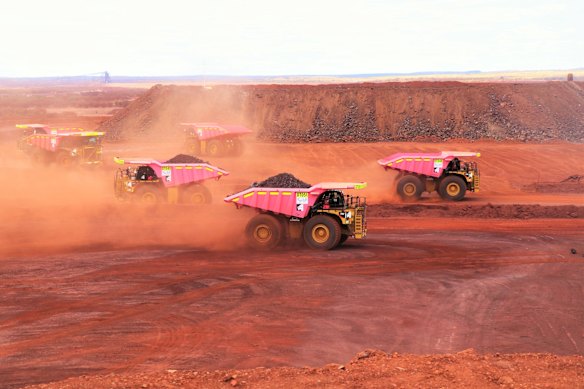
“So, one thing I would point out is, if you think about these big machines, they are big trucks that we’re trying to run on batteries.
“We’ve got a couple of them running around the Pilbara now in those hot conditions, et cetera, charging, trying to work out how to do that as fast as we can.
“But as it stands right now, and the system we are using is not quite ready yet, and that is taking longer than we expected, no doubt about it, but we have actually addressed all the other parts of the D-curve, which we could actually do.”
Fortescue metals and operations chief executive Dino Otranto told the summit that the company had experienced a rise in its emissions in recent years, but still expected to remain on target.
“We haven’t shied away from the fact that we bought in a very energy-intensive operation in magnetite, and we’re ramping that up, so emissions were naturally going to go up for that,” he said.
“If you park that, though, our haematite business on intensity and total emissions has actually gone down.”
Otranto said he also expected a further reduction in emissions when the company’s electric truck fleet became operational.
“We’re pretty close to peak now, and we’ve built all of the generation, the distribution network,” he said.
“For us to decarbonise, we’d electrify everything. Half of our energy actually comes from processing plants from electricity demand, and the other half from diesel.
“So, our diesel equivalent here is about eight to 900 million tons, and the biggest contributor of that diesel consumption is these trucks that everybody’s latched on to.
“And yes, we don’t have them yet. We’ve ordered them, and they’re coming, right, but no one will believe they exist, even though there’s many examples around the world where they do exist.”
Meanwhile, at the same summit, WA Premier Roger Cook labelled the findings of the Deloitte report “nonsense” and said it drastically underestimated the state’s ambitions.
“Renewables formed by battery and gas are going to be essentially the key operating model for the next 10 to 20 years in Western Australia, and we have to accept that reality,” Cook said.
“But don’t underestimate our capacity and our determination to make sure that we move down that pathway as quickly as possible.”
However, WA Greens MP Sophie McNeill challenged the premier’s statement and encouraged him to publish the government’s emissions trajectory data.
“The fact is that Western Australia is a climate pariah, captured by big gas corporations, and is not on track to cut emissions in line with the Paris Agreement to net zero by 2050,” she said.
Conservation Council of Western Australia executive director Matt Roberts warned that without stronger climate targets to hold companies to account, the state would not see significant cuts to Australia’s emissions.
“We cannot rely on BHP, or any other fossil fuel company to voluntarily work towards net zero emissions targets; we need strong government policy,” he said.
“It’s time for less carrot and more stick if we have any hope of addressing our climate crisis.”
Cook said no other jurisdiction in the world had the abundance of renewable energy and natural gas resources that Western Australia did.
“Advantages that have helped make us the strongest economy in the nation, and will keep us there if we get it right,” he said.
“Becoming a renewable energy powerhouse, diversifying our economy, making more things here, creating new business opportunities and jobs for generations to come, all based on reliable, affordable, and lower carbon energy, renewables backed by battery storage and gas.
“This will be our energy mix for many years to come.”
From our partners
Disclaimer : This story is auto aggregated by a computer programme and has not been created or edited by DOWNTHENEWS. Publisher: www.smh.com.au