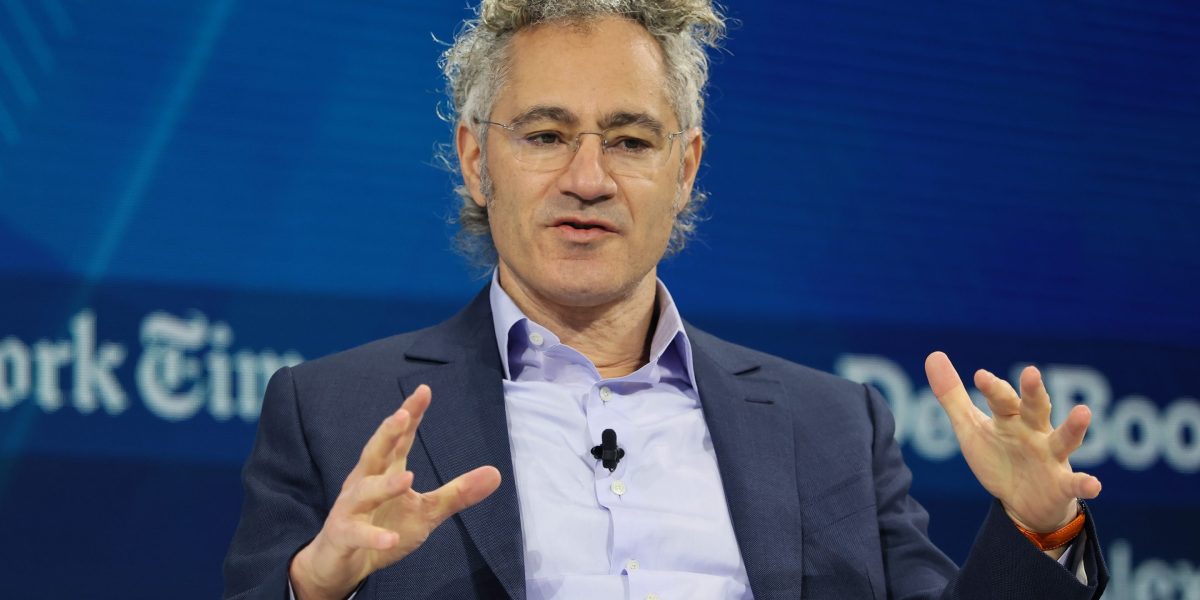
Palantir CEO Alex Karp has a message for Silicon Valley executives touting artificial intelligence-driven job cuts: Don’t be surprised if workers—and voters—turn against you.
Speaking last week on TBPN, the tech talk show recently acquired by OpenAI, the leader of the roughly $325 billion defense contracting and software company warned that corporate leaders need to be more “disciplined” around how they talk about AI and the future of work.
“If you run around saying AI allowed you to fire two-thirds of your workforce—because maybe your competitor’s kicking your ass—you might as well just go sign up for the Bernie Sanders manifesto,” Karp said.
The jab referenced a growing backlash against the power of major technology firms and fears that artificial intelligence could accelerate job losses. Tech companies have laid off roughly 117,000 employees in 2026 alone—nearly matching the total for all of 2025—with firms including Meta, Snap, and Block pointing to AI as a factor in restructuring efforts.
It’s a concern that Sen. Bernie Sanders (I-Vt.) has increasingly seized on. The longtime progressive has repeatedly accused major tech firms of prioritizing profits over workers and warned that automation could deepen economic inequality.
“If Mark Zuckerberg is willing to lay off 10% of his own employees, what do you think his AI will do to the average American worker?” Sanders wrote in May.
The unease comes at a moment when the future of work remains unsettled. Even as tech revenues climb, layoffs have brought more questions about how AI-driven gains will be distributed—a dynamic that could fuel greater support for interventionist economic policies from lawmakers like Sanders and deepen a broader backlash among voters and employees against AI-focused corporate leadership.
Karp warns tech leaders are ‘playing with fire’
While Sanders has stopped short of opposing AI outright, the 84-year-old has proposed more aggressive government intervention in the industry—including an “AI Sovereign Wealth Fund” that would tax companies such as OpenAI, Anthropic, and xAI through equity stakes, with returns eventually flowing to Americans.
He has also backed legislation aimed at slowing the expansion of AI data centers.
Those efforts have tapped into growing unease about AI, driven both by fears of job displacement and concerns over the rapid spread of data centers in local communities. Between 2025 and 2026, the share of Gen Z respondents who said AI made them feel angry rose by nine percentage points, while feelings of excitement and hopefulness declined, according to Gallup.
For Karp, that backlash could only continue to grow—and threaten the competitiveness of business.
“These things are very, very explosive,” Karp said. “The American people sense that there is something dangerous here. And when people are playing with that fire, they assume it won’t burn their hands. That’s not the world we’re in. That fire is going to consume us.”
Fortune reached out to Karp and Sanders for further comment.
Palantir, too, plans to reduce its headcount: ‘The goal is to get 10x revenue’
Karp’s concerns about executives using AI as a public justification for layoffs were echoed this week by fellow Palantir cofounder Joe Lonsdale.
“Everyone who over-hired or lowered the bar too much in the 2021-2023 wave, or isn’t growing as fast as budgeted, now pretends they’re laying people off ‘due to AI productivity,’” Lonsdale wrote on X on Monday.
“I believe in higher productivity thanks to AI—which by the way also often makes each person worth more,” he added.
Yet their comments come with an important caveat: Palantir itself is embracing AI-driven efficiency and does not plan to significantly expand its workforce.
“We’re planning to grow our revenue … while decreasing our number of people,” Karp said last August on CNBC. “This is a crazy, efficient revolution. The goal is to get 10x revenue and have 3,600 people. We have now 4,100.”
Rather than conducting sweeping layoffs, Karp told analysts Palantir plans to largely freeze hiring and use AI to multiply employee productivity. Still, the company’s overall headcount has continued to fluctuate. In its 2025 annual report, Palantir reported 4,429 full-time employees.
Karp has argued that AI is increasing the value of top performers.
“The soldiers at the bottom have gotten much more valuable…the modern enterprise is going to have a very smart executive at the top, and then very talented, creative people with taste all up and down the stack,” he said on TBPN.
In a May letter to shareholders, Karp reported annualized revenue per employee in the U.S. climbed to $1.6 million, up from $884,000 a year earlier—even as the company maintained what he called unusually strict “hiring discipline” for the software industry.
Disclaimer : This story is auto aggregated by a computer programme and has not been created or edited by DOWNTHENEWS. Publisher: fortune.com