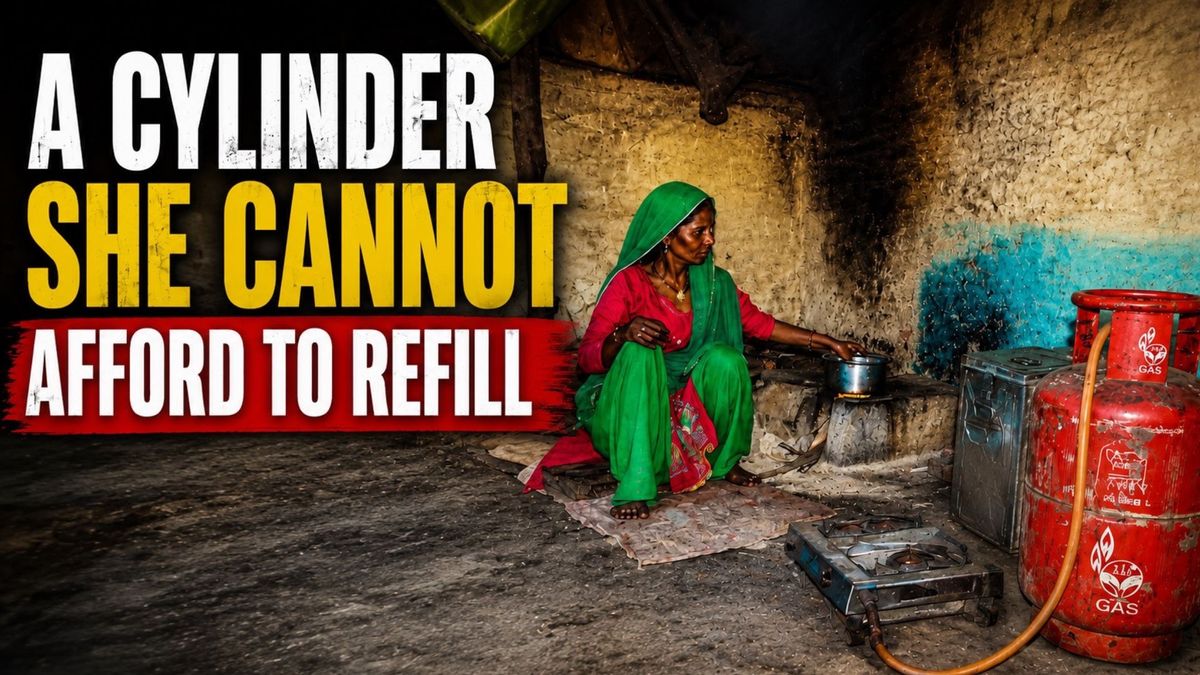
Rekha, 53, has lived in Seemapuri in east Delhi for most of her adult life. She is a mother of three, works as a domestic help in the mornings, and has been a beneficiary of the Pradhan Mantri Ujjwala Yojana (PMUY) since the scheme was launched. The day Rekha’s Ujjwala Yojana connection arrived, she lit the stove and left the chulha outside. No more smoke. No more eyes watering through the cooking. A blue flame that came on when she turned the knob.
Last year, when the government cut the annual subsidised cylinder entitlement from 12 to nine, Rekha began rationing. She started using the chulha occasionally — on days when she could not pull together the money needed to pay upfront before the cylinder would be delivered. The LPG stove was still there. She just could not always afford to use it.
On June 8, 2026, the government cut the entitlement again — from nine cylinders to four. Rekha heard about it through neighbours. “We are poor people,” she said. “We are already facing difficulties paying for LPG because we have to pay so much money upfront and we cannot afford it. Now with only four cylinders, I do not think using LPG makes sense at all. We are thinking of stopping it completely.”
Rekha is one person. But she is not an exception. Across India, millions of households covered under PMUY face the same calculation she is making this week — whether the blue flame is still worth it, or whether the chulha is simply the only realistic choice left. What is happening in Seemapuri is a preview of what experts and civil society organisations warn will happen at scale: a reversal of the single most significant clean cooking transition in India’s history, driven not by preference but by the arithmetic of poverty meeting the architecture of a shrinking subsidy.
On June 8, the Union government quietly reduced the number of subsidised cooking gas cylinders available annually to beneficiaries of the Pradhan Mantri Ujjwala Yojana (PMUY) from nine to four. The announcement came through a press briefing by Praveen Mal Khanooja, Additional Secretary in the Ministry of Petroleum and Natural Gas, without a Cabinet note, without a parliamentary debate, and without a public consultation. For 10.5 crore women from below-poverty-line households across India, it was not a policy announcement. It was the end of a decade-long promise.
When Prime Minister Narendra Modi launched PMUY on May 1, 2016, at Ballia in Uttar Pradesh — one of India’s most economically deprived districts — the scheme came with a clear and specific commitment: free LPG connections to women from below-poverty-line households, with access to 12 subsidised 14.2-kg LPG cylinders every year. The stated aim was to end dependence on firewood, cow dung and crop residue — and with it, the lung disease, the daily labour of fuel collection, and the indoor smoke that had for generations been accepted as the condition of cooking poor in India. Over the decade that followed, the annual entitlement moved in one direction only. In August 2025, the cap was cut from 12 to nine cylinders. On June 8, 2026, it was cut again — from nine to four. What began as 12 has now become 4. Two-thirds of the original promise has been withdrawn.
Also Read:GST Invoice Fraud: Why ₹58,772 Crore Slipped Through Audits
What Four Cylinders Actually Means
To understand what this decision means in practice, consider a family of six living in a village in Uttar Pradesh or Chhattisgarh — the kind of household PMUY was designed for.
When the scheme was launched, the family received a free connection — the government paid ₹1,600 covering the security deposit for the cylinder, pressure regulator, hose, and installation charges. The first refill and stove were also provided free under Ujjwala 2.0. That part has not changed. The connection remains free.
What has changed is what happens every time the family needs to cook.
A refill must be purchased. Today, a 14.2-kg LPG cylinder in Delhi costs ₹942. The family pays that amount upfront, in cash, at the door when the delivery arrives. The government then transfers ₹300 directly into the registered bank account through the Direct Benefit Transfer (DBT) system — but only after the transaction is recorded, and only for the first four refills of the year. The effective cost per cylinder for those four refills is ₹642.
From the fifth cylinder onward, there is no transfer. The family pays ₹942 with no return.
A 14.2-kg cylinder lasts approximately 30 to 45 days for a
Disclaimer : This story is auto aggregated by a computer programme and has not been created or edited by DOWNTHENEWS. Publisher: theprobe.in