

Whether it is a new house or a new apartment, transforming an otherwise soulless space into an expression of who we are and what we value is complicated.
When it is the biggest asset many of us own, it can feel risky just to put a nail in the wall, let alone change the colour or alter the design to suit ourselves. So it’s perhaps unsurprising that so many baulk at personalising spaces.
“People in Sydney are very scared to take a risk because there is always the spectre of resale,” says interior designer Gillian Khaw of Handelsmann + Khaw. “They don’t want to cause offence.”
Sydney interior designer Karen Akers says the desire to fit the real estate mould of all-white interiors only further discourages many home owners from defining their own sense of home, even when it’s a blank canvas.
“Real estate agents have a lot to answer for,” she says. “They tell owners [white walls] are what will get them the most money and that is what people want to hear.”
White is still the most popular interior wall colour, chosen in the belief it will make spaces feel larger and lighter. And when moving into a newly constructed home, the desire for a completely fresh start, with neutral walls and new furniture and furnishings is tempting.
If that’s you, no problem. But for those wanting to make a new build feel like home, read on.
Let history repeat
Most of us don’t have the budget to toss everything out and completely start over when we move house. Khaw says that may be a blessing in disguise.
“People spend a lot of money on their renovations and homes and there is not that culture [in Australia] of inheriting something they will hold on to,” says Khaw. “A lot of things are bought new.”
However, she says choosing to retain your grandmother’s dining table or an elderly aunt’s sideboard with its history and age automatically grounds a new space.
“It’s the genuine character and personality of the person who owns it coming through,” she says.
In new spaces, adding something old can be surprisingly invigorating, as years of built-up patina meets brand-new surfaces.
“I was called to an apartment by clients who had purchased an apartment that was pretty bold in both colour and wallpaper,” says Akers.
“They were coming from Lindfield with heritage furniture, and they put it in the [new] space. They would never have done it otherwise, but they loved the contrast.”
Sonia Warner from interior design firm Woods & Warner says layering materials of different ages creates a sense of attachment and belonging to a space. “Mixing a sleek modern sofa with a vintage rug or an antique side table creates a beautiful juxtaposition that tells a story, giving the impression that the space evolved naturally over time,” she says.
Leaf by leaf
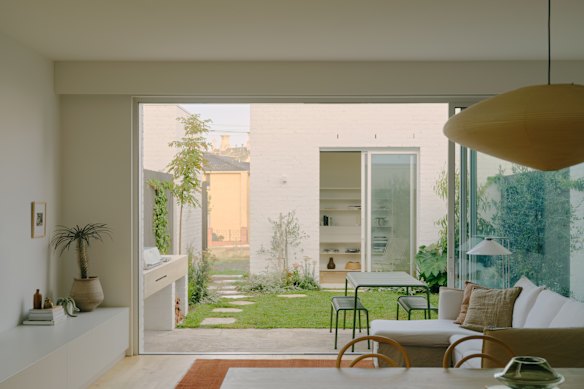
There’s good reason why biophilic design (architectural approach that brings natural elements like sunlight, plants and organic textures into built environments) has taken such a hold in design circles in recent years. Studies abound of the benefits of connecting with the natural world to our sense of wellbeing. Making way for indoor plants, climbing plants on balconies and, where space allows, a garden, is a key step in the transition from clean slate to home.
When Cosentino and her husband, Stephen McGarry Director of Carr Architecture and Interior Design got together with two other couples a few years ago to design three townhouses in Northcote for their families, softening the new build with planting was a priority.
“Landscaping is a key contributor,” she says. “It brings a softness to the architecture and the hard rectilinear brick surfaces.”
Warner says often it is the space between indoors and out where the opportunity lies. Landscaping plays a key part.
“There is an undeniable romance seeing delicate sheer curtains waft in a breeze,” she says. “It instantly introduces movement and evokes a serene, relaxed setting.
“However, true softening requires bridging the gap between indoor and outdoor spaces right at the threshold. By strategically placing dense, tactile plantings directly outside windows and doors, the hard transition disappears.”
Love and light
Yes, yes, you don’t need to explain the importance of natural light to Australians. But managing it effectively, using a variety of methods, can transform glaring daylight into something softer and even playful.
Given they were occupying the middle townhouse, Cosentino and McGarry installed skylights in the bathroom and a light well in the living area that supports an internal courtyard. Planting from outdoors creates opportunity for soft shadow play on newly painted walls, and sheer curtains diffuse light while creating some privacy from the street.
“It’s a simple gesture, a light well in the hallway, but it is so open and it brings in the light all year round,” Cosentino says.
Sounds off
Nothing shouts “new home” like the sound of footsteps echoing through empty rooms. If you have been putting off buying area floor rugs, this is the moment to jump in. Wool rugs with a thick pile are a good start for absorbing sound, along with stacked bookshelves and upholstered furniture and furnishings.
Akers says it can sometimes be a struggle to convince clients of the benefits of layering fabrics.
“Hard surfaces like tile floors and timber floors are very popular because they are easier to clean,” she says.
All yours
Whether you adore bold wallpaper and velvet curtains or white walls and abstract art, don’t be afraid of stepping outside the bounds of “good taste” to choose what you love, says Khaw.
“It would be very easy to go in and say ‘look at this thing in a magazine’. It’s all very safe and someone has signed it off, and it’s approved,” says Khaw.
Warner concurs.
“The biggest design mistake is prioritising looks over how a room actually feels. Too often, spaces are built to look flawless in photos, but they function poorly and end up feeling cold and uninviting to live in.”
 Robyn Willis is a property reporter and the former lifestyle editor for The Sydney Morning Herald and The Age.
Property listings
From our partners
Disclaimer : This story is auto aggregated by a computer programme and has not been created or edited by DOWNTHENEWS. Publisher: www.smh.com.au


