It was hard to read a news story covering the Gulf last week that didn’t contain the word ‘Space X’—with good reason.
Tipped to be the world’s largest IPO with a projected valuation of $1.77 trillion—SpaceX’s IPO is due to take place on Wednesday and is expected to raise roughly $75 billion. Gulf sovereign wealth funds and prominent investors are set to be among the biggest beneficiaries.
The multi-billion-dollar windfalls they are poised to receive will offer a nicely-timed boost to their balance sheets, which have not enjoyed the usual flow of petrodollars since the outbreak of the Iran war.
Zooming out, it marks a significant moment in validating their investment strategies, with the Gulf states ranking among some of the earliest investors in Elon Musk’s SpaceX and xAI—the two companies merged in early February to become a rocket business, satellite internet provider and AI company.
If SpaceX debuts successfully at its expected valuation, it would be one of the clearest examples of Gulf capital backing a transformational technology platform before public markets fully recognized its value.
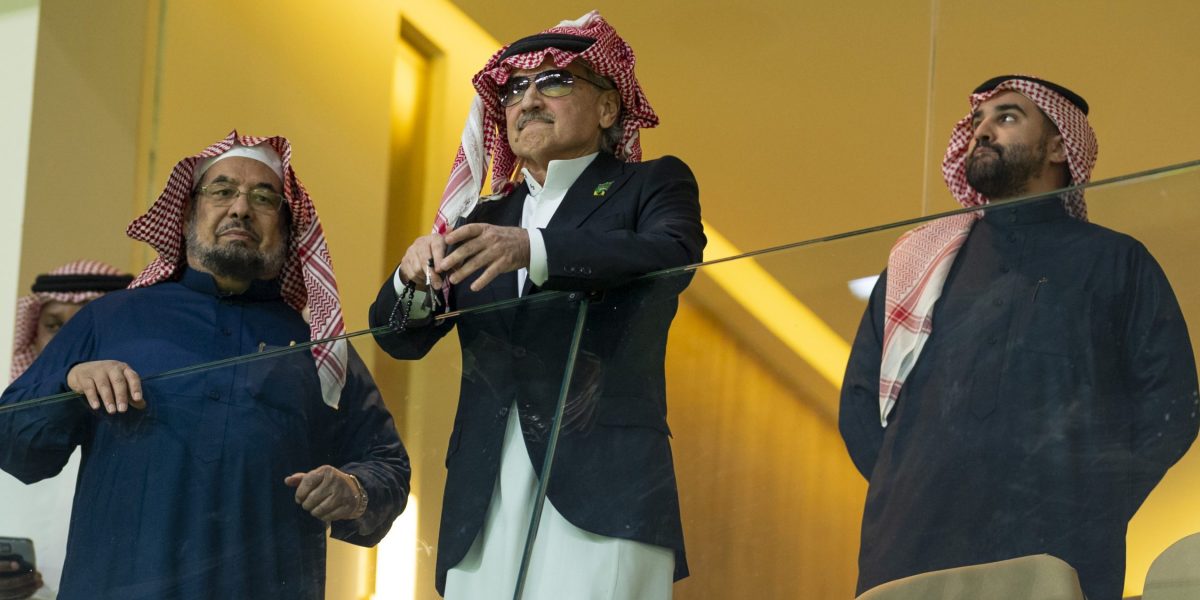
Saudi Arabia’s Prince Alwaleed bin Talal—aka the “Warren Buffett of Arabia”—owns a 0.63% stake in SpaceX that could be worth around $10.6 billion if the IPO achieves its expected $1.77 trillion valuation.
He’s in good company, with a cluster of high-profile Gulf sovereign wealth funds having exposure to SpaceX through both direct and indirect investments.
While their stakes fall below reporting thresholds, the IPO should crystallize enormous paper gains for all of them.
But, for Gulf investors, the listing is not just about financial returns.
In its IPO filing, SpaceX outlines plans to use some of the capital raised to launch a constellation of up to one million data center satellites into orbit, away from the resource and regulatory constraints on Earth.
The company claims that solar panels and laser optical communication in space can produce energy eight times more efficiently than ground-based systems—generating a total of 100 GW of power, equivalent to roughly 100 nuclear power plants.
While the prospectus acknowledges the technology is in its infancy, the plans align with the Gulf’s broader strategic ambitions of building out their digital and communications infrastructure.
These ambitions have been heightened by the ongoing blockade of the Strait of Hormuz, which has revealed that subsea cables are just as vulnerable to geopolitical conflict as oil tankers. The Strait funnels both energy and data through a single, vulnerable maritime corridor, as explained in this piece by Stimson, the research center.
Meanwhile, in early March, the Gulf’s cloud infrastructure was compromised when two Amazon Web Services (AWS) data centers in the UAE and one in Bahrain sustained direct hits from Iranian drones or damage from nearby debris.
Starlink already serves as an invaluable backup network for critical industries during disruptions and regional cloud outages. Given Musk’s continued efforts to build out a resilient communications infrastructure for the Gulf, backing SpaceX’s satellite network is as much a strategic maneuver as it is a commercial tech investment.
Melissa Hancock
melissa.hancock@fortune.com
Get in touch: Reply to this email with feedback or contact me directly at the address above.
IMF cuts Saudi GDP growth forecast
Saudi Arabia’s economy is expected to grow “at about 2%” in 2026, a sizeable downward revision from the International Monetary Fund’s previous forecast of 3.1% published in April, as the kingdom’s economic diversification efforts come under strain.
Saudi Arabia’s economy has proved resilient during the Iran war, but the conflict has weighed on non-oil activity and confidence, leaving growth this year “notably” lower, the Fund said in its latest update.
The findings follow an IMF staff visit to Riyadh between April 28 and May 13.
Strong economic fundamentals—including low government debt and ample reserves—provided important buffers. Elevated oil prices also made up for reduced export volumes and should provide some relief for the current account and fiscal balances this year.
However, the Fund noted that a prolonged or intensified conflict could negatively affect medium-term growth and investment prospects.
“The main risk is an escalation of the conflict, which could further impair shipping routes, damage energy infrastructure with associated output losses, and heighten uncertainty and financial sector risks,” it said.
More positively, the IMF team welcomed the Public Investment Fund’s (PIF) revised 2026-2030 strategy, highlighting its focus on “maximizing financial returns, strengthening investment efficiency and increasing private sector participation.”
UAE talks up and steps up U.S. investments
Khaldoon Al Mubarak, Chairman of the UAE’s Executive Affairs Authority, visited Washington last week to meet senior White House officials. The UAE is keen to inject fresh momentum into its decade-long, $1.4 trillion commitment to investing in the U.S.
Al Mubarak, who also serves as Mubadala’s managing director (Mubadala is Abu Dhabi’s sovereign wealth fund with assets of $385 billion) talked up his country’s investments so far.
“We are exceeding commitments we made to the U.S. one year ago,” he said, referencing the UAE’s pledge last March to invest $1.4 trillion across a range of sectors, including AI infrastructure, semiconductors, energy, and American manufacturing.
In January, Emirates Global Aluminium entered into a joint development agreement with Illinois-based Century Aluminium to build a $4 billion primary aluminium smelter in Inola, Oklahoma. Slated to be the first built in the U.S. since 1980, the massive facility will produce 750,000 metric tons per year, more than doubling current U.S. output.
Al Mubarak’s visit was also aimed at advancing the UAE-US AI Acceleration Partnership, designed to advance global artificial intelligence infrastructure and ensure supply chain security.
The visit came just weeks after the UAE received its first shipment of Nvidia chips, which are being used to construct its 5GW UAE-US Stargate AI campus.
Middle East family offices look to reallocate capital
Middle Eastern family offices are leading a global rethink of investment strategies, with 82% planning to adjust their asset allocations in the coming year, as geopolitical and economic uncertainty drives a renewed focus on wealth preservation.
According to UBS’ Global Family Office 2026 report which you can read here, their current portfolios remain anchored in North America, which accounts for around half of allocations, while also maintaining exposure to Western Europe and the Middle East.
However, family offices in the region are increasingly showing a strong interest in technology adoption as well as sectors that advance regional development priorities.
AI ranks as the top investment theme (50%), followed by AI-enabled healthcare (35%) and infrastructure (30%).
“This reflects a high-conviction and proactive approach to navigating global uncertainty and positioning portfolios for long-term opportunities,” said Niels Zilkens, Head of Wealth Management Middle East at UBS.
In total, UBS surveyed 307 family offices globally with an average net worth of $2.7 billion, with all of them showing an increased focus on prioritizing resilience, diversification and long-term thematic opportunities.
Notably, family offices in the U.S. exhibited the strongest home bias globally, with 88% of portfolios allocated to North America. While AI remains the top investment theme (65%), those surveyed also showed heightened interest in defense and security infrastructure (39%) and broader infrastructure investments (35%).
The Big Number
The value of 10-year dollar bonds issued by Bahrain on 4 June—the first public Gulf Cooperation Council sovereign debt issuance during the Iran war. Orders peaked at $3.2 billion as investors sought out the high-yield debt. Bahraini bonds came under pressure after the outbreak of the war in February, but recovered by mid-April after the UAE provided financial support. The latest notes are likely to be rated “B” by S&P Global Ratings and Fitch Ratings, Bloomberg reported.
What to read this week
- Since the start of the Iran war, a slew of workarounds is keeping crude oil below $100 a barrel, defying many of the industry’s grimmest forecasts for prices as high as $200. Now, however, the limits of some of those efforts are coming into focus as my Fortune colleagues explain.
- The woman who has quietly stood by tech billionaire Elon Musk for 24 years finally gets her moment in the spotlight in this New York Times profile piece. Describing Gwynne Shotwell as “the steady hand at SpaceX,” she was the highest-paid executive at the company last year
- U.S. Treasury Secretary Scott Bessent is weighing up plans to use Iranian assets, including up to $100 billion in frozen funds, to pay for rebuilding the Gulf. The whole area’s infrastructure has been damaged by attacks launched by Iran, the Financial Times explains. And many fear the conflict will continue on its destructive path.
Disclaimer : This story is auto aggregated by a computer programme and has not been created or edited by DOWNTHENEWS. Publisher: fortune.com