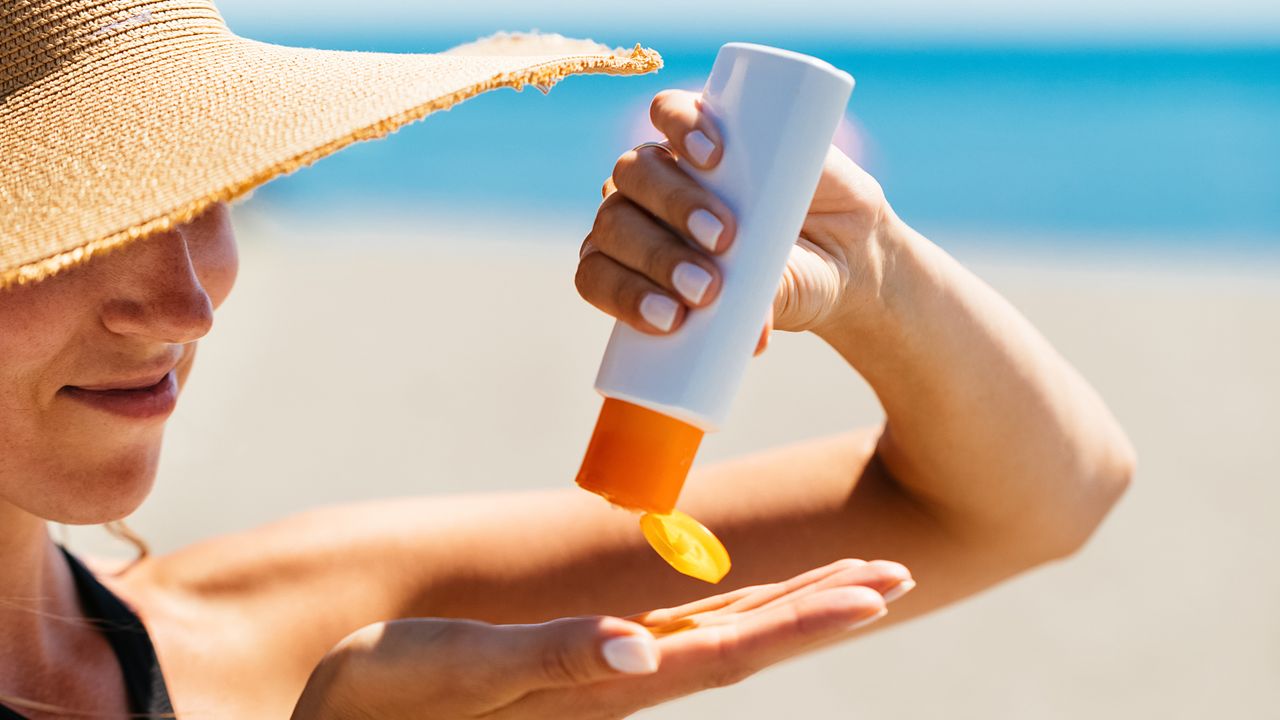
If you’re familiar with the sunscreen world—and you should be, considering we should all be wearing SPF every single day—you know that America is way behind in sunscreen innovation. This is in part because in the US, sunscreen is regulated as a drug rather than a cosmetic, which means it has to undergo robust testing via the Food & Drug Administration before hitting shelves. However, the FDA has finally approved a new active sunscreen ingredient (also called a filter), which would be the first major sunscreen-related approval since 1999—yes, 1999!
On June 9, the administration added bemotrizinol to the list of permitted active ingredients for over-the-counter sunscreens. According to the FDA, bemotrizinol (or BEMT) “provides protection against both ultraviolet A and B rays and has low levels of absorption through the skin into the body.” Now that the approvals have been finalized, BEMT is considered to be generally recognized as safe and effective (GRASE) by the FDA and recommended for use for adults and children ages six months and older.
“The agency has historically moved too slowly in this area, leaving Americans with fewer options than consumers abroad. We’re continuing to modernize the regulation of sunscreen and other over-the-counter drug products,” FDA commissioner Marty Makary, M.D., M.P.H., said in a December 2025 statement when the organization first began the formal process toward approving BEMT. “Americans deserve timely access to the best safe, effective, and consumer-friendly over-the-counter products available.”
Cosmetic chemist Kelly Dobos previously wrote in Allure that chemists in the US have a “pretty limited toolbox” for sunscreen formulation: just 16 active sunscreen ingredients, only eight of which are commonly used. For contrast, in Japan, formulators can choose from over 30 approved filters. According to Dobos, who attended the 2025 Sunscreen Symposium, BEMT is manufactured by DSM-Firmenich, which has been trying to get the ingredient approved in the US for 20 years; it cost them roughly $20 million to bring it to market.
BEMT approval gives cosmetic chemists another ingredient in their toolbox, and Dobos praises it for its efficiency. BEMT provides “true broad-spectrum protection with two distinct absorption peaks, one in the UVA range and one in UVB,” she explains, which means better defense against both sunburns and aging rays. “Unlike older filters that often require high concentrations to achieve adequate SPF, BEMT allows chemists to use lower overall levels of actives while still meeting high SPF and UVA protection targets,” Dobos tells Allure. It may also improve the sunscreen experience: “We can make products with lighter texture and less greasiness in formulations. And, like other organic filters, it’s transparent on the skin.”
The American Academy of Dermatologists is also very much on board with BEMT. “The Academy has been advocating for many years for the availability of more sunscreen options for US consumers,” the immediate past president of the AAD, Susan C. Taylor, MD, FAAD, said in a statement last December, noting that one in five Americans will develop skin cancer in their lifetime. “The United States lags behind many other countries that have nearly twice as many approved sunscreen ingredients.”
Disclaimer : This story is auto aggregated by a computer programme and has not been created or edited by DOWNTHENEWS. Publisher: www.allure.com