Visakhapatnam: Visakhapatnam’s beaches, long celebrated as tourist magnets, are increasingly drawing attention for a more troubling reason: the silent menace of rip currents.
A comprehensive study by academician and researcher, Dr Chintam Venkateswarlu of Andhra University, has revealed the scale of the threat, identifying 122 high-risk days, 213 moderate-risk days, and 30 low-risk days for rip current occurrence along the city’s coastline.
The findings come against the backdrop of more than 400 drowning incidents reported at RK Beach and Rushikonda Beach, highlighting the need for scientific safety interventions.
Rip currents are powerful, narrow streams of water that surge from the shore toward deeper sea regions, often invisible to the untrained eye. This makes them particularly hazardous for tourists and inexperienced swimmers.
Dr Venkateswarlu’s work reveals that wave direction is the most critical factor influencing rip current formation. At RK Beach, currents are most likely when waves approach between 110° and 180°, while at Rushikonda Beach, they occur predominantly between 40° and 170°.
Bathymetry, or seabed topography, was also found to play a significant role, with wave height and wave period determining current intensity, while tidal variations exerted less influence.
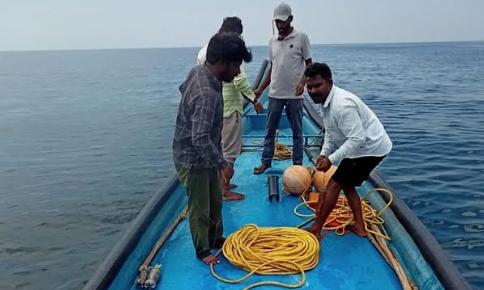
The study involved extensive fieldwork at RK Beach, Rushikonda, Yarada, Appikonda, and Bheemili beaches, including beach profiling, wave measurements, bathymetric surveys, and direct rip current observations.
For the first time in India, coastal video monitoring techniques were integrated with numerical modelling to identify rip current hotspots. Nearly 800 simulations were conducted for RK Beach and 1,500 for Rushikonda under varying conditions, leading to the identification of persistent danger zones.
Such mapping, researchers noted, could guide authorities in deploying lifeguards, installing warning signs, and strengthening public safety systems.
The research also drew on video imagery, satellite data, and field observations to track shoreline changes, sandbar formations, beach cusps, and nearshore bathymetry. Conducted under the guidance of Prof CV Naidu, the work was carried out in collaboration with scientists from ISRO in Ahmedabad and NCESS in Thiruvananthapuram.
Dr Venkateswarlu presented his PhD thesis, “An Integrated Study of Nearshore Processes using Innovative Coastal Video Monitoring Techniques and Numerical Modelling,” in May 2026, and was honoured with the “Best Researcher Award” during Andhra University’s centenary celebrations.
Currently serving as Project Scientist-I at the national institute of ocean technology under the Earth Sciences ministry, Dr Venkateswarlu continues to focus his attention on coastal hazards, rip current dynamics, and beach safety measures.
Disclaimer : This story is auto aggregated by a computer programme and has not been created or edited by DOWNTHENEWS. Publisher: deccanchronicle.com