Officeworks has defended hiking a product’s price before lowering it to spruik it as a Black Friday “top pick”, as fresh data shows retailers routinely perform a similar cycle so that deals advertised as discounts during the busy sales window actually sell at or above normal prices.
It follows a sweep by the consumer watchdog of potentially misleading sales tactics over the Black Friday sales period throughout November, in which about six million Australians were estimated to have spent about $39 billion.
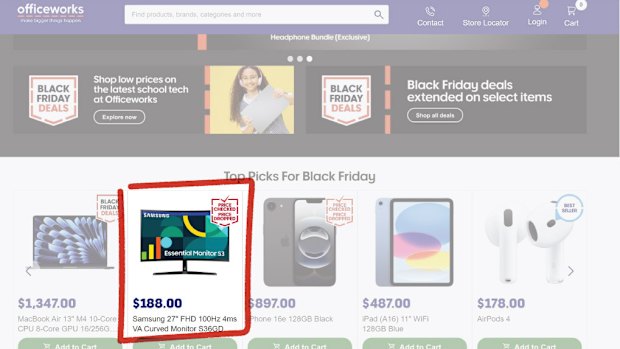
The Samsung monitor in question was advertised as a top pick among Officeworks’ Black Friday offering, after it had previously been sold at that price.Credit: Officeworks website
Among Australian retailers, the office supplies retailer has come under scrutiny over how it changed the price of a 27-inch Samsung curved desktop monitor in the lead-up to Black Friday sales. It was selling the monitor for $188 until November 14, below its base “everyday price of $267”. The price returned to $267 on November 14, before it was lowered to $218 on November 17.
Recently, it returned to $188 – marketed on the “Black Friday Sales” section of Officeworks’ website, in a carousel of products under a headline “Top Picks For Black Friday”. The price changes were picked up on by shoppers, who aired their grievances on social media.
The matter was referred to the Australian Competition and Consumer Commission via a complaint from a member of the public. The ACCC said price changes that misrepresent discounts could be illegal, potentially leading to legal action and penalties.
An Officeworks spokesman, responding to questions from this masthead, said its team conducted “price checks daily and drops prices on our most relevant products to ensure we are passing on savings to our customers”.
‘Sale’ or ‘special’ prices could also be misleading under the Australian consumer law if the ‘sale’ price is actually the normal price.
ACCC spokesman
The spokesman said Officeworks first lowered the price of the monitor to $188 to match a competitor’s price, before returning it to $267 once their competitor’s promotion ended. Lowering it to $218 days later was also in response to a competitor’s discount.
“Our prices will fluctuate with changes in the market, and we work hard to pass on those savings to customers as they occur,” the spokesman said.
“We take our obligations under the Australian consumer law very seriously, ensure our promotional practices adhere to it, and we remain committed to transparent pricing for our customers,” the spokesman said. After being approached for comment, Officeworks readjusted the price to $267.
This example is just one among a barrage of allegedly deceptive deals marketed to shoppers during the month-long global sales period into which Black Friday, historically a single day falling on the Friday after Thanksgiving in the US, has ballooned. This year, Black Friday was on November 28. The extended follow-on event, Cyber Monday, occurred on December 1.
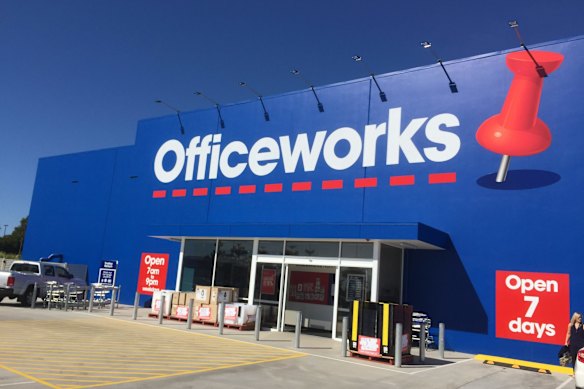
Wesfarmers-owned Officeworks has defended its Black Friday sales pricing.
One third of advertised Black Friday deals globally offered no real savings or were, in fact, more expensive than their lowest prices advertised throughout October and early November, according to an analysis of 2620 products conducted by Canada-based website monitoring firm Visualping.
Deceptive deals were priced 37 per cent higher than their previous low on average and certain product categories were more likely to be on so-called “fake discount”.
Pieces of luggage had the highest share of deceptive deals: 61 per cent were found to have Black Friday specials advertised at prices above what they had previously sold. Half of the Black Friday deals for microwaves that were monitored were also found to be deceptive.
The analysis included major international retailers, such as Amazon, one of Australia’s most popular destinations for shoppers, as well as businesses catering only to customers in North America.
“Many consumers are buying under the assumption they’re getting their best possible price,” Visualping’s Kayla Zhu said. “While Black Friday sales often do offer real savings for many products, shoppers should be aware that not all discounts live up to the hype, and some items had been available at lower prices earlier in the season,” Zhu said.
While the analysis was international and laws governing pricing vary between jurisdictions, Australian consumer law “prohibits businesses from engaging in misleading conduct”. An ACCC spokesman said, “this includes false or misleading statements about prices, including about price savings and discounts”.
“Stating that the sale price is marked down from an earlier price can be misleading when the items were not sold at the price in a reasonable period right before the sale started,” they said. “‘Sale’ or ‘special’ prices could also be misleading under the Australian consumer law if the ‘sale’ price is actually the normal price.”
The ACCC conducted a “Black Friday sales sweep” to identify misleading or deceptive sales advertising. The results of the sweep have not yet been released, but retailers found to have misled or to have deceived may face enforcement action, the ACCC spokesman said. The warning remained relevant going into the Christmas shopping period and Boxing Day sales, he said.
The ACCC has recently taken action against businesses for their pricing conduct. In June, bed and mattress company Emma Sleep admitted that between 2020 and 2023, it had advertised 58 products at a discounted price alongside a higher price with a strikethrough in the text, despite never actually having sold the products for the higher price.
In 2023, Dell Australia was ordered to pay $10 million in penalties for misleading customers about the value of discounts on its monitors.
The Business Briefing newsletter delivers major stories, exclusive coverage and expert opinion. Sign up to get it every weekday morning.
Most Viewed in Business
Disclaimer : This story is auto aggregated by a computer programme and has not been created or edited by DOWNTHENEWS. Publisher: www.smh.com.au