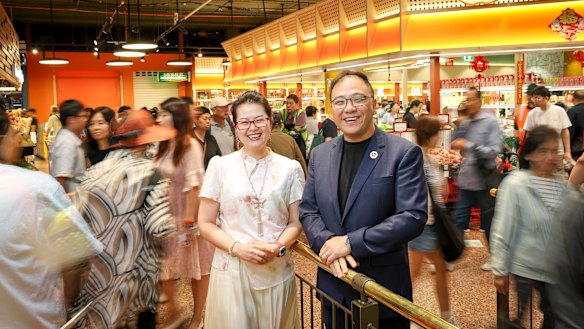

“Happy New Year” greetings echo through Box Hill in Melbourne’s east as shoppers fill baskets with sticky rice cakes, red envelopes, bright lanterns, goji berries and other treats.
The frenetic festive energy is just gathering momentum for those welcoming the Year of the Horse in the City of Whitehorse, where about one in every eight residents were born in China and just over a quarter of the population has Chinese heritage.
The Year of the Horse begins on Tuesday. Traditional family reunion dinners kick off 15 days of celebrations, while on Saturday up to 100,000 revellers are expected to watch lion dancers and fireworks and sample delicacies at the Box Hill Chinese New Year Festival – the single largest event in the municipality.
“It’s like an onion; on the surface it’s fun, it’s vibrant, people come and look at it,” Asian Business Association of Whitehorse vice president Richard Shi said.
“But the more you peel it back, the more complex it gets.”
Shi and association president Bihong Wang are among dedicated volunteers who spend thousands of hours organising the festival.
A major reason Wang does it is so her own children can proudly bring along their friends.
“It’s very important to them, [saying] this is my identity, this is my culture, and we’d like to show you,” she said.
Shi remembers being the only child with dark hair at his Kew primary school after migrating from northern China and said there has been a noticeable difference in cross-cultural communication as the local festival has grown.
He had never seen a prawn dumpling, a southern Chinese dish, before coming to Melbourne, and likened seasonal specialities from across South-East Asia eaten during celebrations in Australia to a common language across dozens of ethnic groups.
The Lunar New Year is also one of the most important events for the local economy.
Shi owns multiple businesses including an importing company. There is such strong demand for dried mushrooms that he prepares an extra 20,000 kilograms for the New Year season alone.
Queues at local institution Ducgo Live Seafood can start from about 7am, with triple the usual amount of Murray cod, coral trout and other fish sold.
Owner Victor Huang, who also runs nearby Canton Lake Restaurant, noticed customers have tightened their belts – as they have everywhere – but big-ticket items like lobster cooked in professional kitchens are popular banquet centrepieces.
“Whether it’s Chinese cultural traditions or if it’s food culture, it must be maintained, it must be passed down to future generations,” Huang said through a translator.
Nearby Welcome Butcher expects to sell at least 1000 kilograms of pork over three days.
“We usually serve about 200-300 [customers] per day, but Chinese New Year, maybe 400,” owner Ray Su said.
More people will pass through the Box Hill Central shopping centre during the festivities than at any other time of year, and there is a noticeable bump in deliveries, according to centre manager James Roper.
“It’s up there with Christmas in terms of economic activity,” he said.
It’s also the busiest time of year for performers from the Chinese Youth Society of Melbourne, a volunteer troupe set to put on 100 lion dances, dragon dances and martial arts displays. Many members are overseas students while others are the third generation of families involved, performance and events co-ordinator Carmen Lau said.
“Our performers train all year long and then it culminates over the next fortnight,” Lau said.
Nicky Luo, a Monash councillor who migrated from China as a teenager, said old traditions like firecracker displays made local celebrations distinct.
“Here it is a very common thing, it is a must have, but in China not necessarily,” Luo said. “We actually kept what was brought here probably 200 years ago, when the first Cantonese came here in the Gold Rush time.”
Other major celebrations will be held around the city. Parts of Little Bourke and Lonsdale streets will shut down in the CBD as up to 200,000 people attend the Melbourne Chinese Lunar New Year Festival on Sunday.
“It’s packed; you can’t even walk,” Melbourne Chinese Business Association president Christina Zhao said.
University of Melbourne Asia studies lecturer and anthropologist Charlotte Setijadi said local celebrations have evolved due to a shift in migrant demographics and generational change, but proud public displays of culture and family meals remain at their heart.
“Lunar New Year is also going to be celebrated, not just by the Chinese, but also by, for instance, the Koreans, by the Vietnamese,” she said.
“Even families that have been in Australia for many generations, who are Australian citizens and perhaps they’ve never even been to their ancestral places of origin … [it is] an important time of the year for the reaffirmation of those ethnic and cultural identities.”
Start the day with a summary of the day’s most important and interesting stories, analysis and insights. Sign up for our Morning Edition newsletter.
 Rachael Ward is a journalist in the City team at The Age. Contact her at rachael.ward@theage.com.auConnect via email.
From our partners
Disclaimer : This story is auto aggregated by a computer programme and has not been created or edited by DOWNTHENEWS. Publisher: www.smh.com.au