What if your next vacation turned into a masterclass in conservation?
Across India are stays that go beyond bed and breakfast; here, windows open into the wild. Far off the tourist trail, these stays border reserves and sanctuaries, where they share ground with the wilderness. Their doors open out into birdsong, and coexistence isn’t preached; it’s a lived reality.
1. Baaghini, Ranthambore National Park, Rajasthan
After spending two decades in Australia, Kalponika Bhattacharya and her husband, Subhro, moved back to India, united by the intent to “do something in the wildlife space”.
Kalponika explains, “We loved the jungle; on every trip to India, we would visit national parks and safaris.”
One of these expeditions was to Rajasthan’s Ranthambore National Park, once the hunting grounds of the maharajasof Jaipur but now famed for its population of the Bengal tiger.
“During my visits to these national parks, I started appreciating the local communities and conservation efforts on the ground. I realised this was what was missing in many stays,” Kalponika explains, adding that they decided to make community engagement the fulcrum of the Baaghini model.
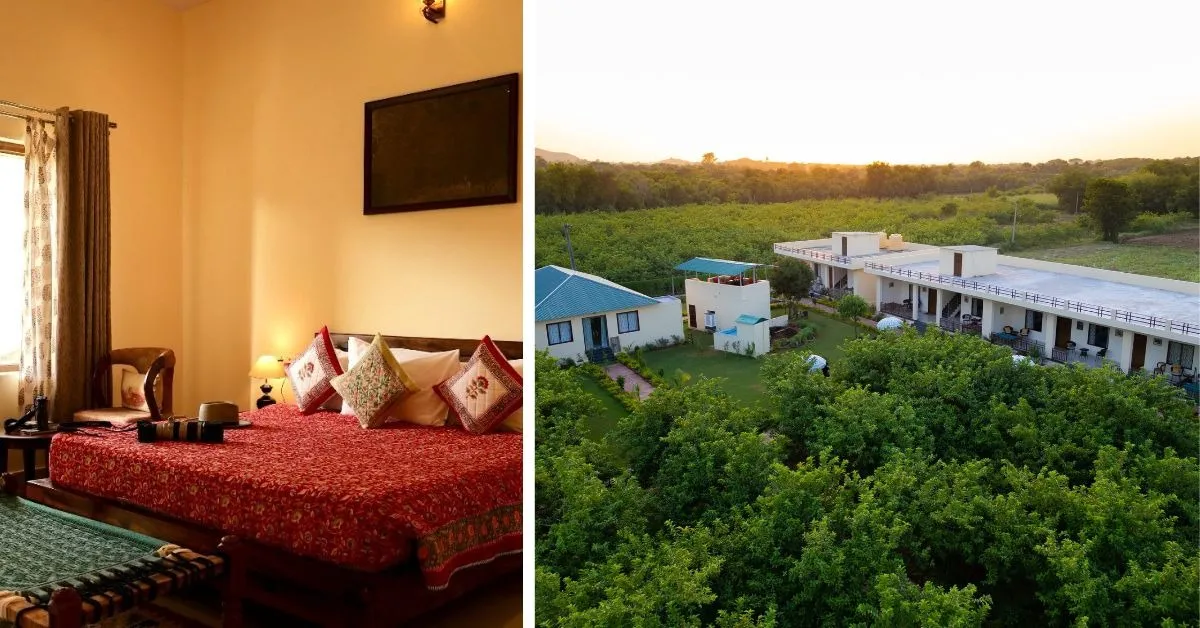
Guava, lemon and custard apple trees decorate the landscape, while frequent visitors — jungle cats, mongooses, foxes and honey badgers — stop by. The proximity of the homestay to the national park (a ten-foot-wide road separates the two) means there is always the chance of sighting a leopard, sloth bear and more.
Book your stay here.
2. Jamtara Wilderness Camp, Pench National Park, Madhya Pradesh
The air around the Jamtara Wilderness Camp in Pench National Park is thick with a rich history of conservation, centred around the tiger.
Back in the 1960s, Kailash Sankhala blew the whistle on the declining numbers of tigers. This was followed by India’s first tiger census, which found the animal’s population to be 1,827. Kailash was chosen by then prime minister Indira Gandhi to head the Project Tiger initiative in 1973.
The stay is in the form of tents that dismantle at the beginning of May every year and are rebuilt by late September, allowing the jungle to take over in the months in between. Walks around the property are like flipping open the pages of a nature guide, where every page dictates a new story.
/filters:format(webp)/english-betterindia/media/media_files/2025/12/03/wildlife-homestays-2025-12-03-18-15-07.jpg)
Today, the eco-stay isn’t the only thing that is born out of the Sankhala family’s conservation endeavours. The family’s initiative, Tiger Trust, is a not-for-profit organisation started by Kailash in 1989, hinged on a community model that makes the locals a part of conservation.
Book your stay here.
3. Sarai at Toria, Panna Tiger Reserve, Madhya Pradesh
The eco-stay is the blend of ideas of two conservationists, Dr Raghu Chundawat and Joanna Van Gruisen, who undertook a 10-year study focused on tigers in the Panna Tiger Reserve. They were keen to explore a community-driven model of conservation.
The eco-stay is a humdinger of a spot, cocooned by forests that are a birdwatcher’s paradise, filled with safari opportunities and chances of spotting the species the Panna Tiger Reserve is famous for — tiger, leopard, nilgai(antelope species), chinkara(Indian gazelle), chousingha(four-horned antelope), chital(spotted deer), and porcupines.
/filters:format(webp)/english-betterindia/media/media_files/2025/12/03/wildlife-homestays-2-2025-12-03-18-40-52.jpg)
The couple’s knowledge of the wild lends a rooted, local flavour to the property, making sustainability stand out throughout the landscape, right from the cottages that are built in a traditional, village-style mud aesthetic to sourcing organic produce.
Book your stay here.
4. Kipling Camp, Kanha National Park, Madhya Pradesh
Nature and the wild are in a choreographed sync at Kipling Camp in Madhya Pradesh, a labour of love of conservationist mother-daughter duo Anne and Belinda Wright. The stay dates back to 1982 and is a medley of grassy meadows and sal trees dominating the landscape.
/filters:format(webp)/english-betterindia/media/media_files/2025/12/03/wildlife-homestays-2025-12-03-20-26-33.jpg)
The view is panoramic, flanked by forest, with the cottages nestled right in the middle of it. Take advantage of the proximity to Kanha National Park to spot the tigers, barasingha(swamp deer), wild boars, chital(spotted deer) and sambar deer.
Book your stay here.
5. Svanir Wilderness Ecostay, Chandaka Elephant Sanctuary, Bhubaneshwar
What if the keepsakes you took back home weren’t just pictures but memories of the wild?
The Svanir Wilderness Ecostay, a passion project by the couple Soumya and Indrani Mukherji, ensures that nature is entwined into every aspect of your stay. Soumya explains, “We have used only locally available material and mimicked traditional tribal architecture to provide our guests with an ideal getaway. All our cottages have their own sit-out veranda with large windows.”
/filters:format(webp)/english-betterindia/media/media_files/2025/12/03/wildlife-homestays-1-2025-12-03-20-31-10.jpg)
You can stroll through the property filled with 3,500 trees or visit the Chandaka Elephant Sanctuary nearby, where you will get a glimpse of elephants, chital(spotted deer), barking deer, mouse deer, langurs, rhesus monkey, Indian mongoose, pangolin, Indian wolf and hyena.
Book your stay here.
Sources
‘India’s Tiger Census’, Published by National Tiger Conservation Authority.
Disclaimer : This story is auto aggregated by a computer programme and has not been created or edited by DOWNTHENEWS. Publisher: thebetterindia.com