Standing pitchside at a muddy Lancastrian playing field is a football fan excitedly applying the finishing touches to an enormous, time-worn scrapbook.
The notes he is making mark the culmination of a five-decade-long odyssey.
When a 17-year-old Tony Incenzo visited the last of the 92 grounds in the Football League in 1981, he became the youngest person to complete a sporting pilgrimage that hardcore fans across the country can take a lifetime to accomplish.
But rather than stopping there and choosing just to follow his beloved Queens Park Rangers, Tony set himself a new goal – to visit every single ground in the English non-league system, spanning hundreds upon hundreds of clubs in every corner of the country.
And when Fulwood Amateurs kicked off at home against Thornton Cleveleys in the North West Counties First Division North on Easter Monday, 54 years after his first non-league match, Tony’s epic quest was complete.
Stamps and signatures from every home club Tony has visited line the pages of his precious scrapbook, a behemoth record of the ultimate football groundhopping adventure.
Fulwood’s entry now sits on its own fresh page, his teenage dream finally realised.
“It’s just overwhelming emotion”, Tony says, following a guard of honour given to him by both sets of players.
“To finally do it, on a glorious sunny day, with a lovely green pitch, is a great relief.”
To play this video you need to enable JavaScript in your browser.
This video can not be played
The non-league system comprises steps five to 10 of English football and all leagues bar the top division – the National League – are regional.
The system has undergone multiple revamps since Tony began his adventure but is now made up of 996 clubs spread across 48 divisions.
Some of those clubs are fully professional and draw home crowds of thousands, but many are amateurs playing in municipal parks with no stands and crowds made up mostly of family members and passing dog walkers.
Adding in clubs who have since dropped out of the system, or dissolved entirely, Tony has watched football at over 2,000 non-league grounds.
“I get as much enjoyment from going to humble non-league clubs as I do big showpiece games,” Tony, now 62, says.
“You can turn up at a non-league game 10 minutes before kick-off, park outside, pay your admission, stroll around the ground, stand wherever you want, buy food and drink – and probably have change from about £15.
“I’ve been to places that I would never ever visit if it wasn’t for football – lovely little villages in Devon, remote seaside spots up in the North East and so on.
“It’s just great fun to travel all around the country and meet the people – people are what make a football trip special.”
It is not just non-league football that Tony has a passion for – he has also watched matches at all 92 stadiums in the top five tiers of English football, at all 42 in Scotland’s four professional divisions and at many others across Europe and around the world.
And, if that wasn’t enough, he has managed all this while not missing a single minute of any QPR home game – including friendlies and testimonials – since 1973, planning his non-league adventures to fit around his dedication to his first love.
Tony’s current total stadium count is 2,689, spread across 5,804 matches.
In time spent watching football – not including stoppage time or extra time – that works out at 522,360 minutes. Or 8,706 hours. Or 363 days.
“It’s my way of life – my whole life,” Tony says. “I simply have to be at a match every Saturday.”
And it’s often not just one match – if the fixture schedule is kind and he plans his travel smartly, Tony might fit in five games across the course of a weekend.
This requires a meticulous approach to planning, trying to group together grounds in a similar area of the country with different kick-off times weeks or months in advance.
And then there are weather disruptions, the bane of non-league football.
“When it’s really bad weather, I’m ringing around trying to see who’s definitely playing, scouting around to see which non-league clubs play on an artificial pitch,” he says.
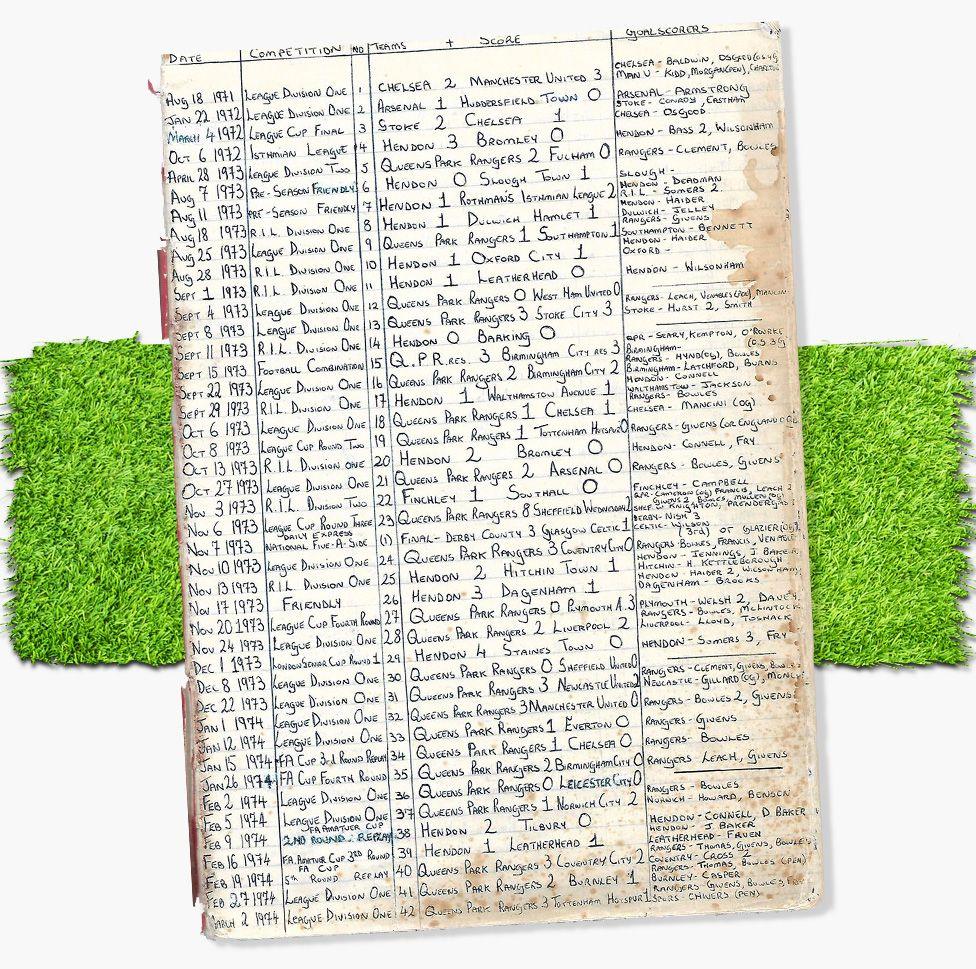
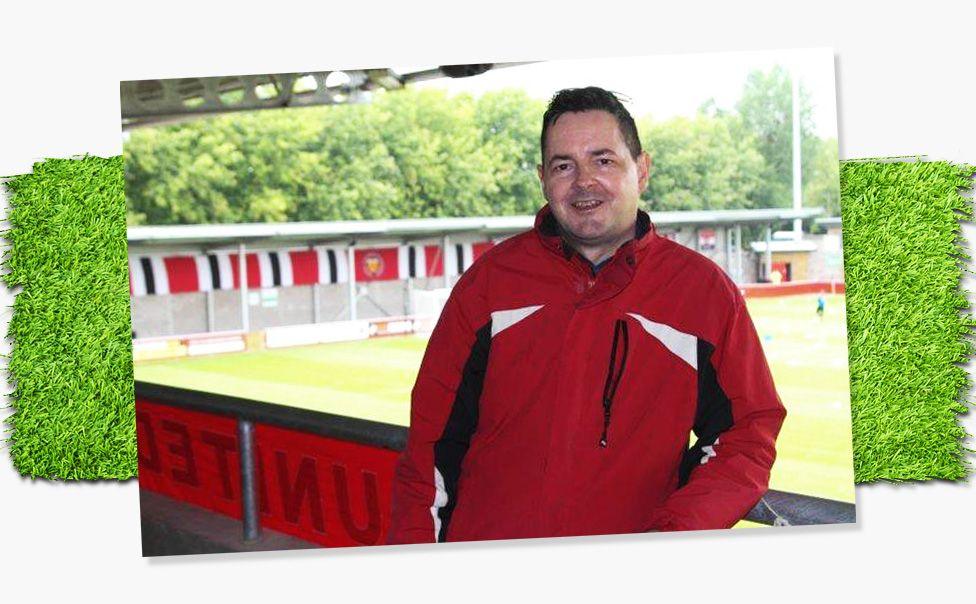
Tony arrives two hours before kick-off to buy a programme before they sell out, chats to fans and volunteers then notes down the line-ups and goalscorers for his scrapbook.
 BBC Sport
Non-league clubs are largely dependent on volunteers. Without local people giving up their time for free, clubs across the country wouldn’t be able to organise fixtures and maintain their grounds.
In some cases volunteers may even deal with messy emergencies, as Tony witnessed first-hand a few weeks ago when he made the 500-mile round trip to Sunderland West End in the Northern League Division Two.
“I arrived two hours before kick-off and the match was in jeopardy because the toilets were overflowing,” he says.
“They had four manhole covers open and all this sewage was bubbling up and it was quite disgusting.
“One of the club volunteers bravely climbed eight feet down under the ground to try to sort it out.
“It turned out one of the officials with the away team, Jarrow, was a plumber so he was roped in to help too. They sorted it out and the match went ahead.”
 BBC Sport
Tony appeared on an episode of BBC children’s classic show Swap Shop in 1981, when presenter John Craven and a camera crew followed him in the final weeks of his mission to complete the 92 Football League stadiums.
When cameras took over a young Tony’s home, his bedroom walls were covered from floor to ceiling with football posters, banners, flags and magazines.
That collection has grown in the subsequent decades into a treasure trove of neatly stacked programmes, tickets, scarves, signed photographs and ornaments spanning multiple rooms in his house in Stevenage.
“I love programmes, because they immediately spark memories of the day,” Tony explains.
“All the way through back to the 1970s, I can visualise every game and every ground I’ve been to by looking at the programme covers.”
Tony travels solo on many of his football trips but on one wall of a spare bedroom is an enormous map of the British Isles, filled with multicoloured stickers documenting the matches he has attended alongside his wife and seven-year-old daughter, who accompany him on some of his trips.
The result and scorers from every match he has attended are all documented, including his very first non-league game, local club Hendon’s 3-0 victory over Bromley in 1972.
But the scrapbook may never be complete as for Tony, the goalposts keep moving.
When new teams are promoted to the non-league system this summer, Tony will have to make the journey to their grounds too so that he maintains his record.
And when bigger clubs move to new stadiums, as Everton did with the Hill Dickinson Stadium at the beginning of this season, Tony has to go back for a fresh visit to top up his 92 total.
 BBC Sport
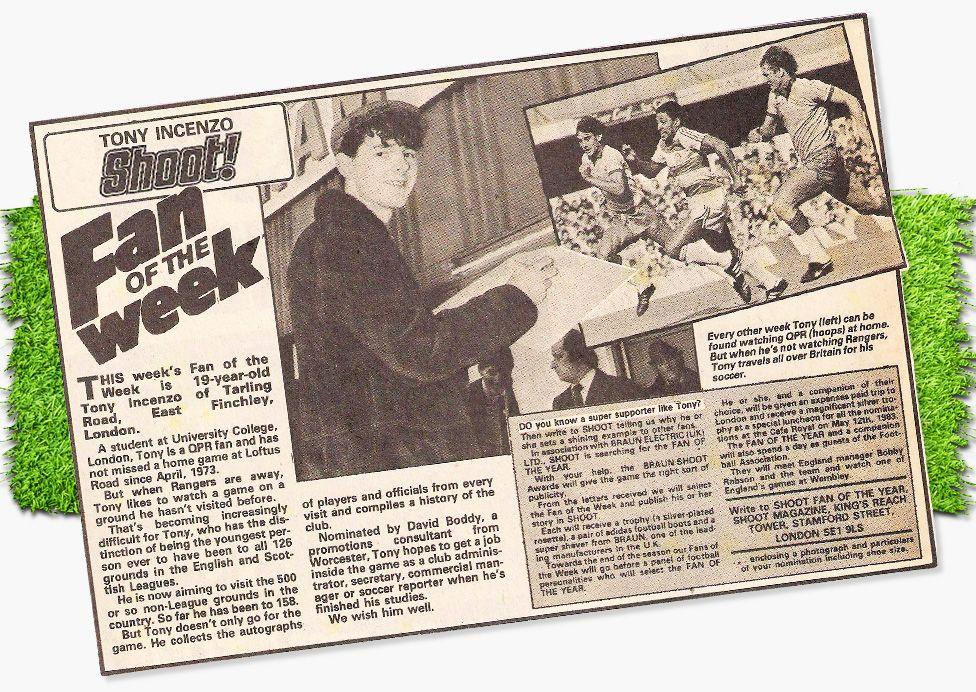
Before his mum took him to his first match at the age of eight, Tony had only ever watched football on the small television in the living room of the family’s council flat in East Finchley.
A huge fan of George Best, Tony’s mum took him to Stamford Bridge to watch Manchester United play Chelsea in 1971.
Tony was so short he could hardly see the game once it kicked off and he missed his mum’s beloved Best being sent off in the first half.
But the swell of the huge crowd, the vibrancy of the lush green turf and the sweet scent of onions frying in the food vans approaching the turnstiles had all made a huge impression on a wide-eyed schoolboy.
Tony had caught the football bug.
Ten years later, he was on TV talking about becoming the youngest person to watch matches at all 92 English league clubs, the holy grail of groundhopping for thousands of football fans across the country and the subject of a plethora of successful books.
After appearing on Swap Shop, he received a signed photograph from presenter Craven, who wrote: “Best wishes on your future travels, Tony. We’ll film you again when you’ve done all the non-league clubs.”
Neither thought it might take another 45 years. Nor did they expect to ever cross paths again.
To play this video you need to enable JavaScript in your browser.
This video can not be played
Tony, who built a career as a radio sports reporter and is now a press officer for QPR, has been so determined to complete the challenge that he went part-time at work this season to be able finally finish his adventure.
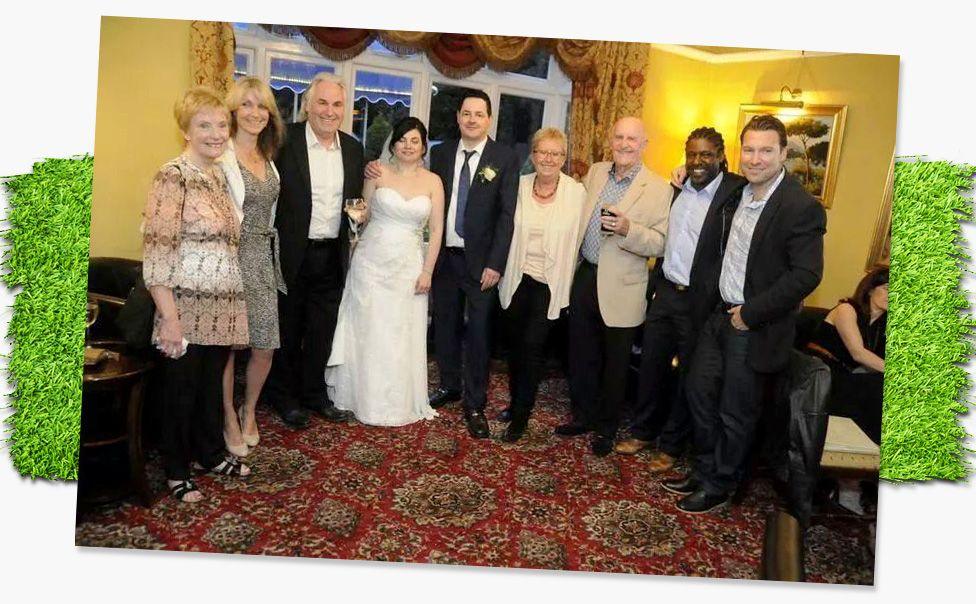
He has also had to manage his personal life around his football trips, including marrying his wife in summer to avoid missing matches.
In 2023, he was presented with a trophy to mark his achievement of attending every one of QPR’s home matches for the past 50 years.
“I actually almost missed my daughter being born”, he says. “My wife went into hospital six days beforehand so I slept on a chair in the hospital for five nights and all the time I’m thinking, ‘QPR are at home in a few days’.
“In the end, my wife had the baby, then I ran out of the hospital into my car and made it to Loftus Road just in time.”
Tony’s love of watching football at all levels means he has attended games in some unusual circumstances, including way below even non-league.
“I got a special invitation to go inside Feltham Prison in 2011 to watch a match as the only spectator,” he says.
“The prison team was in a league alongside companies with shift workers and obviously couldn’t play away games!
“I had to get there an hour before kick-off, had my phone taken off me, got searched and then three prison guards took me and the away team through to a nice little ground in the prison with proper dugouts.
“It was just after the London riots so the prison team was full of good young players and they won the match.”
There was no programme or ticket to show for the trip and no half-time brew but the exit was memorable.
“On the way out, some of the prisoners came out of their cells and started lambasting the away side for losing the game,” Tony says.
“One of their guys replied ‘lost the match but at least we’re going home, lads’ and we were then rushed out of there very, very quickly.”
 BBC Sport
Completing his non-league club visits, Tony made the trip to Fulwood, based in Preston, flanked by writers from Germany and Spain, keen to tell his story to an international audience.
Among those who were first to congratulate him on his feat, 45 years after their first meeting, was John Craven.
The pair linked up on a video call arranged by the BBC, reminiscing about the Swap Shop appearance and catching up on the years since.
“Who would ever have believed that?” Craven said. “It seemed impossible!”
Agreeing that he too had considered his voyage a “pipe dream” back then, Tony is satisfied that the time has been well spent.
“Looking back, I would just tell 17-year-old Tony to enjoy it, keep his records up to date and don’t miss out on other things in life too,” he says. “It’s all been well worth it.”
And just because his non-league adventure is complete, that doesn’t mean there aren’t new goals to be set.
“I would love to go to a football match in every country in Europe next, and maybe get to America for the World Cup and see a few stadiums there” he says.
“I just never want the adventure to stop.”
That scrapbook shouldn’t be put away on a shelf to gather dust just yet, then.
Disclaimer : This story is auto aggregated by a computer programme and has not been created or edited by DOWNTHENEWS. Publisher: BBC