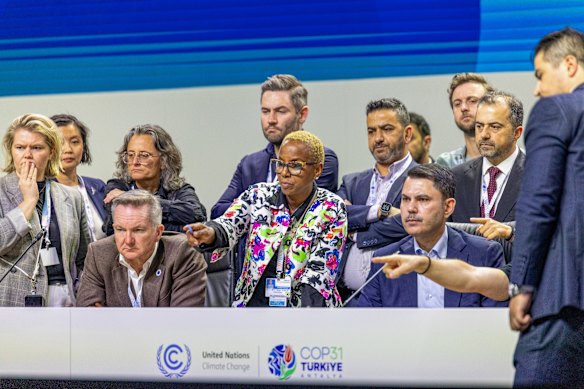

Global climate talks led by Australia in Turkey which began on Monday must focus on rebuilding trust and implementing existing agreements as the impacts of warming hit the world fast and harder, key leaders have said in opening statements.
Australian Climate Change Minister Chris Bowen, who will serve as president of the negotiations at the United Nations’ COP talks, said every delay costs the world more in its human and economic toll.
“Whether it be glacial collapse in Nepal, heat deaths in Europe, or an intensifying El Nino, climate change is here,” he said. “It is not a forecast, it is not a prediction, it is the lived reality for billions of people. Its impacts are growing more frequent and intense.”
He called for the world to rapidly increase electricity from a fifth to a third of global energy consumption, and said the final statement to be agreed to at the talks should be “a focused, practical and concrete response to the challenges and opportunities before us” that reflected the urgency of the threat.
The UN’s chief climate official, Simon Stiell, also focused on the urgency, but acknowledged the frustration that populations around the world are feeling as climate targets are broken.
“The urgency of this moment must drive us forward. Global heating is already costing the Earth. Appalling tragedy has hit the Himalayas, adding to the ever-expanding catalogue hitting communities across every region,” he said.
“A monster El Nino is piling fuel on the climate fire that’s already burning through communities and economies everywhere.”
Turkey’s climate minister, the COP host Murat Kurum, also touched on broken trust in the process, saying the meeting should be focused on outcomes rather rhetoric.
“Let dialogue grow as divisions deepen, restore trust where it is under strain, put resources to work as needs grow,” he said.
As COP president and host, Kurum will be responsible for leading the summit’s so-called Action Agenda, at which governments and civil society groups will be urged to sign up to voluntary pledges to take various actions to tackle climate change.
Bowen, as the COP’s president of negotiations, will be responsible for running the formal talks, at which any final agreement will require the consensus of representatives of the 194-odd signatories that are party to the Paris treaty.
Historically, this process has been slowed by the need for consensus among those nations on the frontlines of climate change, such as small island nations, and those that depend on fossil fuel exports, such as Saudi Arabia, Russia and Australia.
Bowen and Kurum want the electrification push to appear in both the action agenda and the formal negotiations. Reaching the target of 35 per cent electrification by 2035 set by the two would necessitate driving down fossil fuel use, but sidestep the sort of diplomatic fights over fossil fuel targets that have threatened to derail previous COPS.
“I think it is a very smart move,” said Nicki Hutley, an economist who serves as a member of the Climate Council, speaking for the talks in Antalya, Turkey, noting that at last year’s talks in Brazil, Saudi Arabia made a series of “unhelpful” interventions towards the end of the talks.
Similarly, talks in 2023 were bogged down due to resistance from Saudi Arabia to language calling for fossil fuels to be phased out or phased down.
It is expected that between 80 and 90 world leaders will attend the leaders’ summit this week ahead of formal negotiations which being next Monday, including Australian Prime Minister Anthony Albanese.
Among those not attending the summit are leaders of the world’s three largest greenhouse pollution emitters: the United States, which has abandoned the Paris Agreement, as well as China and India. China has so far suggested it supports the goal to rapidly accelerate electrification; India has not, with its environment ministry issuing a statement saying that voluntary initiatives under the action agenda should remain separate from negotiations, and that uniform climate targets must “respect national circumstances”.
In September the United Nations Environment Program acknowledged that the more ambitious goal of the Paris Agreement, to stabilise the climate at 1.5 degrees warming, had been broken, and that the world was at present on track for warming of about 2.6 degrees, down from 4 degrees when the Paris Agreement was signed.
It said it was still possible for the world to overshoot by less than that amount, and to bring warming down beneath 1.5 degrees later this century with rapid global action.
China’s carbon emissions dropped by 3.1 per cent in the third quarter of 2026 as the Hormuz crisis kept fuel prices high, cutting demand, according to an analysis by Lauri Myllyvirta, lead analyst at the Centre for Research on Energy and Clean Air, for Carbon Brief. This is the fastest fall in China’s emissions since COVID-19 and follows an extended plateau in emissions from China due to its rapid uptake of renewables.
Get to the heart of what’s happening with climate change and the environment. Sign up for our fortnightly Environment newsletter.
 Nick O’Malley is National Environment and Climate Editor for The Sydney Morning Herald and The Age. He is also a senior writer and a former US correspondent.Connect via email.
From our partners
Disclaimer : This story is auto aggregated by a computer programme and has not been created or edited by DOWNTHENEWS. Publisher: www.smh.com.au