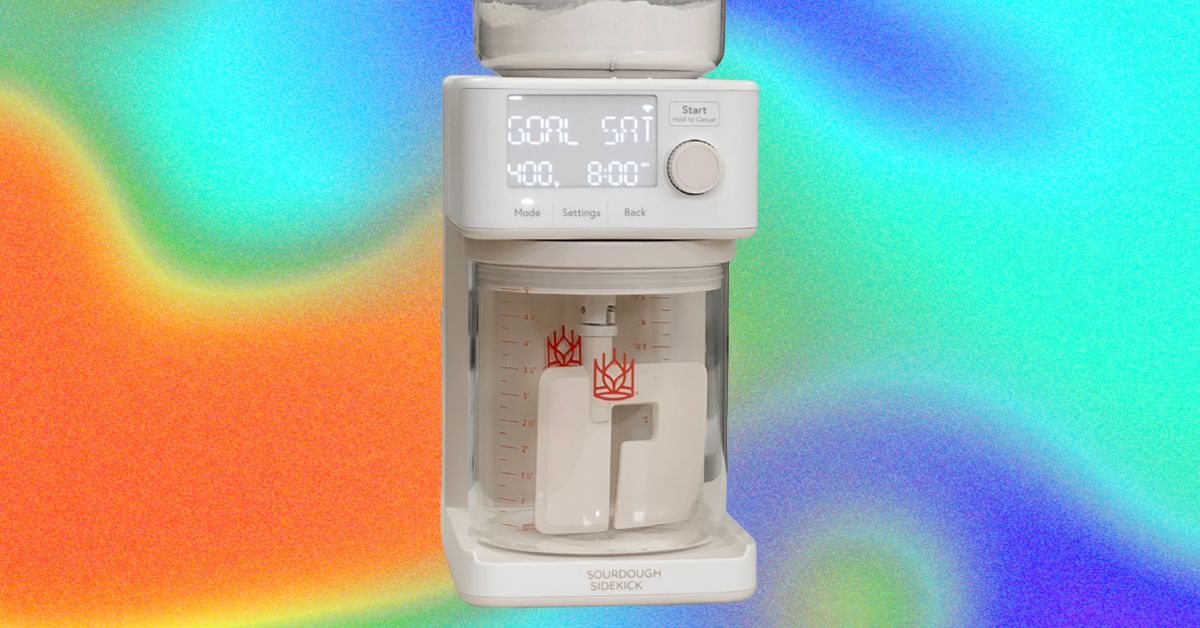
Instead, I followed the directions in the included Quick Start Guide booklet, which indicated that I simply needed to fill the water reservoir and flour hopper, set the current day and time (and the day and time I wanted the starter to be ready—you can choose up to seven days ahead; I chose seven), add a little bit of existing starter, and press “Auto Mode.” Almost immediately, a torrent of flour released from the hopper and began mixing into my seed starter with the stirring paddle. (King Arthur recommends keeping a portion of your starter in the fridge in case things go wrong, and I second this suggestion.)
Oddly, no water was dispensed in this process, so post-mixing, my starter was now in the form of an under-hydrated ball. Over the next few days, it became a larger, drier ball until I finally decided to remove the crock to add a couple of tablespoons of water; as I did, I noticed the reservoir was still at its maximum fill line.
I decided I should probably download the app, where I noticed the Sidekick indicated it needed a firmware update. After the update, the Sidekick began dispensing water during mixing, but I realized I really should have followed the instructions in the main instruction booklet, which calls for using a scale to properly calibrate the amounts of water and flour the machine dispenses.
Theoretically, you should only have to do this once, which is good because it’s an irritatingly lengthy and fiddly process. However, my next attempt (remember when I mentioned saving some starter in the fridge?) went much better, properly dispensing 30 grams each of water and flour each day and initiating a stirring cycle every two hours. It starts with a loud beep, then the paddle begins a loud mechanical whir, and for the first few days this can be quite startling, especially if you’re in the same room when it happens.
You can bypass the every-two-hours stirring cycle via the onboard controls, but since the stirring’s purpose is to knock down the starter’s volume and reincorporate any unconsumed flour, I kept it on. (For what it’s worth, I did think the paddle, an update from the Sidekick’s first design, did a pretty good job of incorporating all of the flour and water each time it mixed.)
Note that, in part due to the regular mixing and the lack of discard (Auto Mode will prompt you to discard after a week, while Ratio and Custom modes, detailed below, will have discard reminders), your finished starter in the Sidekick may not look as traditionally puffy or bubbly as you may be used to. You can disable stirring, or you can go on scent—it should smell tangy and indisputably fermented. As the many online Sidekick adherents often say, “Trust the process.” Some online users recommended adding a few teaspoons of more nutritionally dense rye flour to the (presumably all-purpose) flour in the hopper, which is supposed to supercharge the starter’s growth, but I admit I didn’t notice much of a difference in appearance, smell, or performance between an all-purpose starter and a rye-boosted starter.
Disclaimer : This story is auto aggregated by a computer programme and has not been created or edited by DOWNTHENEWS. Publisher: wired.com