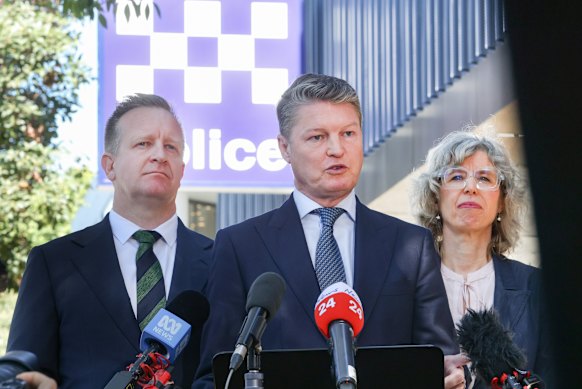
Victorians will be able to check their partner’s domestic abuse history, “pervert glasses” will be banned from swimming pools and predators kicked from dating apps under a Labor election promise to protect women and children.
The government will also, if re-elected on November 28, stop perpetrators becoming next of kin to their victims, and deliver a $31.5 million funding boost to the family violence sector to increase resources and the number of frontline workers.
Family violence groups and experts welcomed the promised funding boost, but say questions remain over how the government can practically implement the disclosure scheme and dating app ban.
Premier Ben Carroll will on Tuesday announce the Labor promise to establish “Clare’s Law”, a disclosure scheme allowing people to ask police whether their partner has a history of domestic violence abuse. The pledge matches a commitment by the Liberal Party in July to adopt the policy.
Under Labor’s election pledge, people could ask police on behalf of a friend or family member who they believe is in a dangerous relationship, and police can proactively tell someone if they deem their safety is at risk.
“Clare’s Law” is named after Clare Wood, who was murdered by her ex-partner in the UK in 2009. The law currently exists in South Australia.
“You deserve to know if your partner has a secret violent past,” Carroll said on Monday.
South Australian police can share with a person their partner’s prior convictions, police reports, charges, arrests and intervention orders and breaches.
“Clare’s Law” is among a suite of family violence election promises from Labor, which came to power in 2014 off the back of Daniel Andrews’ pledge to call a royal commission into family violence. But the issue has remained a problem throughout Labor’s 12 years in government.
Labor also plans to introduce a ban on AI smart glasses, which allow users to record video from their point-of-view, at public pools, change rooms, community sport venues, hospitals, aged care homes and family violence services.
Smart glasses have legitimate uses, but have been dubbed “pervert glasses” due to their potential to covertly film people inappropriately. The devices entered the mainstream discussion about online safety when Kmart began selling them for $89, and they quickly sold out.
Labor has already announced a ban on smart glasses in schools, kindergartens and childcare centres, but the expanded crackdown would make Victoria’s laws the strongest in Australia.
“Tech has changed, so must our laws,” Carroll said. “Creeps shouldn’t be able to secretly film kids at Saturday sport.”
Labor also promises to make it a criminal offence for convicted domestic abusers or sex offenders to use dating apps, in an attempt to stop the platforms becoming hunting grounds.
Coroners would also be given powers to stop abusers remaining as next of kin to their victims, by appointing an alternative in cases involving domestic violence or estrangement.
Carroll is also promising a $15.5 million boost to domestic violence support group Orange Door for more staff and resources, which will assist 10,000 more victim-survivors, and $16 million to be invested into a new fund to provide grants to early intervention programs aimed at reducing violence.
Monash University Professor Kate Fitz-Gibbon, a national family violence research expert, said the commitment to greater funding for frontline services was encouraging, but it was “a pity it takes a forthcoming election to receive this”.
“The sector has been calling for greater investment for years, with services struggling to meet demand and too many victim-survivors unable to access the support they need when they seek safety,” she said.
Fitz-Gibbon said the community had been aware for a long time that demand for family violence services exceeded capacity, and “what matters now is whether these election promises translate into sustained investment and meaningful improvements in the safety of women and children, regardless of the election outcome”.
The appeal of “Clare’s Law” was understandable, but its effectiveness was unproven, Fitz-Gibbon said.
“Our research has found limited evidence that domestic violence disclosure schemes actually prevent violence or improve safety outcomes,” she said. “We need to be careful that governments don’t prioritise reforms that are politically appealing over those that have a stronger evidence base for improving women’s safety.
“Victim-survivors deserve more than policies that sound good in an election campaign. They deserve sustained investment and evidence-based reforms that will make a meaningful difference to their safety.”
Phillip Ripper, the chief executive of men’s behaviour change and safety agency No To Violence, congratulated Labor “on hearing the call to intervene earlier to end family violence”.
“Sadly, the $4 million per year over the term of the next government is a drop in the ocean compared to the billions of dollars spent every year on police and courts responding to violence after the damage is done,” he said.
“Victim-survivors do need police to respond in a crisis, but they want action earlier. They want to be safe at home and they want the interventions to end men’s violences before it escalates.”
Ripper called on the opposition to strengthen its commitment to community safety and “recognise that the most dangerous place in Victoria for women and children is their own home”.
Dr Joumanah El-Matrah, the chief executive of the state’s peak family violence body, Safe and Equal, welcomed the funding commitment for support services and early intervention as recognition of the importance of access to services before violence escalates.
The $15.5 million investment promise to fund support workers and Orange Door was “a vital boost that will extend access and support to an additional 10,000 clients”, she said.
El-Matrah didn’t comment on Labor’s support for the disclosure law, but said restricting smart glasses and the use of dating platforms by people convicted of family or sexual violence sent an “important signal” for people’s safety must be considered.
Start the day with a summary of the day’s most important and interesting stories, analysis and insights. Sign up for our Morning Edition newsletter.
 Angus Delaney is a state political reporter at The Age. Email him at angus.delaney@theage.com.au or contact him securely on Signal at angusdelaney.31Connect via email.
 Wendy Tuohy is a senior writer focusing on social issues and those impacting women and girls.Connect via X or email.
From our partners
Disclaimer : This story is auto aggregated by a computer programme and has not been created or edited by DOWNTHENEWS. Publisher: www.smh.com.au