
TEHRAN – Mount Damavand, Iran’s highest peak and a prominent volcanic landmark in the Alborz Mountains, has been included in the International Union of Geological Sciences’ (IUGS) list of the world’s 100 top geological heritage sites.
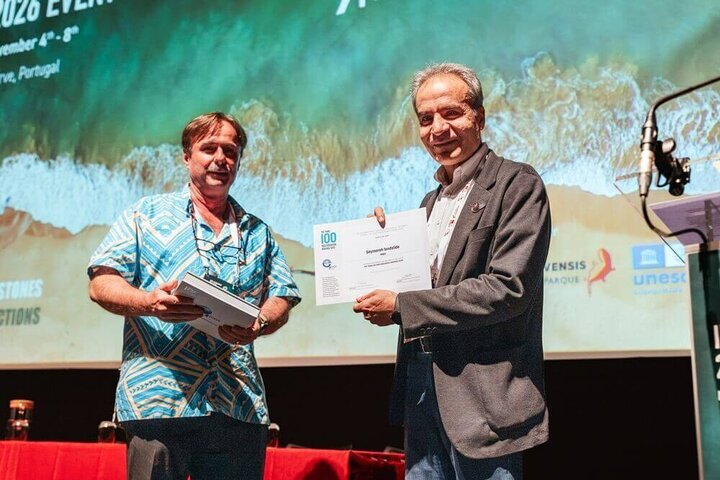
The designation was announced on Friday, November 6, 2026, during an IUGS Geological Heritage event in Loulé, in Portugal’s Algarve region, hosted by the Algarvensis UNESCO Global Geopark.
Alireza Amrikazemi, head of Iran’s UNESCO Global Geoparks Network and vice-chairman of the National Committee for Earth Sciences and Geoparks under the Iranian National Commission for UNESCO, told ISNA news agency that the nomination was prepared jointly by him and Jamshid Hassanzadeh of Glendale College in California.
The dossier was submitted to the IUGS last year, followed by a period of providing supporting documentation and defending the nomination before the evaluation panel. Amrikazemi presented the case in Algarve on November 6, when Damavand was officially recognized as a selected global geological heritage site, ISNA reported on Sunday.
The mountain has been listed under volcanology as site No. 252.
Amrikazemi said Damavand holds exceptional scientific significance, describing it as the highest peak in West Asia, standing at 5,610 meters, and the largest known stratovolcano formed within a continental setting.
“Volcanic activity in tectonic environments such as the Alborz Mountains is usually short-lived and limited in scale. Damavand, however, has remained active in such an environment for approximately 1.8 million years, with its youngest eruptions dating back around 7,300 years,” he said.
The mountain’s distinctive geological characteristics have made it a rare subject of international scientific interest, he added.
Damavand spans approximately 25 kilometers in width and preserves a complete sequence of its eruptive history. Another unusual feature is its renewed activity following a dormant period of around 200,000 years, which resulted in the formation of a new volcanic cone slightly southwest of the older crater.
Remnants of the earlier volcano remain visible along the mountain’s eastern and northern slopes.
According to Amrikazemi, these characteristics make Damavand a natural laboratory for studying intraplate volcanism and volcanic hazards in active mountain ranges.
Beyond its geological importance, the mountain also holds a prominent place in Iranian cultural heritage.
Amrikazemi noted that Damavand features in several narratives of Ferdowsi’s Shahnameh, including the legendary imprisonment of Zahhak. The Shahnameh, Iran’s celebrated epic poem, is also included in UNESCO’s Memory of the World Register.
He said the IUGS’s official description of Damavand recognizes the connection between the mountain’s geological significance and its place in Iranian culture.
The IUGS Geological Heritage Sites program was launched in 2022. Its first 100 sites were announced that year in Zumaia, Spain, while the second group was unveiled in 2024 in Busan, South Korea.
More than 1,000 experts from 90 countries and 20 international organizations have participated in the identification, evaluation and selection of sites under the program.
The third group of 100 geological heritage sites spans 47 countries, with six sites located in the Middle East. Other selections in this round include Mount Fuji in Japan, the Norwegian fjords, the San Andreas Fault in the United States and Mount Aconcagua in Argentina.
The Grand Canyon, Mount Kilimanjaro and Mount Everest were among sites recognized in previous rounds.
Amrikazemi said the designation places Damavand alongside some of the world’s most significant geological landmarks, while emphasizing that international recognition alone would not guarantee its preservation.
“The value of this designation lies in drawing greater attention to the protection of the mountain and its educational use. Our responsibility to safeguard Damavand has now increased,” he said.
Mount Damavand, extinct volcanic peak of the Alborz Mountains in northern Iran, about 42 68 km northeast of Tehran. Estimates of its height range from about 5,610 meters to 5,670 meters; it dominates the surrounding ranges by 900 to 2,450 meters. Its steep snowcapped cone is formed of lava flows and ash and is crowned by a small crater with sulfuric deposits. Below the crater are two small glaciers; there are also fumaroles (holes for escaping fumes and gases), hot springs, and mineral deposits of travertine.
Damavand became volcanically active at least 1.8 million years ago, and its most-recent eruption was about 7,300 years ago. The mountain is mentioned in several Persian legends, one of which gives it as the resting place of Noah’s ark.
AM
Disclaimer : This story is auto aggregated by a computer programme and has not been created or edited by DOWNTHENEWS. Publisher: tehrantimes.com




