Childcare centres are becoming mega facilities to attract more enrolments, with developers passing the risk of their big builds onto families, research has found.
Melbourne’s rising land and construction costs increasingly determine childcare centres’ location and size, rather than where the need is highest, according to the report by national advocacy group The Front Project.
The increasing size of early learning centres was due to developers needing to reach a certain level of enrolments to get a return on investment.
“But bigger is not necessarily better when it comes to high-quality provision,” said The Front Project chief executive Dr Caroline Croser-Barlow.
“Developers are making perfectly legitimate considerations, but it has a direct impact on children.”
Researchers found the business model, akin to a food chain of lenders, developers and landlords, was designed to benefit investors. Each takes a cut along the way.
While not unique to the early childhood education industry, Croser-Barlow said the sector was unusual because families couldn’t easily switch services and governments tended to lift subsidies when fees started to hurt household budgets.
A Productivity Commission report released in June showed the Child Care Subsidy accounted for about $20 billion a year in government spending nationally.
“There is no downward pressure, and one of the things that has led to is oversupply in particular areas,” she said.
“It doesn’t sound like a problem, but problems arise later if it leads to dropping enrolments and cost-cutting because the sorts of costs that are cut are usually staffing costs and those are the most important in terms of quality.”
After wages, property is the second-largest cost in early childhood education and care, accounting for about 15 per cent of operational costs, the report found.
More than 200 childcare centres nationally have closed in the past year.
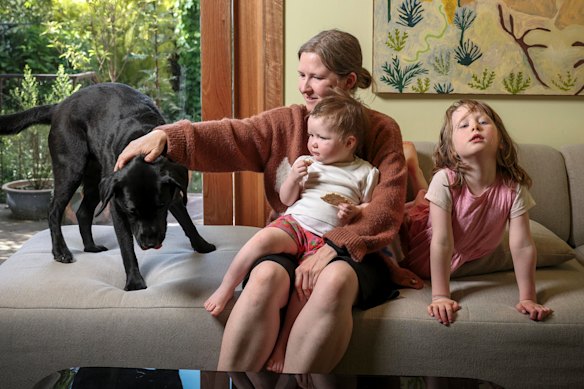
Reservoir mum Etta Curry says she had to find a new centre for her children when their small not-for-profit, Merrilands Uniting Early Learning, was pushed out of the market after four private centres opened nearby.
Curry said the “complete oversupply” of centres had created hundreds of extra childcare places in Reservoir’s north-west, despite Darebin City Council identifying only 123 were needed by 2041.
She said the extra places could mean existing centres would operate at reduced capacity, meaning lower margins and more staff sharing between sites.
“If we allow these not-for-profits to close, it will be even harder to unscramble the egg,” she said.
“A market system does not have children’s best interest at heart. I think the government should do all they can to fund these small not-for-profits from shutting down.”
Croser-Barlow said that while landlords were protected by contracts which required tenants to cover losses accrued by a terminated lease, childhood education providers bore a large share of the risk. And families also paid a price.
“[The model] is not optimised for supporting a continuity of service for families,” she said.
Researchers reviewed around 20,600 property transaction records dating back to the 1940s, and matched them against the national register of services.
They also spoke to 50 developers, landlords, fund managers, providers, regulators and advisers.
They found 68 per cent of investors were self-managed super funds, ‘mum-and-dad’ investors, and high-net-worth private investors.
Early Childhood Australia chief executive officer Samantha Page said the report provided more evidence for the benefits of moving away from a market-driven early learning sector.
“We have been concerned for several years now that new services are getting too big,” Page said.
“Particularly when operated by inexperienced providers who do not understand the impact of group size and learning environments on educators and their capacity to provide both active supervision of children and intentional teaching through play-based pedagogy.”
A communiqué released following a joint meeting of Australian education ministers last week agreed one of the functions of a proposed national Early Education and Care Commission would be to provide government with insights on “supply and demand, market shape and workforce development” in the early childhood education sector.
Minister for Early Childhood Education Jess Walsh said a key role of the commission would be helping to plan and coordinate the system across the country, including locating services where they were needed.
“We will consider the findings of The Front Project’s report alongside other evidence as we continue work towards a universal early education and care system,” she said.
Walsh also said the government’s Service Delivery Prices project would help them better understand the finances of delivering quality early learning, and their $1 billion Building Early Education fund was supporting new and expanded services in areas of need.
Croser-Barlow said the announcement was both pleasing and disappointing.
“It’s way more progress than we’ve had for a decade or so, but it still seems to be stuck in the slow lane when, for families, this is a really urgent issue,” she said.
 Nicole Precel is an education reporter at The Age. She was previously an audio video producer. She is also a documentary maker. Get in touch at nicole.precel@theage.com.au or securely at @nicoleprecel.57 on signalConnect via X, Facebook or email.
 Bridie Smith is an education reporter at The Age. A former desk editor, she has also reported on science and consumer affairs.Connect via X, Facebook or email.
From our partners
Disclaimer : This story is auto aggregated by a computer programme and has not been created or edited by DOWNTHENEWS. Publisher: www.smh.com.au