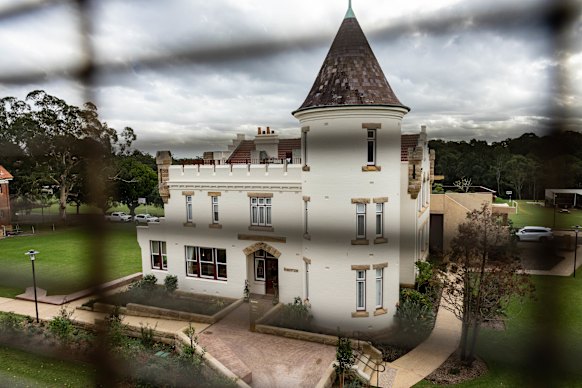

A private school that made teachers share beds with students should be barred from enrolling new students, forced to pay back staff and face investigation over allegations of misused government funding, a landmark parliamentary inquiry has found.
The NSW parliamentary committee has referred Redeemer Baptist School in North Parramatta to the police, the Australian Taxation Office, Services Australia and the Office of the Children’s Guardian for urgent investigation into allegations it covered up child sexual assault, and engaged in forced labour of staff, and tax and welfare fraud.
The 200-page report, after an inquiry triggered by a joint investigation by The Sydney Morning Herald and 60 Minutes, found the acclaimed private school places children at risk of significant harm and was not merely a strict religious school, but “something more insidious, an environment marked by control, surveillance, and rigid discipline”.
Former students who spoke to the committee described growing up in an atmosphere “dominated by fear, shame and the uncomfortable feeling of always being watched”.
The state’s school regulator, the NSW Educational Standards Authority (NESA), has been urged to freeze all new enrolments at the school, while it investigates what the report called severe child safeguard breaches, including students sharing beds with teachers while on mandatory school camps, and children being forced to eat food to the point of vomiting.
The report found the school exercised “invasive, extracurricular control” over private lives, punishing pupils for attending outside birthday parties or holding Facebook accounts. For church and homestay children, elders exerted “particularly intense” authority: searching rooms, confiscating devices, and sitting in on minors’ private psychology appointments.
One former student recalled a teacher screaming “at point-blank range” that attending an outsider classmate’s birthday party was “an un-Godly thing”.
The report condemned NESA and its predecessors, noting it “failed to identify critical risks that warranted further inspection and investigation, to the detriment of students and staff”.
The committee was critical of school leaders Russell Bailey and Jonathan Cannon for declining to appear at the inquiry, despite multiple invitations and a summons attempt. The school cited upcoming HSC exams for its lack of availability.
The Department of Communities and Justice was criticised alongside NESA. The committee found it was “unacceptable that both bodies seemingly ignored available and significant evidence while simultaneously acknowledging the very regulatory failure that has put students at risk”.
The committee described the school’s handling of sexual assault allegations as its most “egregious evidence”, finding it indefensible and potentially illegal that the school staff flouted mandatory reporting obligations and “effectively enabled alleged abusers to remain near children”.
It stated it was “alarmed” by practices that placed children into situations where they lived with teachers, noting it “erodes the professional boundaries essential to the teacher-student relationship”.
“Such practices create environments where children are exposed to serious risks of harm, while simultaneously dismantling the safeguards that allow them to recognise abuse or know where to turn when boundaries are crossed,” it said.
The report called for NESA and the Department of Education to review the school’s homestay arrangements for international and domestic students.
The committee expressed alarm that two decades of regulatory audit gaps allowed the school to potentially misuse government funding, and called for NESA to explicitly incorporate “an understanding of high-control environments and their impact on student welfare” in its report, and take further regulatory action by auditing its financial affairs.
The inquiry also examined the schools’ finances, after this masthead revealed the school has received $58 million in state and federal funding, accumulated a property portfolio worth up to $100 million, paid zero in wages, while channelling about $30 million out through unverified “service charges” to its affiliated church.
The report said it was “troubling that an asset-rich, seemingly prosperous school operates by withholding wages from its workforce, who claim benefits, while the school receives millions of dollars in public funding”.
The report also found staff at the school were unpaid and classed as volunteers, and lacked essential workplace rights, including protection from psychosocial hazards, clearly defined working hours and the right to refuse tasks.
The inquiry recommended Redeemer Baptist School repay its staff, including superannuation and other employee entitlements.
The committee found the school’s board of directors failed to satisfy basic governance standards, and lacked independent directors. It found no independent avenues for students, staff or parents to lodge grievances without fear of retribution.
It concluded that while the school and church maintained distinct corporate entities on paper, they were “inextricably linked in practice, sharing identical leadership, decision-making forums and organisational culture”.
The report analysed the school under the context of group-based coercive control, as defined by a recent Victorian inquiry into cults.
The inquiry examined the realities of student life, noting the school’s disciplinary practices centred on public humiliation and intimidation.
Boys and girls were forbidden from being friends “or even talking unless necessary”, and faced the possibility of suspension, expulsion, or public reprimand for mingling. Appearance was strictly policed; while historical inspections where staff “looked up the skirts of young girls” to check underwear colour have ceased, punishments for uniform breaches persist.
Students routinely changed in classrooms rather than private facilities; former student Michael Jones testified that female teachers entered while he was undressed on at least three occasions.
Start the day with a summary of the day’s most important and interesting stories, analysis and insights. Sign up for our Morning Edition newsletter.
 Emily Kowal is a Walkley award-winning education reporter for The Sydney Morning Herald.Connect via email.
From our partners
Disclaimer : This story is auto aggregated by a computer programme and has not been created or edited by DOWNTHENEWS. Publisher: www.smh.com.au