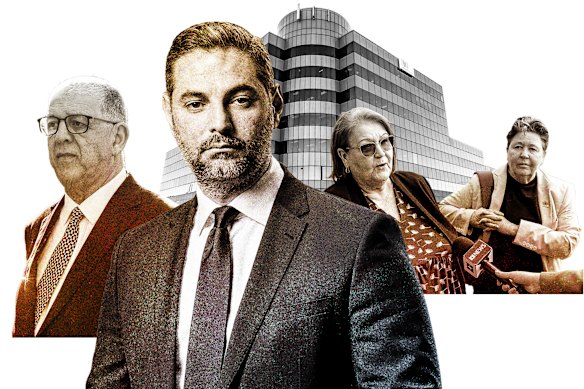

A long-running inquiry into allegations of maladministration and dysfunction at a Sydney council has found no evidence of widespread or systemic failures, despite NSW Local Government Minister Ron Hoenig describing the accusations as “the worst” he’d seen levelled at a council.
The NSW Office of Local Government’s public inquiry into Liverpool City Council, which cost taxpayers at least $4 million, examined councillors’ conduct as well as the council’s handling of finances, property purchases, and more than $150 million in state government grants for infrastructure.
In his 518-page final report, published on Tuesday, Commissioner Ross Glover said the council “was not entirely free from error, nor is it ever likely to be”, but only recommended minor changes.
“While I am satisfied that there [is] a range of areas in which improvement, and an ongoing commitment to improvement, are warranted, the evidence does not satisfy me that there have been widespread or systemic failures by the governing body or the council in the performance of their statutory functions,” Glover said.
“I am also satisfied that the members of the governing body have displayed an appropriate understanding of their statutory roles and functions.”
The findings are likely to heap pressure on the Minns government and Hoenig, who described allegations against the council, contained in a 2024 interim report which triggered the inquiry, as “the worst I’ve ever seen”.
He signalled his intent to suspend councillors and tried to postpone that year’s election until the inquiry was completed.
Opposition Local Government spokesman Chris Rath, who used parliamentary powers to compel the government to produce the final report, which Glover handed to Hoenig in September, on Tuesday said the minister “deliberately sat on the report when it didn’t recommend administration”.
“This is a massive blow to the Minns Labor government who have run a nasty campaign for three years to get the council sacked,” Rath said.
“[Hoenig] should offer an apology to the ratepayers of Liverpool.”
Hoenig and Liverpool City Council have been contacted for comment.
The 52-day hearing last year also scrutinised the council’s staff employment practices – including its revolving door of 10 acting or permanent chief executive officers in eight years – and tensions between Mayor Ned Mannoun and his long-time political rival, councillor Peter Ristevski.
Glover said in his report the “overwhelming weight” of evidence at the inquiry clearly indicated the relationship between Mannoun, a Liberal, and Ristevski, a former Liberal who recently joined the Family First party, was “fractured and at times hostile” but they were open to mediation – which he recommended should occur.
“Whether it will result in any meaningful and lasting change, however, is ultimately up to them.”
The commissioner noted the council’s fiery meetings – which were closely scrutinised in the inquiry – pointed to the “interpersonal divisions” between councillors, which often resulted in heated exchanges and strong disagreements. Glover noted there was “room for improvement” in the officials’ behaviour, but he did not make any adverse findings against any councillors regarding their meeting conduct.
“By and large, the governing body can consider and deal with most of its business appropriately … [but] all councillors have a role to play in setting the tone in which meetings are conducted.”
The commissioner also recommended the council implement a process to audio-visually record parts of council meetings held in closed session, and arrange training for councillors on conflicts of interest and respectful debate in meetings.
He noted the council had developed a new policy framework for the recruitment, oversight, and termination of the employment of its chief executive.
Glover said an “explosion” of complaints related to alleged councillor code of conduct breaches – of which there were 148 in 2024-25 – was “unprecedented”, but he did not make findings on any of those matters so as not to interfere with any internal investigations.
He stopped short of finding that the dynamic among councillors was impacting the organisation’s wider performance, but said: “There is a potential for those tensions to permeate and ultimately reach a level where they may affect the operation of the council for the remainder of its term, and potentially into the future, unless they are addressed.”
Glover recommended Hoenig consider issuing the organisation with a performance improvement order, and appointing one or more temporary advisers, to allow the council to resolve its governance, performance or financial problems before actions such as suspension.
Hoenig told a September budget estimates hearing the cost of the inquiry was $4 million to $4.5 million.
The report that sparked the inquiry was part of a broader investigation into the council’s recruitment and staffing processes, which the government said unearthed “matters sufficient in seriousness and volume” to warrant an urgent hearing.
The council launched action against Hoenig in the NSW Land and Environment Court in a bid for the election to go ahead as scheduled.
Judge John Robson found the interim report failed to observe the requirements of procedural fairness as it was published without giving named individuals an opportunity to respond. But he said the government had not unduly influenced the probe, clearing the path for the inquiry to go ahead.
Start the day with a summary of the day’s most important and interesting stories, analysis and insights. Sign up for our Morning Edition newsletter.
From our partners
Disclaimer : This story is auto aggregated by a computer programme and has not been created or edited by DOWNTHENEWS. Publisher: www.smh.com.au