
Global carbon emissions are projected to decrease by 0.4 per cent this year, a new report shows, as world leaders begin to arrive at climate talks in Turkey, where the Australian president of negotiations hopes to secure agreement to speed up the electrification of the world’s economy.
The fall in emissions, revealed by the Global Carbon Project, was reported alongside new data showing that August 2026 was the joint warmest month ever recorded, alongside July 2023.
“With a global average surface air temperature 1.65°C higher than the estimated pre-industrial baseline, this August was the first month to exceed 1.5°C since November 2025,” says an analysis published by Copernicus, the European Union’s Earth observation program. It said August marked the end of Western Europe’s warmest summer on record, surpassing the previous record set in 2003.
The fall in greenhouse gas emissions is linked to both the rapid deployment of renewable technologies and a fall in demand caused by oil prices shocks stemming from the closure of the Strait of Hormuz, which caused emissions from oil to fall 1.9 per cent. The Global Carbon Project, a collaboration of scientists tracking and analysing greenhouse pollution, found the dip in pollution it detected was not enough to signal a sustained declined.
It found that while global energy demand continues to rise, two-thirds of the increase is being met by new solar and wind power and electric vehicles.
“A decline in fossil CO2 emissions is encouraging, but a reduction driven partly by geopolitical shocks is not a sustainable climate solution,” said Professor Pierre Friedlingstein, director of the Global Carbon Budget Office at the University of Exeter, who led the study. “The long-term answer remains the rapid deployment of clean energy technologies. While renewables and electric vehicles are increasingly offsetting growth in energy demand, further acceleration is needed if global emissions are to peak and enter a sustained decline.”
The impact of compounding energy crises caused by wars in Iran and Ukraine has roiled global climate efforts, causing demand surges for both renewables and alternative fossil energy sources, and causing governments to focus on domestic price impacts rather over global climate pledges.
“This year’s fossil fuel cost chaos has delivered a global shockwave, hitting households hard and spreading inflation like a cancer,” said UN climate chief Simon Stiell in his opening speech to COP31 on Monday.
But the cost increases have also shifted the economic case in favour of electrification, said International Energy Agency executive director Fatih Birol, who has declared that the world is entering ‘the age of electrification.’
“When I first said that we got a lot of eyebrows raised,” he said in an interview with this masthead earlier this month. “But the market dynamics – leaving aside climate change – confirm it every day, every year, every month.”
China’s emissions over 2026 are projected to decrease by 0.9 per cent, following two years of low emissions growth. Alongside its falling oil use, China’s coal emissions rose by 0.3 per cent, but electricity generation from renewables continues to grow strongly.
While China produces 32 per cent of global fossil emissions, it is also the country most active in deploying clean technologies and increasing carbon sinks through reforestation, the report found.
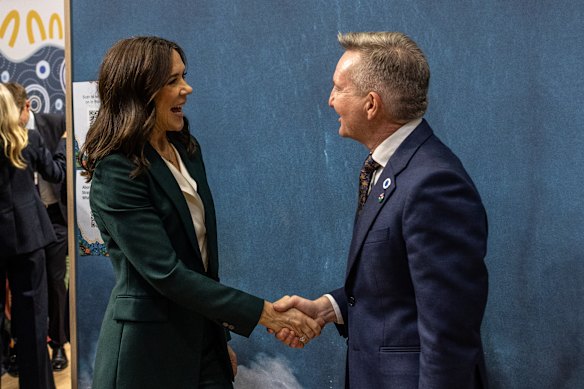
China has backed calls by the COP climate talk hosts, Turkey, and president of negotiations, Australian Climate Change and Energy Minister Chris Bowen, to seek global agreement to accelerate the electrification of the global economy. Turkey is responsible for voluntary agreements made at the United Nations climate conference, while Bowen is responsible for the formal negotiations, which demands consensus from all the 193 nations which are party to the Paris climate treaty, and the European Union.
Bowen has signalled he would like an agreement on electrification to be part of a final COP cover text, though India, the world’s third-largest greenhouse polluter, has declared opposition to the effort.
The talks begin in the face of global frustration at the failure of the COP process to either halt warming or implement many of the agreements signed at previous summits. Bowen and his Turkish counterpart, Environment Minister Murat Kurum, are seeking to manage expectations for this meeting by declaring it would focus on delivering on past commitments rather than pursuing sweeping new deals and pledges.
“It should be an implementation COP, because frankly speaking, we have too often fallen into the trap of trying to do many new things, rather than just deliver on what we already have,” EU climate chief Wopke Hoekstra told the European Parliament in a climate debate last month.
The effort to attract nations to sign on to plan to increase electrification to 35 per cent by 2035 – under the slogan “35 by 35” – is seen as a way to advance ambition to decarbonise the world without engaging in a dispute with oil exporting nations like Saudi Arabia.
Get to the heart of what’s happening with climate change and the environment. Sign up for our fortnightly Environment newsletter.
 Nick O’Malley is National Environment and Climate Editor for The Sydney Morning Herald and The Age. He is also a senior writer and a former US correspondent.Connect via email.
From our partners
Disclaimer : This story is auto aggregated by a computer programme and has not been created or edited by DOWNTHENEWS. Publisher: www.smh.com.au