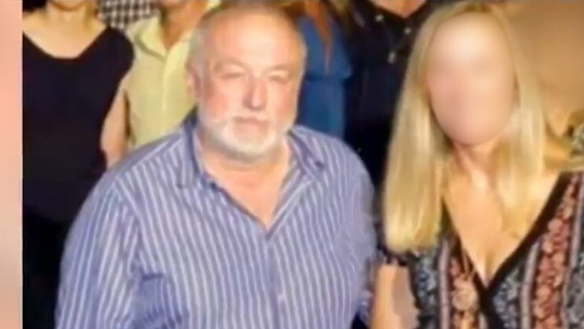

A large brain cyst and multiple strokes suffered by Mark Bombara were unlikely to have caused him to murder a Floreat mother and daughter, despite suspicions raised by his children, an inquest has been told.
Independent neurologist Professor Kevin O’Connor was one of six medical witnesses listed to give evidence at the WA Coroner’s Court on Tuesday, on the second day of the inquest into the deaths of Bombara and his victims, Jennifer Petelczyc, 59, and her daughter Gretl, 18.
Bombara, 63, fatally shot the women at their Floreat home on May 24, 2024, while searching for his estranged wife, Rowena, before killing himself.
The inquest heard Bombara suffered strokes in January and May 2024 and had a 100-millimetre cyst on his brain.
Some of his children, including his daughter who was a nurse, suspected the medical conditions had led to changes in their father’s behaviour, ultimately leading to the events of May 2024, the court heard.
But O’Connor told the inquest it was “highly unlikely” Bombara’s cyst had caused a change in behaviour, instead suggesting the growth had likely been there since birth.
“I do not think it contributed,” he told the inquest.
When asked if a stroke could have caused a change in Bombara’s behaviour, O’Connor told the inquest: “No I do not.” But he did accept it may have contributed to Bombara’s depression.
O’Connor told the inquest he did not have concerns about Bombara’s cognition prior to the murders, due to his “level of planning”.
“From his actions there was a lot of sequential planning … the note he left, the syntax, grammar,” he told the court.
“Going to his [Boyup Brook] farm for the firearm, changing vehicles, disabling location software. This was quite a level of planning over days, [thinking] in sequence.”
Earlier on Tuesday, the inquest heard from neurology registrar Dr Ravi Ambati, who treated Bombara during his admission to Sir Charles Gairdner Hospital in May 2024, weeks before the killings.
Ambati, who appeared via video link from Canada, told the inquest he was “surprised” to hear of the shootings.
“It seemed quite an ordinary presentation. I was surprised to hear he had done such a drastic thing,” Ambati said.
Bombara was discharged from hospital on May 7, 2024, despite an intern raising concerns about his mental health, the court heard.
Ambati told the court that unless someone was suicidal or had previous mental health history, it was hard to get a psychiatrist to assess someone experiencing low mood.
The court heard Bombara’s occupational therapist had not cleared him to be discharged either, but the team only found that out once he had been discharged.
“In hindsight, we would obviously want an occupational therapist to clear a patient before he goes home,” Ambati told the inquest.
But he told the court the final decision to discharge a patient rested with a consultant.
Ambati painted a dire picture of resourcing at Sir Charles Gairdner hospital, telling the inquest it was the “most busiest stroke team I have ever worked”.
He told the court weekend staffing was particularly stretched, with just two doctors responsible for about 50 patients, while also dealing with urgent stroke cases.
The court also heard from Bombara’s former GP, Dr Arwen Boyle, who cried in the dock recalling her dealings with the father in the lead up to the killings.
She told the court she now worked for a skincare clinic, moving away from GP duties “in part” due to how the incident has affected her.
The court heard Bombara was struggling with his marriage breakdown, but denied having suicidal thoughts repeatedly.
Boyle referred him to a psychiatrist on May 16, but the assessment had not taken place before the killings.
She told the court she had not been contacted directly by family members about their concerns over his behaviour. The court heard Rowena had raised concerns with a previous GP, but Bombara had switched clinicians shortly before the murders.
“I wish I had known that there was a risk. If that call had been made to me it might be a very different situation we find ourselves in,” Boyle told the court.
Boyle also told the inquest she had received only part of Bombara’s hospital discharge paperwork, making it difficult to know the full extent of his history.
The inquest before acting state Coroner Sarah Linton continues on Wednesday.
Crisis support is available from Lifeline 13 11 14, or Beyond Blue 1300 22 4636.
 Carla Hildebrandt is a journalist with WAtoday. She previously worked on ABC’s Four Corners and as a court reporter at The Daily Telegraph in Sydney. For secure contact: carlahildebrandt@proton.me.Connect via email.
From our partners
Disclaimer : This story is auto aggregated by a computer programme and has not been created or edited by DOWNTHENEWS. Publisher: www.smh.com.au