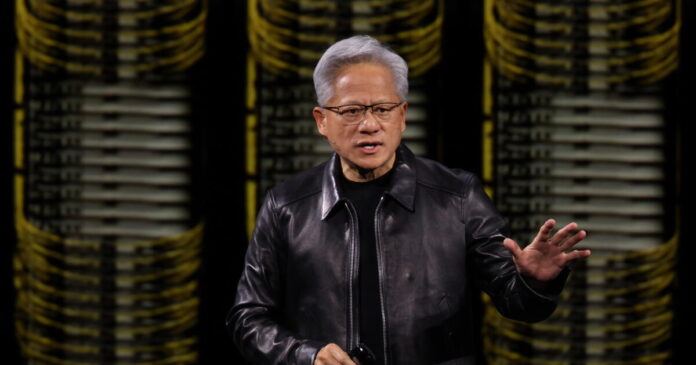
Over three decades, Nvidia Chief Executive Jensen Huang helped propel the chipmaker’s rise into one of the world’s most valuable and resilient companies, leading the business through near-death and periods of reinvention.
Now the self-described “battlefield CEO” faces a personal crisis that will test a roughly $4-trillion Silicon Valley powerhouse that has become the face of the artificial intelligence revolution.
Over the weekend, the 63-year-old tech billionaire and married father of two sent an apology to his employees, admitting he had an affair and is hoping to win back trust. Nvidia’s board announced it is launching an investigation after allegations surfaced that Huang had a relationship with a suspected Chinese spy.
“Leading NVIDIA is the privilege of my life. My responsibility is to serve you and be worthy of your trust. I have fallen short of that responsibility. I am fully committed to NVIDIA and will work to earn back your confidence,” Huang said in the note to employees.
The board said it doesn’t believe the relationship compromised Nvidia’s secrets or national security. China has dismissed the allegations as an unsubstantiated “smear” campaign against the country.
The revelations, though, rattled Silicon Valley and Washington, where federal lawmakers have called for an investigation into accusations that China targeted the powerful tech mogul. The scandal also comes as the U.S. competes with China in the AI race, raising more scrutiny over Nvidia’s business with the country.
Nvidia launched the investigation after the New York Times first reported in late October that American intelligence agencies found that Huang developed a close relationship with a Chinese citizen that was passing on intelligence to Beijing. The woman, Alice Huang, worked as an executive for Singapore-based data center company Megaspeed, which is one of Nvidia’s biggest customers in Southeast Asia. Megaspeed didn’t respond to a request for comment but told the New York Times that it “cannot respond to a media trial and welcomes formal, evidence-based investigation.”
On Monday, Nvidia’s share price fell about 5% to roughly $177 as investors expressed anxiety about how the scandal will affect the company’s future.
Though analysts say it’s unlikely that Huang will be ousted as chief executive and Nvidia will probably remain a dominant AI player, the drama has raised questions about the company’s succession plans and how it will affect the chipmaker’s competition with rivals.
“He’s become a tech celebrity, which has shown to be both a blessing and a curse for companies. His conduct could raise questions about his judgment and potentially undermine some of the confidence he’s built among investors, customers and developers,” said Jacob Bourne, an eMarketer analyst.
Over the years, Huang, who’s known for donning a black leather jacket, has shown he’s a visionary, dealmaker and politically savvy, forging strong ties with President Trump. Bob O’Donnell, chief analyst at Technalysis Research, said that Nvidia will likely be around for decades, but that the scandal is shining a spotlight on who will succeed Huang.
That will be hard to top. Huang’s two children work for Nvidia.
“He’s been able to turn that big personality and vision and dealmaking into this point where he is arguably the leader, certainly of the hardware side of the tech industry,” O’Donnell said. “Everything he says matters and every company wants to do deals with Nvidia.”
Huang is no stranger to navigating through turmoil, and as a leader he’s emphasized the importance of character and resilience.
Born in Taiwan, Huang spent some time in Thailand before his family sent him to the United States, where he attended a religious reform school. There, he told news outlets, he was bullied for being Chinese and even scrubbed toilets.
He met his future wife, Lori, at Oregon State University, where they were studying electrical engineering.
Huang, along with engineers Chris Malachowsky and Curtis Priem, founded Nvidia in 1993 at a Denny’s diner in San José, where they envisioned building a computer chip to improve video game graphics.
In its early days, Nvidia contracted with game company Sega, but it almost went out of business by betting on the wrong approach for building graphics chips. Huang laid off employees and convinced Sega to invest $5 million in the company, avoiding bankruptcy, according to an interview he did on “How I Built This with Guy Raz.”
The company created specialized computer chips that would not only be used for gaming but also for cryptocurrency mining, AI model training and robotics.
Nvidia also partnered with OpenAI, the maker of ChatGPT, early, before people turned more to AI to automate tasks. In 2016, Huang hand-delivered Nvidia’s new supercomputer to OpenAI. As ChatGPT became more popular, Nvidia benefited from the AI boom.
“He’s been on the cutting edge of all of this for a very long time, and then the rest of the world kind of caught up with what he saw and what the industry was doing, and now of course we are where we are,” O’Donnell said.
As other tech leaders have called for a slowdown of the AI race, Huang has called for speeding up AI innovation, stating it could help improve safety. Computers, he said, are just software and not conscious.
Even as Nvidia’s prominence has grown, Huang has told media outlets he still worries the company could go out of business, though he says he’s stepped up in times of crisis.
“The perfect day is [when] we are in trouble, and you just create the worst possible condition. And Jensen, we need you to come and help us think through this,” Huang said in an interview on “How I Built This with Guy Raz.”
The Associated Press contributed to this report.
More to Read
Disclaimer : This story is auto aggregated by a computer programme and has not been created or edited by DOWNTHENEWS. Publisher: latimes.com