In northern France, the story of Australian troops who died during World War I is still being written in stone.
Mark Dapin
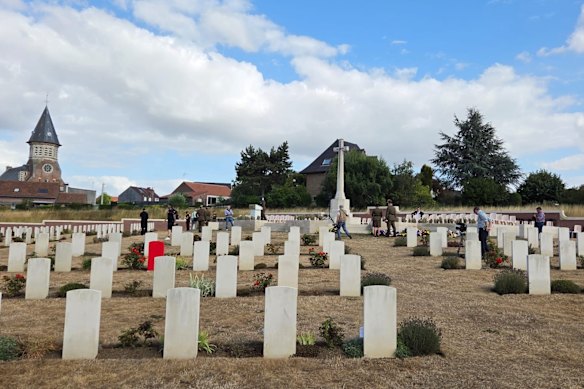
On a summer’s afternoon at Pheasant Wood Military Cemetery in northern France, I am suddenly taken aback to find life imitating art among the serried ranks of identical white headstones.
In 1976, Scottish-Australian folk singer Eric Bogle wrote and recorded the ballad No Man’s Land, about an imagined visit to the graveside of a young soldier killed in France in 1916. In Bogle’s soliloquy, the sun shines down on the green fields of France while the warm wind blows gently and red poppies dance. In Pheasant Wood, I find myself standing by the grave of Australian infantryman Lance-Corporal William Andrew Craigie, who died at the Battle of Fromelles on July 19, 1916, and whose inscription reads simply:
The sun’s shining down/On green fields of France
Warm wind blows gently/The red poppies dance.
I’m startled into tears that Bogle’s words have become a part of our dialogue with the dead: they’re no longer simply poetry, they’re history.
And history has been written, revised and rewritten in this place. Northern France is cemetery country, where the parades of soldiers’ graves are as much a part of the landscape as the oak and beech trees, and the fields of barley and beet. Between 1914 and 1918, more than 530,000 British and Commonwealth servicepeople lost their lives in France. Whatever else they did in their lives they remain military personnel in death, like NSW-born labourer Craigie.
After the war, their remains were collected from their burial sites and reinterred in about 1200 graveyards created and maintained by the newly constituted Commonwealth War Graves Commission (CWGC). Those who could not be identified are remembered on grand and grim monuments still weighted with impossible sadness.
Pheasant Wood is a martial anomaly: a First World War cemetery that did not open until in 2010. It’s the newest CWGC cemetery, the first for five decades. As such, this historic farmer’s field on the edge of the village of Fromelles – and this Portland stone marker with its quatrain plucked from a song – invites reflection on the very nature and practice of commemoration, and what it is that we remember on days such as Remembrance Day. Because the story of these burial grounds is heart-tearing, and redolent with the values of age that has passed.
Indeed, I’m almost surprised that the folk singer’s lyrics were allowed on the headstone, as strict regulations have governed the wording on CWGC monuments since the end of the First World War – rules that are supposed to ensure there are no contentious statements on military headstones.
In 1921, the father of a British soldier was forbidden to mark his boy’s grave with the words “a noble son sacrificed for capitalism”. And in 1922, the CWGC refused to allow a British couple’s son to lie under the legend “his loving parents curse the Hun”. When asked for an alternative proposal, the family suggested a verse that began: “With every breath we draw, we curse the German more.” This too was rejected.
The CWGC cemeteries were planned to reflect an equality of sacrifice among officers and “men”, meaning each stone would bear only a serviceperson’s regiment, name, rank and number, age and date of death, and an approved religious symbol such as a Christian cross or a Star of David. Families could add their own “approved” inscription, ideally comprising no more than 66 characters (including word spaces), and were initially charged three-and-a-half pence per letter for the privilege. An entire inscription might cost almost £1 for Australian parents who would never be able to travel across the world to see it – and they were still not permitted to be the final arbiters of the wording.
Even today, when an inscription proposed for the tombstone of a freshly identified Australian soldier is considered “unusual or contentious in some way”, the wording has to be submitted for approval to the CWGC’s Policy and Commemorations Group in the UK, says a spokesperson for the Department of Veterans’ Affairs (DVA). In addition, “To maintain historical integrity, inscriptions are expected to reflect language that could reasonably have been used at the time of the casualty’s death. For example, references to modern expressions, later events, or the passage of time are not permitted.”
What then are we to make of a eulogy, culled from a song written 50 years ago, but 60 years after a soldier’s death, whose verses go on to suggest that the killing and dying in the First World War was “all done in vain” and that military cemeteries bear witness to “man’s blind indifference to his fellow man”?
I’m here with a battlefield-tour group led by the irrepressible Lambis Englezos, a Greek-Australian retired art teacher whose efforts and energy largely led to the discovery of the burial site of missing casualties of the Battle of Fromelles, a bloodbath that historian Ross McMullin has called “the worst 24 hours in Australian history”.
On July 19-20, 1916, British and Australian infantry launched a diversionary assault on German positions east of the village of Fromelles, to draw enemy troops away from the Somme. But the Germans realised that the attack was a feint, and the foot soldiers who charged their machine-guns were cut down like buckwheat.
About 2000 Australians were killed, of whom more than 1330 could not be found. The remains of some were misidentified and confused with the body parts of other men. Many others are remembered on the wall of the nearby V.C. Corner Australian Cemetery and Memorial, where their names look down upon the graves of 410 casualties whose identities were only “known unto God”.
But where were the others? “They had to be buried somewhere,” says Englezos. “It’s just logic.”
In the face of perceived establishment indifference, Englezos and others spent years searching British and German records before they finally discovered the pits used by the German Army to bury 250 Commonwealth soldiers who had been killed on the German side of No Man’s Land.
Englezos believes we have a national duty to recover and honour our war dead. His son Anthony fought in Afghanistan. “We saw him swear his oath of allegiance at his induction, before he went off to train,” says Englezos. “And soon after, I was in V.C. Corner Cemetery when I took a phone call from my Australian soldier son – and there are 410 Australian soldiers buried in that cemetery: no headstones, not recognisable. The irony and the symbolism was not lost on me.
“I’m not the hard bastard I look,” says Englezos, who does not look like a hard bastard.
When the mass graves were excavated in 2008, there were thought to be several British troops among the bodies, but it’s now widely believed that all (or all but one) are Australian. A total of 181 men have been identified by DNA, and all are buried at Pheasant Wood. Every year on the anniversary of the battle, the name of another Australian – or handful of Australians – is generally announced, and new headstones are unveiled.
It’s 110 years since the battle when our tour group enters the cemetery, and a single stone is wrapped in bright red cloth embroidered with the emblem of the Australian Commonwealth Military Forces. It stands over the grave of Private Roy Leslie Martin, a labourer born in Young, NSW. A podium has been erected with seating for various military and civil dignitaries, including Lieutenant Colonel Geoffrey Godkin of the Australian Army and the Mayor of Fromelles. Among them sit Australians whose ancestors are buried at Pheasant Wood, including Ray Martin, the nephew of the late Private Martin. There are speeches in English and French; a rather ramshackle procession of local ex-servicepeople; the Ode of Remembrance; the Last Post; a minute’s silence; two national anthems; the Lord’s Prayer; and a bagpiper playing Amazing Grace.
Ray Martin’s granddaughter Ariana removes the cover from her distant relative’s tombstone, to reveal the text: He that was lost is found.
A variation on this theme is common on the stones in Pheasant Wood – but at whose behest? Technically, the responsibility for the inscription still rests with the next of kin. But while donated DNA is used to trace them, it is not necessarily the DNA donor who is accepted as next of kin. Instead, that status falls to the oldest surviving traceable family member. Ray Martin did not give his DNA. The donors were his son and his brother. But when the CWGC called Ray about the wording on the stone, he says, “I put a couple in, but they said, ‘No, that’s no use.’ ”
Why was that?
“I mentioned the 110 years [since Roy died] and you weren’t allowed to do that,” he says. “And then they agreed on this one.”
But it turns out that “lost and found” was among suggestions initially proposed to the family by the CWGC.
As the crowd disperses, a portly French veteran animatedly addresses a heavily decorated Australian soldier. “I love Bluey!” he declares loudly. Half an hour later, at a genially shambolic reception to which all of Fromelles seems to have turned up for free beer and chips, I meet Stuart Barr, a Canberra-based public servant who was among the guests on the podium.
Stuart’s great-uncle, Percy Barr, was 19 when he died at Fromelles, and his remains were not correctly recognised until 2024. “There was a grave that was attributed to Percy,” says Stuart, “but it was obviously a misidentification. He was marked as ‘believed to be’ in it. There was some doubt.”
Stuart provided his DNA to the Australian Army’s Unrecovered War Casualties Team, and the family was notified of Percy’s revised identification about three years later. The inscription on Percy’s headstone has an archaic ring: He fought, he died/Not for his own/But for England’s unsullied name.
Stuart explains that this was the original wording on the mistaken stone, provided by Percy’s parents after the war. The CWGC contacted Stuart and offered the chance to change it, but recommended he left it as it was. But how was he ever traced to donate his DNA in the first place?
“I got this cold call out of the blue,” says Stuart. “A gentleman from the Fromelles Association phoned me up and asked if I were a relative of Percy Barr! I’ve got no social-media presence, so I don’t know how they found me.”
Back home from the tour, I speak with Geoffrey Benn, president of the Fromelles Association of Australia, a group of volunteers dedicated to preserving the memory of the men who fought at Fromelles. Benn says tracking down the next of kin is like putting together the pieces of a jigsaw when you don’t have any pieces, don’t have the lid, and don’t even know where to find the box.
Once the association identifies a soldier who was killed behind German lines and might be among those buried at Pheasant Wood, members search his service record for the names of relatives. They then check those names against census records and electoral-office records, then try to trace their descendants through historical telephone directories, further census records and newspaper articles.
“Sometimes it comes down to a family tree being put up on Ancestry as a public listing,” says Benn.
Once a likely candidate has been identified, Benn might call up and say something like, “I don’t know you, and I don’t want any money or your bank account details, but I was hoping you might help me with some historical research. Have you heard of the Battle of Fromelles?”
“And they say, ‘What?’” says Benn.
If they agree to be screened as a possible descendant, the association notifies the army, which provides the relative with a DNA test kit: a mouth swab for saliva and a test tube preaddressed to a laboratory in the UK. When the result is positive, the army convenes an Identification Board to which the Unrecovered War Casualties Team submits evidence that a body can finally be named. However, not everyone contacted agrees to cooperate. Some people are wary of spam phone calls.
“We were trying to track down a vicar in the UK,” says Benn. “The poor vicar’s wife said, ‘We will not be involving ourselves in this. You can just f— off!’”
In the immediate post-war years, there was anger and sorrow in Australia at the CWGC’s per-character charge for an inscription. In 1920, the president of the Melbourne branch of the Returned Sailors and Soldiers Imperial League (the forerunner of the RSL) called it “the most paltry and contemptible thing I have heard of”.
Eventually, the Australian government agreed to cover any unpaid costs, but the decision was not made public, so many of the poorest families suffered their children to pass without even an epitaph. Meanwhile, the CWGC committee continued to reject personal verses for British soldiers such as: “Set out to save England. Result: England permanently damned” and “Against his will/A man to kill.”
“He died the just for the unjust” was disallowed even though it is a quote from the New Testament. But the family of Australian Corporal John Collin Goodall, buried in Ypres, was permitted the ambiguous, I am here as the result of uncivilised nations.
Ambiguity – intended or otherwise – is a theme at Pheasant Wood. Two stones carry lines from First World War poet Wilfred Owen. The grave of Lance Corporal Ralph Johnson, who was killed at the age of 17, is inscribed: Dulce et Decorum est/Pro patria mori.
Detached from the body of Owen’s Dulce et Decorum est (which denounces the maxim as “an old lie”) this quotation from the Roman poet Horace means simply, “it is sweet and proper to die for one’s country.”
While it is wildly unlikely that Johnson’s surviving family believes that the 17-year-old boy died sweetly and properly, that is the only way the inscription could have been read at the time of his death. (Owen did not complete his poem until 1918; it was not published until 1920 and Owen’s work was little known to the public until the 1960s, when it was popularised by opponents of the war in Vietnam.)
In fact, the words Dulce et decorum est pro patria mori are inscribed on the South African war memorial in Launceston (unveiled in 1904), as well as the Graceville War Memorial in Brisbane, the Harwood Soldiers Memorial in Harwood Island, NSW, and Westbury War Memorial in Tasmania, among others.
More of Owen’s words grace the tombstone of British-born Victorian stableman Private Samuel Farlow: Red lips are not so red/As stained stones kissed/By the English dead.
These are lines from Owen’s 1918 poem Greater Love, an extended metaphor of romantic ardour and battlefield death, a fragment from which would have been meaningless in 1916.
At least one of the newer headstones attempts to reconcile the tension between past and present. The inscription for Lance Corporal Frederic James Glenn of Sydney reads in part: Ideas change/Death never.
But perhaps the single most dramatic change for the dead of Fromelles is the honour they gathered over their century of anonymity. In 1916, they were coldly and stupidly sent to charge murderously fortified German positions. The first time their bodies were interred, they were simply tossed into a pit by the enemy.
If their remains had been identified after the battle, they would have been buried under a temporary cross with a short ceremony attended by a muster of their surviving mates. Then, when the war was over, their parents would have been asked to contribute three-and-a-half pence for each letter (and word space!) used to create the wretched stanzas by which their child might be remembered in a distant necropolis that they could never hope to visit.
Yet 110 years later, those same men are reburied with full military honours at a bilingual ceremony attended by senior representatives of the Australian and French governments, the Australian Defence Force, and the Mayor of Fromelles – as well as my coachload of battlefield tourists and half the village.
Their headstones pulse with the poetry of Wilfred Owen and Eric Bogle – whose graveside meditation is now a part of a graveside itself. And as I stand over the resting place of William Craigie in a green field in France, I struggle to grasp what all this means.
The author travelled in Fromelles as a guest of Mat McLachlan Battlefield Tours.
Read more from Good Weekend magazine:
Get the best of Good Weekend delivered to your inbox every Saturday morning. Sign up for our newsletter.
From our partners
Disclaimer : This story is auto aggregated by a computer programme and has not been created or edited by DOWNTHENEWS. Publisher: www.smh.com.au