A different kind of drama – the actors creating pictures through sound
-
Published
A box of gravel, a handful of leaves and a miniature door might not sound like the ingredients for a wedding day drama.
But in a room filled with people experimenting with sounds, they are helping to bring an entire world to life.
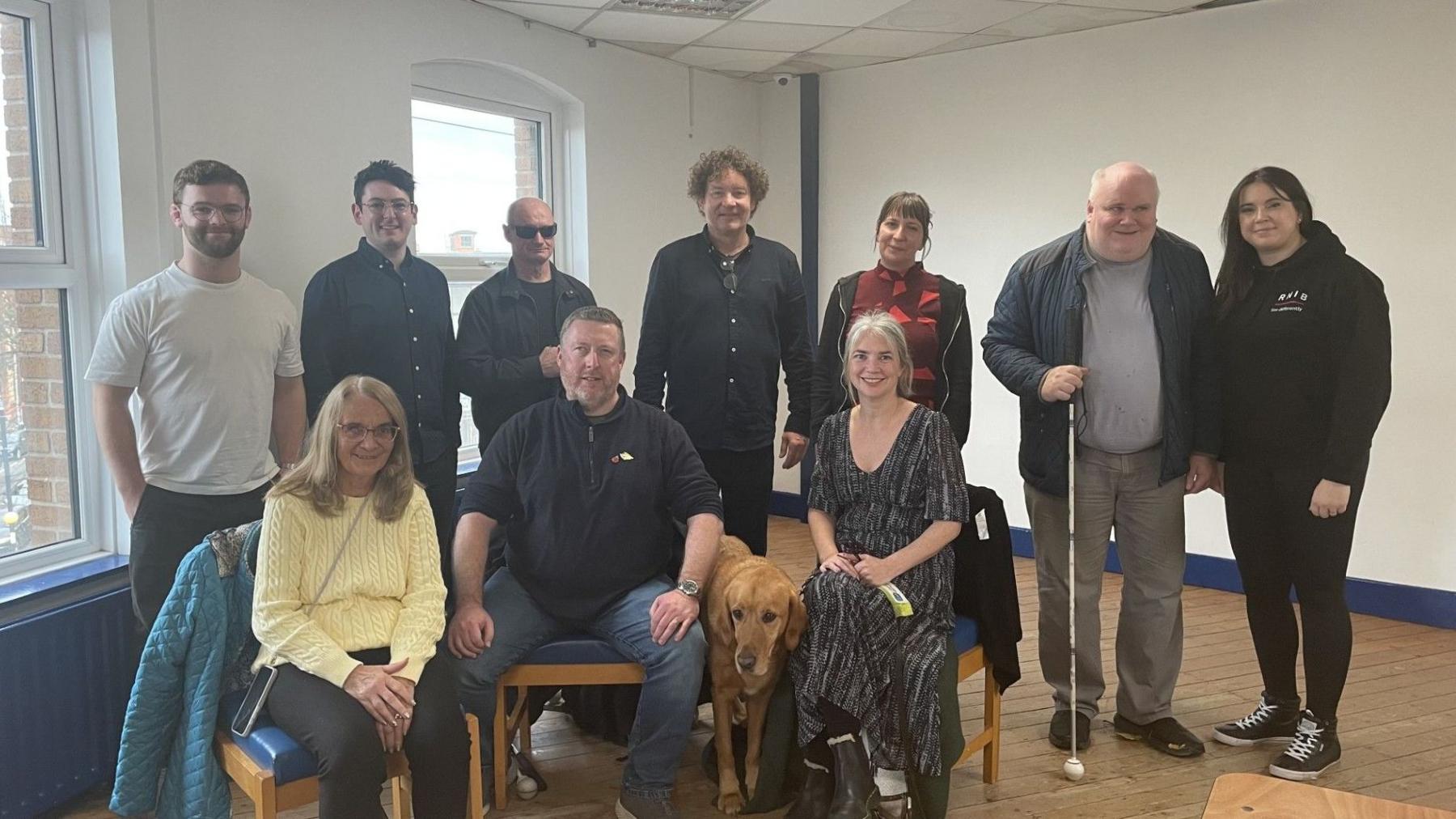
For a group of blind and partially-sighted people, an audio-based drama workshop is giving them the chance to explore performance – without relying on visual cues.
Instead, they are using sound to create characters, settings and stories, building a picture in the audience’s mind without showing them a single image.

The group is writing a play involving a jilted bride on her wedding day, alongside a household of well-meaning but chaotic characters.
Playing the bride, called Nuala with the Hula, Helen Kennedy never got the opportunity to do this in mainstream drama clubs.
“I love [amateur drama] but a lot of the clubs don’t want me in the group because they’re afraid I’ll fall off the stage.
“Because my whole life is sightless and [this is] all sound based, this is just perfect for me.”
Kennedy is one of a number of people taking part in the workshop, which is part of a two-year project by the organisation Sightless Cinema.
It creates cinema without pictures, with people who are blind and visually impaired using sound to tell stories and bring them to life.

The group experiment with props including a wind machine and a foley door – a miniature door with a latch used for sound effects – as well as different materials such as plastic and leaves.
“It’s kind of tricky when you don’t have any visual cues and you have to listen for your cue but it’s really good fun,” Kennedy says.
Another participant, Jim Masterson from Belfast, lost his sight after being assaulted when he was younger.
He has not taken part in drama since secondary school.
“It’s good to get back into it again but it’s different: Then I could see… now I’m completely blind.”
Experimenting with sounds is something that Gareth Smyth has enjoyed.
“[Performing arts is] a way of expressing yourself… and I certainly feel that disabilities should not prevent you from doing so.
“It’s not so much about the disability but it’s about what the disability can enable you to do.”

For Dorothy Leeman, the experience has also been an opportunity to discover what she can do.
She never imagined she could improvise the way she has – and has made new friends through the group.
“That was really, really good fun and I wouldn’t have missed it for the world.”
Andrew McBride loves the art of sound production and wanted to get involved.
He takes part in other dramatic performances and is used to performing in front of an audience – but improvising is “totally new” to him and “slightly terrifying”.
Drama in the blood
Dawn Hopper says drama is in her blood and something she loved taking part in before experiencing significant sight loss.
She says Sightless Cinema is about “trying to paint a picture in people’s minds” without the audience being able to see what is happening.
She adds it has been really educational to learn about the different tools and techniques.
Hopper says being involved in the arts can be difficult for those with sight loss because so much of it is visual.
“It’s an opportunity to break down some of those barriers again.
“Just because you have sight loss, [it] doesn’t mean that you can’t be involved in arts.”

Philip Chong wasn’t sure what to expect at first – but thought it was going to be “a bit of craic [and] a bit of laughs at least”.
For him, the experience has been “that and a lot more”.
He says the workshop helped him to think on his feet and experience different types of drama.
A celebration of creativity
The project will culminate in a performance in 2028, when audience members will be blindfolded in Queen’s University Belfast’s SARC Sonic Lab.
Ciarán Taylor, who runs the workshop, says it brings together theatre, sound and radio drama techniques – and gives people a reason to get out and meet each other.
“The greatest thing is the blind community and the sighted community getting together for these performances, which are a real celebration of creativity.”
Sightless Cinema has also teamed up with Queen’s University and the Royal National Institute of Blind People (RNIB), which helped recruit participants.
-
-
Published6 June 2023
-


Disclaimer : This story is auto aggregated by a computer programme and has not been created or edited by DOWNTHENEWS. Publisher: BBC