‘My darling girl, you are everything to me’ – auctioned letters reveal WWI love story
-
Published
“My darling girl, you are everything to me…”
Those words were written by Gunner Willie Webber to his wife Gladys from the battlefields of World War One.
The newly-weds, who were married at St Edward’s Church in Knighton, Powys, in December 1917, had very little time together as Willie – a gunner with the Royal Garrison Artillery’s 297th Siege Battery – was serving on the Western Front. He was killed just weeks before the Armistice in 1918.
More than a century later, Willie’s letters have inspired an extraordinary act of remembrance by the community – thanks to the efforts of two strangers who refused to let the couple’s love story be forgotten.

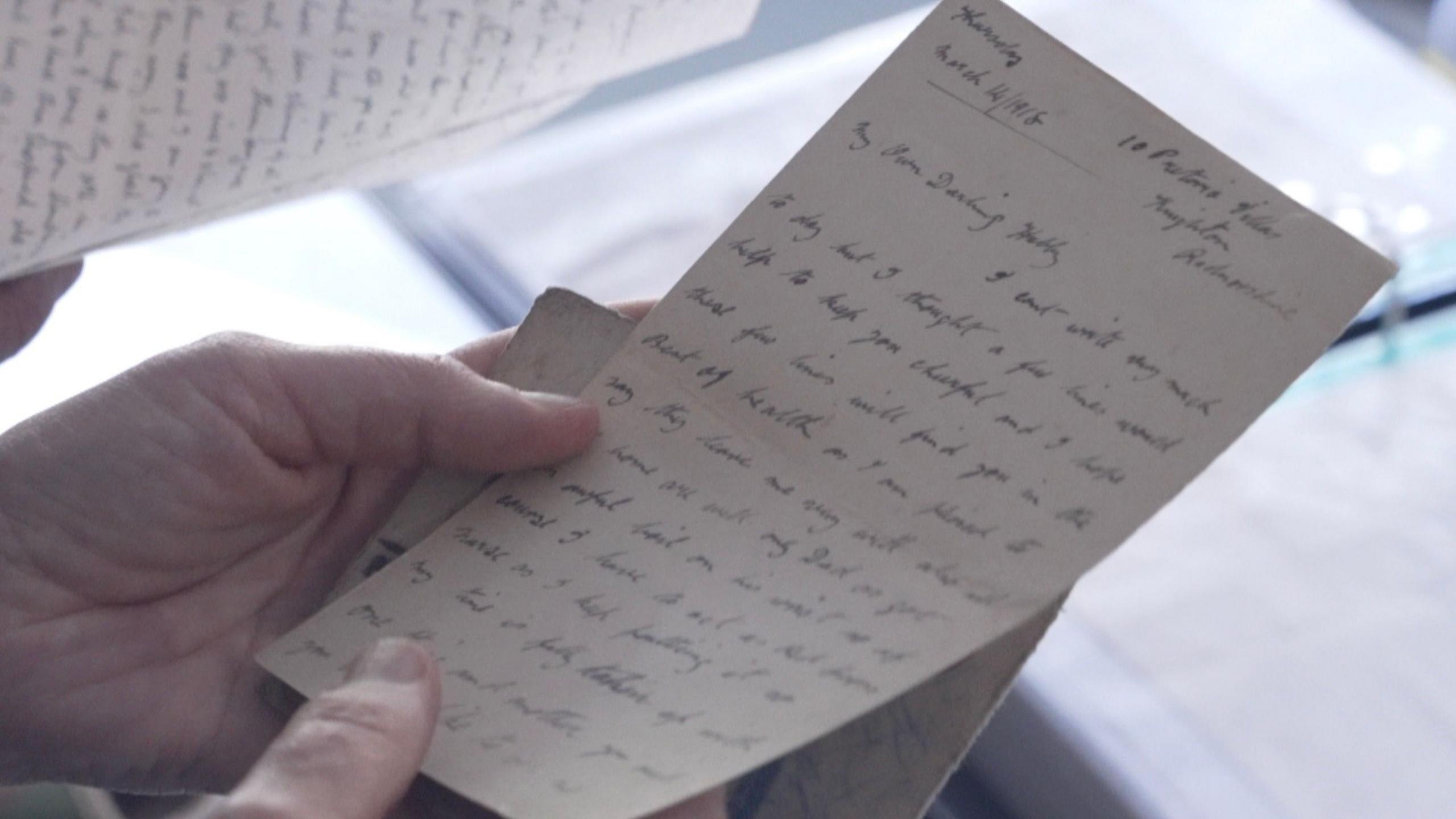
The bundle of 100 letters, dated from December 1917 to October 1918, chart a love story unfolding against the backdrop of war.
After briefly returning home injured and marrying Gladys in late 1917, Willie went back to the front line in France.
He sent his new wife pressed flowers and affectionate messages, signing off: “Your own true hubby & loving sweetheart. Willie.”
Willie wrote regularly and his letters are filled with hopes and dreams for the future.
But the reunion he longed for never came.
Just four weeks before the Armistice, in October 1918, the young soldier was killed in an accident when his gun backfired. He was 25 years old.
The couple had no children, no direct descendants and, as time passed, nobody left to tell their story.
Their story could so easily have ended there. Instead, those letters triggered a remarkable act of remembrance more than a century later.

In 2025, the collection of love letters was put up for sale at an online auction.
Among those following the auction was Andy Garner, a mechanic from Norwich, who collects, transcribes and self-publishes wartime letters – ensuring the people in them are not lost to history.
When he came across Willie and Gladys’ correspondence, he was determined to save it.
“Those letters just kept drawing me back,” he said. “I’m adamant Willie was going, ‘Come on Andy, you can do this’!'”
The auction price kept climbing, but – in the final seconds – Andy placed a winning bid of £351.51.
Later, reading through the complete collection, he found himself deeply moved by the couple’s devotion and Willie’s steadfast belief he would make it home.
“No matter what he’s going through, their love shines through,” said Andy.
“It’s giving them both the hope to survive.”
Though he could barely afford the money he had spent, Andy was determined to publish the transcripts.
‘A story about love’
However, something unexpected happened.
Keith Budgen, the man who had sold the letters, decided he couldn’t keep the auction money.
“I woke up the following morning and immediately contacted Andy,” said Keith.
“I said, ‘You can have the money back. It’s the right thing to do.’
“I had been given the letters, and I just knew that Andy had to have them.”
The pair bonded over the letters and came up with the idea to commemorate Willie, the fallen soldier, in Knighton – the place where he and Gladys had married.

What followed was a remarkable community effort.
Within just two-and-a-half weeks, supporters raised £1,600 for a memorial bench at St Edward’s Church.
The church immediately embraced the project and a remembrance service was organised. Bell-ringers created a special tribute, a bugler volunteered to play, and members of the Royal British Legion lent their support.
“The fact that he wasn’t commemorated on any cenotaph, either in the town where he was born or in Knighton, made it a fabulous idea,” said Ian Ferguson, of the Royal British Legion.
Reverend Rachael Storer, of St Edward’s Church, paid tribute to Andy’s determination to share the couple’s story.
“It all started with those letters that he bought at auction,” she said.
”Ultimately, this is a story about love.”

Lynn Scales, who wrote a special standard for the bell-ringers in memory of the couple said: “Sometimes we forget the sacrifice that some people have made for the defence of this country.
“Gunner Willie sounds like he was doomed to be forgotten – but not any more.”
Andy’s wife, Lex, wrote to the BBC because she wanted others to know about her husband’s work.
“Once he spreads the word, other people come on board and they all want to help because they care,” she said.
“It seems to have this really beautiful ripple effect.
“Willie and Gladys were just regular everyday people, and for someone to actually take that time to remember them, I think it’s beautiful.”
More than a century after Willie wrote those letters, he and Gladys have found a new community. Not through blood or family ties, but through an act of remembrance initiated by two strangers, who refused to let their story be forgotten.
More top stories
-
-
Published1 day ago

-
-
-
Published1 day ago

-
-
-
Published23 hours ago

-
Disclaimer : This story is auto aggregated by a computer programme and has not been created or edited by DOWNTHENEWS. Publisher: BBC