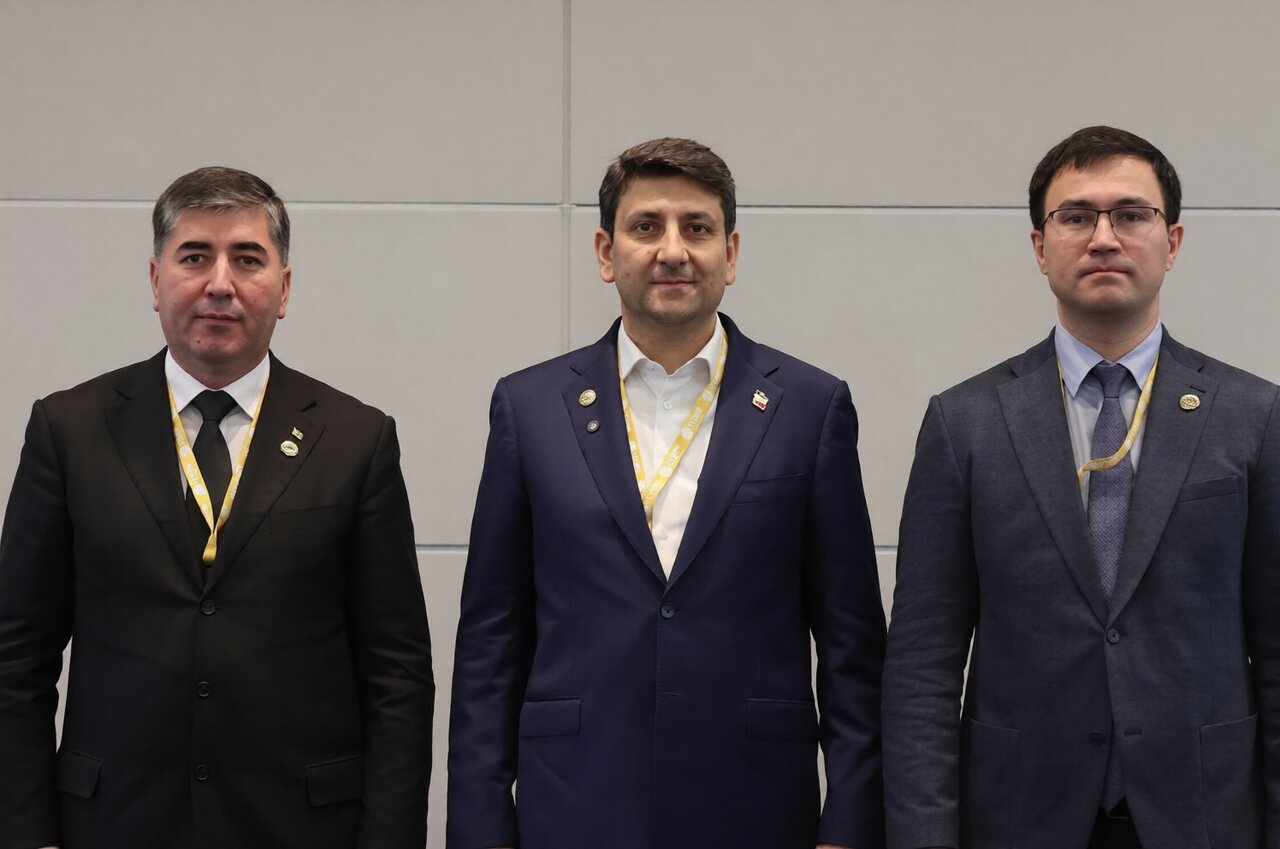
TEHRAN – Iran, Turkmenistan, and Kazakhstan have reached an initial agreement on establishing a joint digital corridor to connect Central Asia with the Persian Gulf and neighboring countries, in a move aimed at strengthening regional telecommunications infrastructure and expanding digital connectivity.
The agreement in principle was reached during a trilateral meeting between Iran’s Minister of Information and Communication Technology, Sattar Hashemi; Turkmenistan’s Minister of Communications, Khadzhimurat Khudaygulyev; and Kazakhstan’s Vice Minister of Artificial Intelligence and Digital Development, Musaliev Doszhan Uladinovich.
The meeting was held on the sidelines of the International Telecommunication Union (ITU) Plenipotentiary Conference (PP-26), which is taking place in Doha, Qatar, from November 9 to 27, IRIB reported.
The discussions focused on strengthening telecommunications cooperation and improving digital connectivity across the region.
The proposed corridor is expected to help reinforce regional communications infrastructure and enhance the sustainability of digital services by developing new connectivity routes and increasing interconnection capacity among the three countries.
It would also enable the participating countries to make better use of their geographical positions and existing infrastructure to improve digital links and accelerate data exchange between Central Asia, the Persian Gulf, and neighboring states.
Developing ICT ties with Brazil, Ghana
An Iranian delegation led by the ICT minister is attending the conference with the aim of bolstering technology diplomacy, bilateral and multilateral collaborations, and pursuing the interests of the country in global governance of information and communication technologies.
Holding meetings with his counterparts and senior officials of the member states, and exploring opportunities for cooperation in advanced technologies and digital economy fields are among the other scheduled plans of the Iranian delegation.
On the second day of the conference, Hashemi held a meeting with Brazil’s national regulator, Carlos Manuel Baigorri, discussing ways for the enhancement of joint efforts.
Referring to the capacities of the two nations, Hashemi proposed boosting cooperation in fields like communication infrastructure, fiber-optic networks, data centers, artificial intelligence, and cybersecurity.
Developing academic and scientific ties, sharing specialized expertise, conducting joint research projects, cooperating in space technologies and satellite applications, and fostering interactions among knowledge-based companies and private sectors of the two countries were among other issues raised by the official.
Elaborating on the capabilities of the ICT research institute for research and educational collaborations, Hashemi invited Baigorri to pay a visit to Tehran to get more familiar with the country’s scientific and technological capacities.
For his part, the Brazilian official announced Brazil’s interest in deepening collaborations with Iran in the ICT field. Baigorri welcomed the ideas proposed by the Iranian ICT minister, noting that promoting cooperation between private sectors, technological companies, and scientific centers of the two nations will pave the way for the implementation of joint projects and initiatives.
The ICT minister also met Samuel Nartey George, Ghana’s Minister for Communication, Digital Technology and Innovations, discussing avenues for the development of technological interactions between Iran and Ghana, particularly artificial intelligence,
Highlighting the country’s technical and engineering capabilities in developing communication infrastructures, he voiced Iran’s readiness to cooperate on connecting schools, medical facilities, and public centers in rural and underprivileged areas in Ghana, through developing fiber-optic networks, supplying equipment, transferring technical knowledge, and training human resources.
Expanding digital government services, exploring the potential joint investment for manufacturing fiber-optic cables and devices required for communication networks, enhancing collaborations between scientific and research institutions of the two countries in fields like AI, cyber security, modern communication technologies, and smart government were among other proposals put forward.
The official invited his Ghanaian counterpart to visit Tehran and explore the country’s capacities in AI, digital government, and knowledge-based firms.
For his part, Nartey George welcomed these suggestions and called for bolstering interactions in digital infrastructures, sharing knowledge, and specialized experiences; he also underscored the importance of transforming existing capacities into concrete and actionable programs.
The Plenipotentiary Conference is the principal governing body of the ITU. It serves as the authoritative decision-making mechanism on the organization’s strategic and financial plans, leadership, and overall direction.
Held every four years, the ITU Plenipotentiary Conference (also known as “Plenipot” or “PP”) affirms common positions among ITU’s Member States worldwide. PP-26 calls on countries to work “Together for a connected digital future.”
Delegates from ITU’s 194 Member States will address the world’s most pressing digital opportunities and challenges, define the UN agency’s strategic vision through 2031, and elect its leadership for the coming four years.
The conference is also expected to address critical, collective issues, such as expanding global connectivity and investment, strengthening the resilience of digital infrastructure, ensuring reliable emergency and humanitarian communications, advancing space-based connectivity and sustainability, and harnessing emerging technologies for development.
PP-26 features an extensive Ministerial Program, with high-level thematic discussions on resilience and emerging technologies, offering senior leaders a platform to exchange insights, showcase national achievements, and address shared challenges. The conference further supports the meaningful participation of women and youth, with dedicated activities on inclusion and accessibility in the digital transformation agenda.
ITU Member States will elect the organization’s top management team as well as members of the ITU Council and Radio Regulations Board. Member States will also agree on the organization’s strategic and financial roadmap for 2028 to 2031.
MT/MG
Disclaimer : This story is auto aggregated by a computer programme and has not been created or edited by DOWNTHENEWS. Publisher: tehrantimes.com