It’s election day morning and, with voters poised to reshape the country’s political landscape, Scarlett Johansson is still trying to figure out when she’ll have time to vote.
Speaking by phone from her home in New York City, the 41-year-old actor laughs as she resigns herself to probably voting at “prime time,” when she expects the lines to be longest. Johansson, who helped assemble her fellow “Avengers” stars for a video supporting Kamala Harris in the 2024 presidential election, is feeling anxious but hopeful.
“I feel like we’re living in such a weird dystopian time — there are so many things stressing me out in the zeitgeist,” she says. “Hopefully there will be a historic turnout and things will positively change.” As it turned out, Democrats won both houses of Congress in a historic midterm landslide.
Johansson has plenty on her plate. Fresh off Halloween with her daughter Rose, 12, and son Cosmo, 5, she’s about to start shooting “Scapegoat,” the new film from “Hereditary” director Ari Aster (more on that later). She’s been working virtually nonstop since February, playing a New York homicide detective in Mike Flanagan’s upcoming “The Exorcist: Martyrs” and taking on a still-secret role opposite Robert Pattinson in Matt Reeves’ “The Batman: Part II.”
She and her husband, Colin Jost, who is busy with another season of “Saturday Night Live,” coordinate their schedules to keep their children’s lives as normal as possible. Johansson would love to return to Broadway, where she won a Tony in 2010 for “A View From the Bridge,” but says theater is difficult to reconcile with raising young children.
“I consider myself the CEO of our household,” she says, her famously husky voice instantly recognizable even over the phone. “I’m a hands-on parent. I love being a mom. Kids have so much going on and their lives are important.”
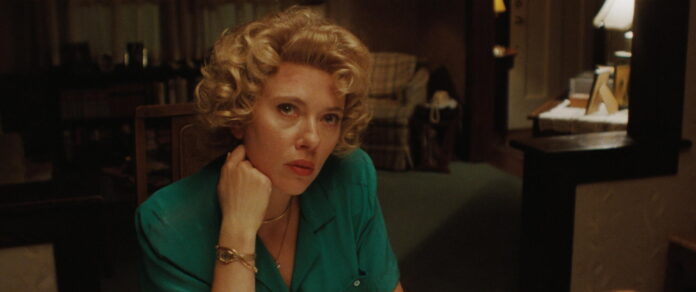
“She has a marvelous face,” says Johansson’s “Paper Tiger” director James Gray. “I would just film one shot of her listening, and it would tell something of the story. That’s rare. It’s telling you that the actor is always thinking.” Johansson in “Paper Tiger”
(Neon)
Johansson’s latest film puts that maternal devotion to a far more harrowing test. In “Paper Tiger,” a new crime thriller from director James Gray set in 1986, she plays Hester, a Queens mother whose husband, Irwin (Miles Teller), and his former-cop brother Gary (Adam Driver) become involved in a dubious consulting job connected to the Russian mob and Brooklyn’s polluted Gowanus Canal. When the deal turns violent, Hester and her two sons find themselves in the mob’s crosshairs. At the same time, she is confronting a frightening medical diagnosis that she keeps secret from her family. The Neon film opens in limited release on Friday.
Gray, known for emotionally intense, character-driven films like “We Own the Night” (2007) and “The Lost City of Z” (2017), drew on his own family history for “Paper Tiger.” He initially envisioned a different version of the story with Anne Hathaway, who had played a character based on his mother in 2022’s “Armageddon Time.” But Hathaway was tied up with Christopher Nolan’s “The Odyssey,” so Gray reworked the story into something more operatic and turned to Johansson, whose work he had long admired.
With her tight perm, oversized glasses and thick outer-borough accent, Johansson’s Hester has a watchful unease as the dangers surrounding her family mount. It’s an unusually unglamorous, tightly wound performance, one that allows Johansson to disappear into an ordinary woman’s increasingly desperate circumstances. For Gray, much of her portrayal comes down to what she can convey without saying a word.
“She has a marvelous face,” the director says. “I don’t just mean physical attraction. I mean that the camera captures a level of introspection where she doesn’t have to say anything, really. I would just film one shot of her listening and it would tell something of the story. That’s rare. It’s telling you that the actor is always thinking.”
Johansson sees Hester as a woman who had put aside her youthful ambitions — “as I think many women do,” she adds — to devote herself to her family. With her eldest son preparing for college, Hester believes those sacrifices are finally paying off, giving him opportunities she and her husband never had. “That’s the American dream, right?” Johansson says.
For Gray, the film’s most painful element comes directly from his own life. His mother was diagnosed with glioblastoma, an aggressive form of brain cancer, when he was 18. She tried to shield her husband and sons from the full extent of her illness, but Gray believes the secrecy ultimately damaged their relationships.
Watching Johansson re-create aspects of that experience was sometimes almost unbearable for him. “It’s like watching a simulacrum of your life,” Gray says. “I still dream about my mother from time to time. I don’t think you ever get over that kind of loss. She was conjuring it in a very authentic way.”

“I’m still trying to make things I think are cool,” Johansson says. “Or maybe going to be cool. Sometimes you sign up for something and it’s going to be cool — and then it’s not as cool as you thought it was going to be. That happens too, right?”
(Ebru Yildiz / For The Times)
Johansson says she didn’t realize until preproduction how deeply the story drew on Gray’s own family history. Rather than trying to re-create his mother, she imagined Hester becoming increasingly disoriented and terrified as the tumor begins affecting her vision and her husband proves incapable of protecting the family from the danger he’s brought into their lives.
“It’s almost like she’s living in an alternate reality,” Johansson says. “It’s like a nightmare that she can’t wake up from.”
Beyond the film’s immediate drama, Gray says Johansson was deeply curious about the generations of Jewish immigrant history that shaped Hester’s family and their aspirations for a better life. It’s territory that Johansson has explored in other recent projects. In 2019’s “Jojo Rabbit,” she played a German mother secretly sheltering a Jewish girl from the Nazis, earning an Oscar nomination for supporting actress (she was also nominated for lead actress that same season for Noah Baumbach’s “Marriage Story”). Last year, she made her directorial debut with “Eleanor the Great,” about an elderly woman who begins passing off her late friend’s Holocaust survival story as her own.
Johansson, whose mother is Jewish and father is Danish, sees these stories as part of a broader interest in identity. Raising two children while watching her own parents grow older, she’s become increasingly curious about intergenerational trauma and how experiences are passed down through families.
“You’re in that sort of sandwich generation,” she says. “You have a more fully formed perspective on your parents’ experience.” That curiosity carries over into her acting. “At this stage in my work, I’m interested in the deeper element of, you know: How did I get here? What makes me this way?”
Few actors of her generation have moved as comfortably between the machinery of blockbuster filmmaking and the more unpredictable corners of independent cinema. As Black Widow in the Marvel Cinematic Universe, she became one of Hollywood’s biggest box-office draws, but she has also repeatedly challenged audiences’ expectations, playing an enigmatic alien seductress in Jonathan Glazer’s “Under the Skin,” an unseen artificial intelligence in Spike Jonze’s “Her” and a succession of eccentric mystery women for Wes Anderson.
Through it all, Johansson says her instincts about choosing roles haven’t changed much since she was a teenager making “Ghost World.”
“I’m still trying to make things I think are cool,” she says. “Or maybe going to be cool. Sometimes you sign up for something and it’s going to be cool — and then it’s not as cool as you thought it was going to be. That happens too, right?”

“The script is just so intense,” Johansson says of “Scapegoat,” the new movie she’s making with Ari Aster. “It has this immediacy to it that is really different. I’ve never read anything like it before.”
(Ebru Yildiz / For The Times)
For Johansson, the rhythms of an actor’s life were established early.
“I remember going with my fax pages, taking the train with my mom to Times Square and going on castings after school,” she says. “Eating a tuna sandwich in Howard Johnson’s afterward and then picking up sheet music next door for vocal lessons. Going to Lee Strasberg on Saturdays. It’s all I’ve ever done.”
She still can imagine finding satisfaction in other fields — medicine, psychology, design — but the idea of giving up acting is almost impossible to comprehend.
“It would be like asking a painter what they would do if they didn’t paint,” she says. “It’s just totally woven into the fabric of my entire life.”
Directing offered Johansson the chance to learn something new after more than three decades on movie sets. She hopes to do it again, though she’s in no rush. “I just want to make sure I find something where the lemon’s worth the squeeze.”
Johansson has considerable clout — and a history of using it. In 2021, she sued Disney over its decision to release “Black Widow” simultaneously in theaters and on streaming, arguing that the move deprived her of box-office bonuses. The dispute was settled out of court. Three years later, she publicly challenged OpenAI after it unveiled a chatbot voice she said sounded eerily similar to hers, despite her having declined an offer to lend her voice to the company. OpenAI denied copying her voice but withdrew it nonetheless.
Having navigated Hollywood since childhood, Johansson knows that sustaining a career requires more than talent, particularly in an industry that can be unforgiving to female actors as they get older. With studios struggling to draw audiences to theaters, she thinks carefully about whether a movie can actually connect with moviegoers.
“Am I making something that other people want to see? Is there an audience for this movie?” she says. “I’m not making a movie just for me.”
She sometimes goes further, questioning whether a studio should make a movie at all.
“Sometimes I get studio projects that I have to say, ‘I don’t think you should make this. I don’t know who you’re making this for,’ ” she says. “ ‘It seems irresponsible to make this.’ ”
Earlier in her career, Johansson says, she sometimes felt she needed a commercial hit to reach the next level. But having achieved just about everything an actor could hope for, what is the next level? Asked how her idea of success has changed over the years, she pauses, struggling briefly to find an answer.
“It’s a good question,” she says. “My aspirations are maybe different now. I’ve been kind of contemplating that too. I think I’m sort of in the middle of that.”
Whatever direction she takes, Johansson has no shortage of work ahead, including Aster’s “Scapegoat,” which co-stars Jacob Elordi and Jude Law. The director of “Midsommar” and “Beau Is Afraid” has kept his plot a closely guarded secret. Depending on which rumors you believe, it’s either a thriller about a doctor performing surgery on a social media star or a sci-fi romance.
“I don’t know what it is either,” she says. “I’ll have more information for you after a few weeks.”
But she’s clearly excited by what Aster has conceived. “The script is just so intense,” she says. “It has this immediacy to it that is really different. I’ve never read anything like it before.” She found herself repeatedly shocked by it. “Colin was like, ‘What are you reading?’ Because I kept going, ‘Oh, my God!’ ”
For all the uncertainty about what comes next, the experience of acting itself remains a powerful draw. Johansson describes the exhilaration of working with another actor when they’re “soaring together” and every piece of a scene seems to click into place.
“Something is happening, alive in a moment, being captured by a camera and 200 crew members witnessing it and participating in it and making it possible,” she says. “And it’s for these two minutes of film.”
There’s a genuine excitement in her voice as she tries to put the experience into words.
“It’s why I’m still doing it,” she says.
More to Read
Disclaimer : This story is auto aggregated by a computer programme and has not been created or edited by DOWNTHENEWS. Publisher: latimes.com