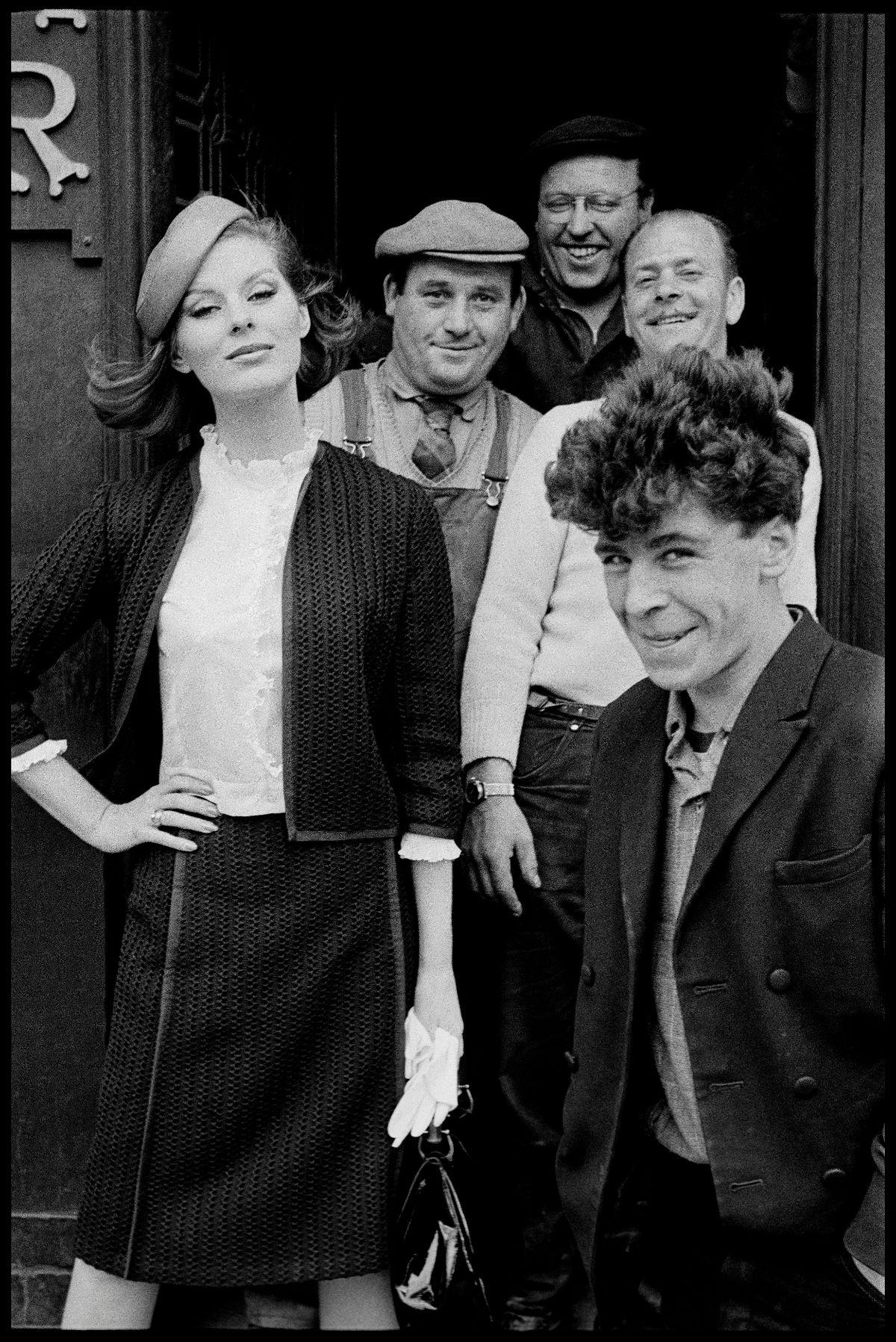
From The Beatles and David Bowie to the Kray Twins, Twiggy, Michael Caine and even the late Queen, photographer David Bailey has captured some of the most famous faces of our time. But long before his iconic portraits of models, musicians and the photographer was turning his lens on the streets of London, documenting its places and everyday people.
Now, a major retrospective opening on November 11 is shining a light on his early career, offering fresh insight into the man who came to personify the swinging London of the 1960s. David Bailey himself says that the capital he recalls most vividly is that which surrounded him growing up in East Ham. He explains: “I remember the London of my childhood. That’s probably the London that stays with you the most.
“What drew me to the ordinary people and streets of London? Because you can see these people. Famous people generally aren’t walking down the street. I’ve always been passionate about photography and all forms of art. I photograph what interests me.”
The exhibition, which is being held at Leica Gallery London, will showcase 22 images from the late 1950s through to the mid 1960s. Included is a shot of legendary model Jean Shrimpton, with whom David Bailey had a four year relationship. He captured her in a 1964 backstreet, wearing the photographer’s own army jacket, and later noted that she was “magic,” with a knack of knowing where the light was and a natural in front of the camera, which loved her.
Of all the images in the exhibition, he says this is his favourite. Some photographs show the city’s blackened post war buildings. Others reflect some of the hardships faced by its residents, caught in the gaze of his lens as they go about their day to day living.
David, now 88 and who was married to both actress Catherine Deneuvre and model Marie Helvin, says: “The title of the exhibition, Time After Time, just seemed to make sense. It’s about time, I suppose, and looking back.” The child of a tailor’s cutter and a machinist, he struggled at school with undiagnosed dyslexia, but was attracted to photography thanks to his love of natural history. He left on his 15th birthday to become a copy boy in Fleet Street.
It was while he was doing his National Service that he bought a Rolleiflex camera and became determined to pursue a career in photography. But he admits he never had a grand plan when it came to developing his career: “I just carried on taking photographs.”
After starting as a photographic assistant, his reputation grew and by 1960 he was contracted as a fashion photographer for British Vogue. His skill and keen eye helped change the way the world saw both fashion and celebrity culture, overturning the traditional formal poses in fashion photography by injecting energy, sharp lighting and movement into shots.
His photographs also helped define the look of 1960s Britain, with simple black and white backgrounds which focussed attention on the subject. It was, he later said, his subject’s personality he wanted, not his own. Over a 60 year-plus career, the four times married photographer captured hundreds of iconic figures across music, film, fashion, art, and public life including Bob Dylan, Jack Nicholson, Peter Sellers, Brigite Bardot, Nelson Mandela and Margaret Thatcher.
But Gallery Director Lou Proud says it is those early images that formed the roots of his work. She explains: “Everybody knows David Bailey as a great photographer, but they are not so used to seeing the other side of him. I think these images are a deeply personal vision – it’s where he came from and that’s still part of him.
“We see glimmers of what is to come afterwards but there is no sugar coating what he is seeing – the darkness and austerity of the end of the 1950s when some were still on rations.”
What connects both his images of the famous and those caught walking past a shop or standing outside a pub is, says Lou, the photographer’s humanity. She adds: “I think David Bailey loves people and he loves a connection with a person or a place.
“He has walked these streets many times – London is in his DNA afterall. It may be a more complicated city now but there is still hardship; there can still be loneliness. It’s not just about his talent as a photographer but about him bringing out a person’s soul.”
Lou, who has been director of the Mayfair gallery since it opened in 2019, admits she thought there was a “fifty fifty chance” of him saying no to the exhibition, so was thrilled when he gave it the green light. She says: “He is a real British cultural icon and doesn’t have one style – he does so many things. He’s a perfectionist and has never stopped being in demand to this day.”
The man himself says he doesn’t spend much time thinking about the London he captured decades ago. David, who was married in 1960 for a year to Rosemary Bramble and remains married to model Catherine Dyer, says: “London changes, people change. That’s life. You take the photographs and move on. People can make up their own minds. That’s the point of photographs. As for what might come next in a still busy career his answer is simple: “Tomorrow.”
*Time After Time is at Leica Gallery London Mayfair, 14 Dover Street, London, W1S 4LW from November 11 2026 to January 14
Disclaimer : This story is auto aggregated by a computer programme and has not been created or edited by DOWNTHENEWS. Publisher: mirror.co.uk