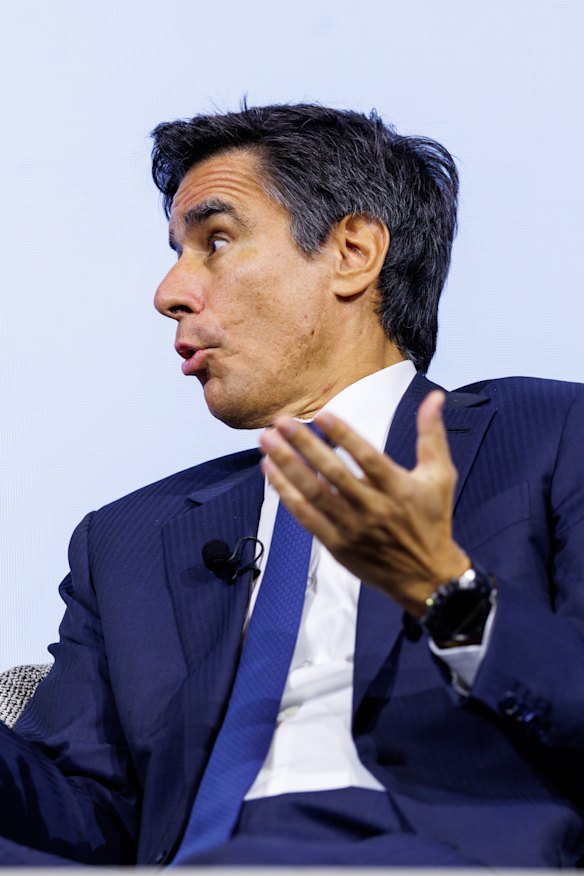
ANZ chief executive Nuno Matos has had a short but ruthless reign at the big four bank. Last year, he swung the axe on more than 3500 jobs. Now he’s turning the screws on staff who aren’t turning up to the office.
Buried deep on page 198 of ANZ’s 348-page annual report, released on Monday, are some stats on the extent to which Matos has taken the big stick to folks who don’t come into the office. ANZ has a workforce of about 40,000 people, of which 18,000 are based in Australia.
In a section titled “Accountability and Consequence Framework”, it’s revealed that in the financial year to September 30, ANZ dealt with 2204 employee relations cases involving alleged breaches of its code of conduct. That was up a whopping 40 per cent on 2025. This comes as Matos homes in on managing non-financial risk at the bank by focusing on accountability.
Of those, 670 cases resulted in “a formal consequence or the employee leaving ANZ”, with 139 of those people fired from Melbourne-headquartered bank, 405 issued with warnings and 126 leaving the $121 billion company.
“The increase in cases has been mainly driven by an increased focus on office attendance non-compliance,” the annual report, signed by chairman Paul O’Sullivan, reveals.
ANZ’s explicit hybrid working policy is that punters must attend the office at least half of their working days, with the flexibility to work the other half of their time remotely. The bank declined to comment.
Reshuffle at Australian Women’s Weekly as top editor departs
It used to be one of the most prized jobs in Australian journalism. Now the role of editor at The Australian Women’s Weekly may no longer exist at all.
That’s the word in Australian media circles, after staff at the women’s magazine were told earlier this month that editor Sophie Tedmanson was set to depart the business, according to people familiar with the developments, after just three years at the magazine.
The Australian Women’s Weekly is published by the nation’s biggest magazine publisher, Are Media, which also owns supermarket favourites including Better Homes and Gardens, Marie Clare, New Idea and Elle.
Are Media, through a spokesman, confirmed Tedmanson had vacated her role as editor, but would not be drawn on whether the position would be cut altogether. Instead, the publisher said it would soon begin recruitment for the “newly created role” of editorial director of The Australian Women’s Weekly and Women’s Weekly Food.
During the publishing industry’s heyday, the top job at The Australian Women’s Weekly was among the most influential in the business. It has been filled by a string of big names, including Ita Buttrose, perhaps better known for her controversial reign as chair of the ABC, along with Helen McCabe, who went on to found Future Women and is now a non-executive director at Claire Kimball’s The Squiz, and Deborah Thomas, who spent close to a decade in the top job before moving into corporate roles at ACP Magazines.
Are claims AWW has a monthly print readership of 1.3 million and a multi-platform audience of 2.8 million. Roy Morgan Research has the monthly print readership at 1.4 million in the year to June 2026 and a multi-platform audience of 1.64 million.
But the publisher clearly doesn’t like what it sees, with the Weekly now slipping to Australia’s second most-read paid magazine after Better Homes and Gardens. How else to explain all the change going on at 54 Park Street?
It was only in June the company confirmed it had made its marketing boss redundant as part of a round of job cuts that impacted up to 30 people.
That shoe dropped only a couple of months after the publisher announced that its chief executive, Jane Huxley, would also head for the door. Her replacement, the company announced in March, would be Are Media’s director of content, Sally Eagle. Tedmanson was contacted for comment.
Immigration cuts for thee
Stuart Bonds is so hopelessly addicted to conspiracy theories his brain has been reduced to gloop.
This, as far as we’re concerned, is the only charitable way to interpret comments made by the man running at the top of One Nation’s upper house ticket in NSW at an anti-mass migration rally at the weekend, where he alluded to the far-right great replacement theory.
At the rally, Bonds rejected the idea “an immigrant arriving yesterday is as Australian as you or me”.
He also claimed if “we don’t support Australian mothers having Australian children, we are going to pay for other cultures’ children to be brought up in our lands”.
What to make, then, of his Finnish wife Sini Ariell Bonds, who celebrated her newly acquired Australian citizenship in a social media post in October last year?
When we asked One Nation how Bonds squares his public comments with his wife’s immigration to Australia, the party furnished us with a statement from the candidate himself.
“My lived experience has shown me that people do not simply leave their culture at the border when they arrive. My wife, Sini, has lived in Australia and paid tax here for more than 10 years,” Bonds said.
“She built and runs her own business and worked through the proper channels to become a citizen. Sini respects our laws – and is Finnish at her core. Our family speaks, reads and writes Finnish. That is why cultural compatibility matters when immigration occurs at the scale we are seeing.”
Start the day with a summary of the day’s most important and interesting stories, analysis and insights. Sign up for our Morning Edition newsletter.
 John Buckley is a CBD columnist for The Sydney Morning Herald and The Age.Connect via email.
From our partners
Disclaimer : This story is auto aggregated by a computer programme and has not been created or edited by DOWNTHENEWS. Publisher: www.smh.com.au