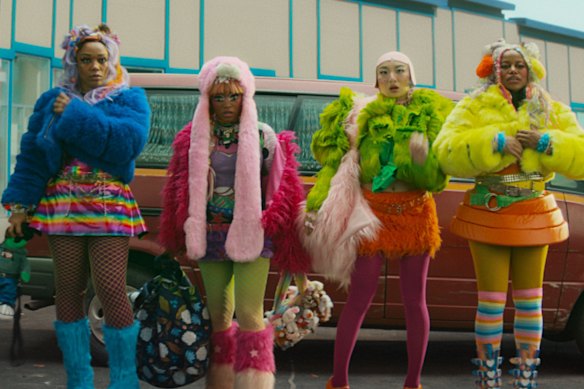
Demi Moore plays the meanest fashion maven of all in Boots Riley’s ode to the art of shoplifting.
There has to be a hellzapoppin’ party going on inside Boots Riley’s head, right? Anyone who saw the filmmaker-cum-rapper’s anti-capitalist satire, Sorry to Bother You, is probably still dazed by its hotchpotch of barbs about telemarketing, the horny version of Siri dirty-talking everyone in the telemarketers’ executive lift and a climactic rebellion led by people with the heads of horses. But Boots wasn’t finished: hell, no.
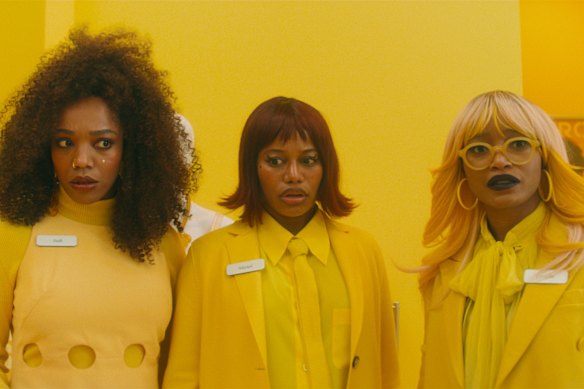
So here he is again with I Love Boosters, in which a vibrant girl gang of career shoplifters joins forces with Chinese sweatshop workers via a teleporter in the shape of a toilet seat. Demi Moore, having been so gloriously reborn in The Substance, plays a fashion maven called Christie Smith so mean she makes Miranda Priestly look like Maria von Trapp. And if you fancy a lovelorn demon who sucks out women’s souls during oral sex, he’s here in the comely person of LaKeith Stanfield. A ton of stuff is going on.

Oakland, the culturally diverse city north of San Francisco where Boots Riley has lived all his 55 years, has always had its boosters: people who steal from downtown stores and resell the goods in the neighbourhood. They are both recognised and, he says, respected. “Somebody had the hook-up and they’d have, you know, an apartment full of stuff,” he says. He went for the clothes. “Being a broke rapper for a long time and needing to look fly as part of the job requirement, you needed to know some boosters.” Although, he says, his best-ever booster buy was a laptop.
In I Love Boosters, his three heroines – sassy leader Corvette (Keke Palmer), Sade (Naomi Ackie) and Mariah (Taylour Paige) – know how to avoid security guards and stuff their sweatpants with clubbing gear, but they barely scrape together a living. Corvette, the leader of the so-called Velvet Gang, is squatting in an abandoned fried chicken shop that still stinks of old oil and is literally running away from debt; her unpaid bills have rolled themselves into a gigantic ball that chases her down the street. Stuff like that happens all the time.
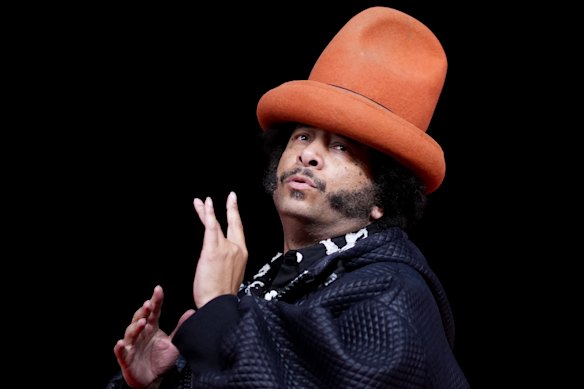
The three of them dream of designing clothes themselves, but nobody on their side of the tracks gets to be a Christie Smith. Riley certainly isn’t down on fashion; he dresses with a pronounced sense of showmanship. “For some people, that ends up becoming their only chance to show their creativity, right?” he says. “You know, to express themselves to a certain extent. Because the movie ultimately is about loneliness and how we try to get connection through various ways: through art, through success, through love.”
Ackie, who sounds 100-per-cent Oakland in the film but in fact comes from London, was photographed at a Schiaparelli show not long before the film screened at the London Film Festival. “That’s quite meta, isn’t it?” she says, laughing. As the daughter of a seamstress, she grew up loving the craft behind clothes.
“With this film, I think it takes that love and then it goes really deep into the good and bad sides of it,” she says. “I guess, to me, the film is about whether we can do two things at the same time: create a beautiful world, where we have access to express ourselves the way we want to through film, music, fashion, art, but also a world where the people who are behind the scenes and who are creating it aren’t exploited.”
Riley describes himself as a communist, which is a bold and unusual position to take in the United States. “Well, it’s interesting,” he says. “Because like 40 something per cent of the population, even in right-wing polls, are saying that they’d rather see us in a socialist society. They might say, ‘I don’t think that’s going to be able to happen’, but they also say, ‘That’d be great if it could.’” (The subsequent midterm results would suggest he’s onto something.)
For him, boosterism is an integral part of the consumer culture, and despite sporadic campaigns to make the sins of the poor an issue, nobody really cares about shoplifting.
“Boosters are not outside of capitalism, even though what they’re doing is illegal. They’re part of the distribution of the commodity.”
Fakes and copies are also part of the system. “It only mentions a little bit in the film, but they know it’s happening, and it’s the way that their products get advertised, right? Because the cool people are now wearing the stuff. They kind of talk about it in the Gucci movie [House of Gucci, 2021]: that they let bootlegs happen because then people see other people with their handbags and that’s who they want to be.” All he does, he says, is take that into the realm of the fantastical.
Riley has notebooks in which he writes things down that occur to him. “Sometimes it’ll be a lyric. Sometimes it’s more of an album concept,” he says. “But a lot of times it’s like problem-solving. Like: where would Christie Smith live?” Answer: she lives in a condo in an achingly fashionable high-rise that is falling over, so that her floor is about a one-in-three gradient.
“It’s a fact,” says Riley, “that there is a building that’s sinking like two inches in San Francisco called the Millennium Tower. You’re not going to notice that, but people are like rolling marbles to show you that it is. So it’s like leaning on that a little bit. How do I take it to another level? How do I heighten those contradictions?”
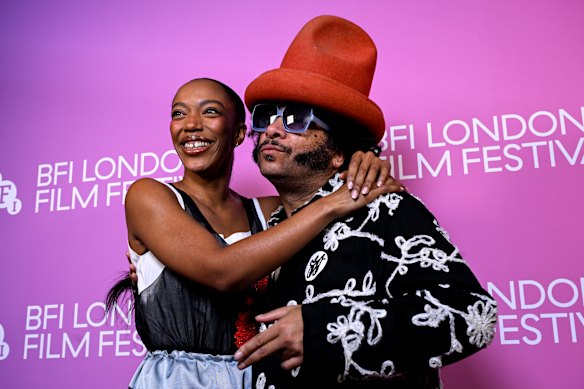
“[Riley] creates this really specific world,” says Ackie, who has always loved reading fantasy for the same reason. “But then you get on set and he’s like, ‘OK, do whatever you want.’ There’s a lot of trust and a lot of letting go, which I think is a beautiful, creative space to be in. It reminded me of when I used to do devised theatre at school, where there are no rules; it’s like you’re in a toy box.”
What made the mind of Boots Riley fizz this way? He went to film school, he says, but what really inspired him was seeing Spike Lee making movies that people wanted to see. Until then, alongside his musical career, he had been involved with a community theatre where 40 people would cram into a room to see plays about the workers’ struggle. “And I was like, OK, we’re going to have to make a lot of plays to help make the revolution this way.
“Then Spike Lee made Do the Right Thing. And I was like, ‘Oh, OK. Even though we have different politics, I see he’s doing something.’” Riley thought if he turned economic analysis into something wild, he could make the audience feel it. “But I would say that politics is what gives me the aesthetic of the movie. So much art is only considered artful when it’s nihilistic. This is not nihilistic. Because I have an optimistic viewpoint. I think that we can change things.” Imagination – for Boots Riley, at least – has no limits.
I Love Boosters opens in cinemas on November 12.
More from Spectrum
Disclaimer : This story is auto aggregated by a computer programme and has not been created or edited by DOWNTHENEWS. Publisher: www.smh.com.au