
When I start to do the maths, it hurts. There’s the $800 per term for dance, before competitions and costumes. There’s a similar figure for gymnastics, and there’s netball and swimming, too – double it all for two kids.
Every time I think we’re coming up for air, there’s another term fee, costume or competition that needs attending to.
It’s a choice, I realise. And a privileged one at that. The average parent pays $4500 a year for their kids’ sport in Australia.
It’s prohibitively expensive, not to mention logistically challenging. And it is just one of the reasons that only 18 per cent of children in Australia aged between five and 17 meet the recommended levels of aerobic and strengthening activity.
This is among the findings of the Blueprint for an Active Australia, a collaboration between the National Heart Foundation of Australia and 70 of the nation’s foremost experts in physical activity and public health.
“Our kids aren’t fit, our kids aren’t strong,” says Elizabeth Calleja, the senior adviser on physical activity at the National Heart Foundation of Australia.
The report, aimed at bridging the gap between activity guidelines and current activity levels, also found that Australian children “are less physically fit than their international peers”.
In what Calleja equated to a “D minus”, they ranked in the 41st percentile for aerobic fitness (20-metre shuttle run) and the 28th percentile for muscular fitness (standing long jump).
And even though many children live within two kilometres of their schools, fewer than one-quarter of primary schoolchildren in Australia walk or ride a bike to school.
But why not? Here are four of the key reasons, according to the Blueprint published on Thursday.
A lost opportunity
Last week, WHO published a report card on adolescence and physical activity. It found one in four children reported zero days of being active in the previous week.
“That’s alarming,” says Calleja, who led the Blueprint. We need to encourage more autonomy and opportunities for children to be active, she adds, but a concern many parents have is safety.
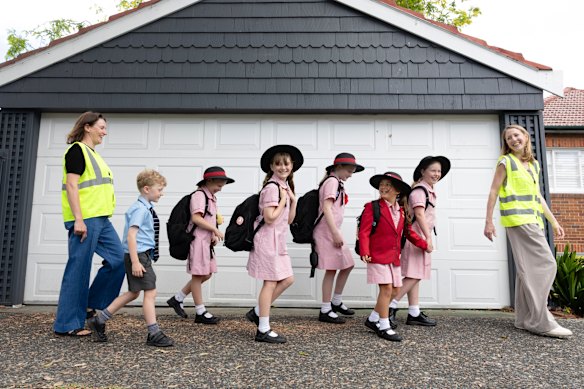
Three months ago, mothers Sophie Krynauw and Julia Edgare started a professional walking bus for local children in Mosman, called Walked By.
Krynauw, originally from the UK, felt frustrated by the long car lines out the front of her children’s public school and so did a survey through the P&C to find out why more children were not walking or riding their bikes.
Parents responded that they didn’t feel it was safe or that their children were too young. So the two parents, who met through a sustainability initiative for schools, decided to take action.
The idea was to alleviate the concerns of parents while giving children the opportunity to be active, connect with nature and community.
They charge parents $5 per child, collecting them from their homes in the morning and walking multiple routes to different schools in the area.
“I think wellbeing habits start when you’re young, and the skills and the muscles are developed when you’re young,” says Krynauw. “Lots of parents don’t walk their kids places because they don’t have the time or the opportunity to do so.”
They currently walk about 30 children to school and say the council has been “amazingly supportive” of the initiative, putting up signs and working with them to make the routes safer.
This is just one of many local initiatives happening across the country. The question for Calleja is how to co-ordinate efforts so it is not just down to individual champions to help children to get moving.
“We’ve got the frameworks, we’ve got the strategies, but it’s not being implemented strategically and systematically across the country,” she says.
We have made activity boring
Many schools have become risk-averse in response to injuries and a more litigious society.
“I’ve heard of schools who banned ball sports altogether,” says Calleja, who led the Blueprint.
But allowing kids to push their boundaries builds confidence, resilience and the ability to make calculated choices around risk as they grow older.
“For a principal, they’re worried about a child getting injured and then getting sued or them being accountable for that outcome,” says Dr Jordan Smith, who co-leads the Physical Activity for Cognitive and Mental Health research stream at the University of Newcastle.
“Whereas they don’t face any backlash for a kid, 10 years later, having anxiety because they never had the ability to challenge themselves.”
As well as helping children to learn how to judge fear and danger, risky play – including monkey bars and climbing – helps them to learn fundamental movement skills.
“We need our school principals who are advocates in this space to talk about the improvements in academic performance as well as [children’s] mood and their ability to cope with change and stresses,” Calleja says.
The misunderstanding about physical activity
Smith says some teachers and principals don’t understand how important a role physical activity can play in a child’s education. In fact, children focus better after movement.
Increased blood flow from physical activity activates certain brain regions, Smith explains.
But there are structural changes to the brain too, including in the hippocampus, which is responsible for memory.
“Kids that are fitter and more regularly active actually have a larger hippocampus, which is associated with better functioning in terms of working and long-term memory,” Smith says.
Unlike some other countries, including Scandinavia and Finland, physical education in Australia becomes optional in high school, a time when depression and anxiety often emerge.
“We’re taking that away from a group of kids who actually could use it the most both for mental health reasons and for academic reasons,” says Smith.
“There’s a lot of evidence showing that when you actually exchange physical activity for curriculum time, there is no decline in academic performance and, if anything, it just gets better.”
A climbing expense
The cost of children’s sport is consistently identified as a barrier for parents – and for some schools. Alongside the expense of the activity and the added cost of uniforms, equipment and competition, the price of transport to and from sports is another barrier.
Increased cost-of-living pressures disproportionately affect people of low-socioeconomic status, who tend to be less physically active.
But, it affects all parents. One mother told me she was trying to steer her child away from the sport she wanted to play because of the cost, while another called the expense “crazy”.
Encouraging physical activity is Smith’s job, yet the price of sport for his two children weighs on him and his wife.
“The interest rate rises are sucking extra money out of our discretionary budget,” says Smith, an author on the Blueprint. “We do have to have conversations around ‘Are we going to do that extra sport or activity?’ It’s really hard.”
While a number of state, territory, local and federal governments offer financial incentives, they are not co-ordinated nor consistent. They include South Australia’s Sports Vouchers Plus program and nationwide trials subsidising registration in organised sport and active recreation programs.
And herein lies the heart of the Blueprint’s purpose: How do we remove the barriers for all children and turn the dial on the current statistics?
On Thursday, Calleja is presenting the report and its recommendations to government and policymakers.
“There’s a lot of work in regards to how we’re performing on a literacy level from maths and English. How do we keep the physical literacy in there as well?”
Make the most of your health, relationships, fitness and nutrition with our Live Well newsletter. Get it in your inbox every Monday.
 Sarah Berry is a lifestyle and health writer at The Sydney Morning Herald and The Age.Connect via X or email.
From our partners
Disclaimer : This story is auto aggregated by a computer programme and has not been created or edited by DOWNTHENEWS. Publisher: www.smh.com.au