
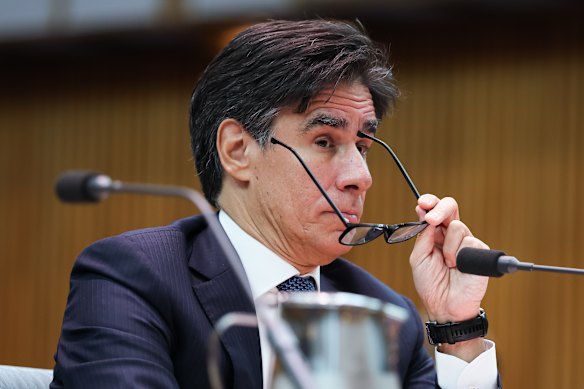

The CEOs of two of the nation’s largest banks have backed cuts in government spending to bring down inflation and make housing more affordable amid warnings the AI building boom could push up the cost of suburban homes as they compete for electricians and plumbers.
Both ANZ boss Nino Matos and his Westpac counterpart Anthony Miller told a parliamentary committee on Thursday that any reduction in government expenditure would help reduce demand and price pressures across an economy that had to become more productive if Australians’ living standards were to improve.
Treasurer Jim Chalmers has promised spending cuts in next month’s mid-year budget update as the government comes under fire for its management of the economy.
The Reserve Bank last week lifted interest rates for a fifth time this year over concerns that inflation, which has increased to 4.3 per cent, will continue to climb. Central banks around the world are lifting interest rates in part due to the fallout from the war against Iran and the global AI construction boom.
Miller said the nation’s inflation problems were fundamentally being driven by the economy’s failure to absorb demand stemming from businesses, households and the government.
“Any pull back of demand, public or private, will contribute to reducing the inflationary challenge that we’re currently navigating,” he told the committee.
Matos noted that inflation around the world was being driven by a “super cycle” of spending linked to AI, renewable energy projects and defence.
Cost of living pressures were challenging “Western social cohesion”, he said, as living standards fell due to higher inflation and higher interest rates.
“Any spending reducing in the economy, be it public or private, will take the pressure from inflation. It’s just economics,” he said.
“Less spending in general will contribute to lower inflation.”
Figures released by the Australian Bureau of Statistics this week showed the biggest quarterly fall in home loans taken out by investors for existing homes on record with substantial falls as well for the construction of new properties.
Miller said while the government’s recent tax changes were aimed at reducing demand, especially from investors, there should be a renewed focus on lifting productivity across housing.
He urged the federal government to consider a “break-glass” plan to let states approve all major infrastructure projects in a bid to get projects built faster and more cheaply.
“One area easily in our control is the approval process. It’s an anchor on our growth. We will not meet our targets on housing or energy nor will we improve living standards unless we move faster,” he said.
After announcing last week’s hike in interest rates, Reserve Bank governor Michele Bullock said the RBA was not looking to drive the economy into recession.
Matos said the greatest threat to the Australian economy was not a homegrown recession, but one caused by a “blip” in the AI boom.
“We have a very curious situation in the world where we have the equity markets at record highs because of the tech wave and basically because of the AI wave, but at the same time you have record highs of interest rates,” he said.
“It’s a dangerous situation for the world.”
The size and speed of the domestic AI construction boom has caught Australian authorities by surprise. Last week the Reserve Bank, which in May had been expecting private sector investment to grow by just 0.8 per cent in 2026, revised up its forecasts to 12 per cent.
Analysis released on Thursday by Oxford Economics Australia suggests even that may be conservative.
It estimates that cumulative spending on data centres could surpass $240 billion by 2030 and be a major driver of the economy. Expenditure is rapidly climbing from $1 billion in 2020 to $20 billion this year and is forecast to reach $60 billion by the end of the decade.
But that activity will require thousands of extra workers, many already employed in housing construction.
It estimates that spending on data centres could surpass $240 billion by 2030. It is rapidly growing with expenditure climbing from $1 billion in 2020 to $20 billion this year and forecast to be $60 billion by the end of the decade.
Total employment in data centres is expected to peak at 38,400 workers of which 36,000 will be involved in construction. That workforce would include 4500 electricians, about 22 per cent of the total working on major projects right now, and 5600 plumbers.
Oxford economist Oscar Guth said the sharp increase in demand for specialised tradies would increase cost pressures across the entire construction sector.
“The rapid expansion of the data centre pipeline is likely to intensify competition for specialised labour, adding to wage and contractor cost pressures in an environment of already elevated inflation,” he said.
“With energy, defence, hospital and other infrastructure projects progressing on similar timelines, competition for the same trades also raises the risk of construction delays and later completion dates.”
On top of the 38,400 jobs directly connected to data centres, another 84,000 jobs are forecast to be generated through supply chain links to construction with an extra 96,000 created because of higher additional spending.
The pressure on the jobs market will spread from Sydney and Melbourne, where 87 per cent of the data centre construction workforce is currently based, to the other metropolitan and regional areas by the end of the decade.
Regional construction employment alone is tipped to grow from 300 this year to more than 10,000 in 2030.
Cut through the noise of federal politics with news, views and expert analysis. Subscribers can sign up to our weekly Inside Politics newsletter.
 Shane Wright is a senior economics correspondent for The Sydney Morning Herald and The Age.Connect via X or email.
From our partners
Disclaimer : This story is auto aggregated by a computer programme and has not been created or edited by DOWNTHENEWS. Publisher: www.smh.com.au



