ONE BIG THING
Nvidia appoints CEO search agency to find replacement for Jensen Huang as Congress preps probe into White House and chip exports
A decision has been made. It seems all but certain that Jensen Huang’s time as Nvidia CEO is coming to an end. Nvidia’s board met last night to discuss how to prepare for his removal. Since then, we have learned that they selected an outside firm to find candidates to replace him and that the board is considering naming a temporary CEO while the search goes on, according to Bloomberg.
Here are Huang’s possible replacements, per the FT:
- Finance chief Colette Kress.
- General counsel Tim Teter. He led much of Nvidia’s lobbying efforts in Washington, but that activity is now likely to come under congressional scrutiny (see below).
- Operations chief Debora Shoquist.
- Worldwide field operations chief Nick Parker, who joined the company last August.
- Chris Malachowsky, Huang’s engineer co-founder.
- Ian Buck, Nvidia’s data center business head, who has a deep background in the software that Nvidia’s chips use.
- ARM CEO Rene Haas. He previously spent seven years at Nvidia.
- AMD’s Lisa Su, Nvidia’s closest rival.
Huang’s fate was sealed when the NYT reported that he’d had a second affair with Kimberly Powell, Nvidia’s vice president of health care: “Mr. Huang, 63, and Ms. Powell, 48, were captured on video being affectionate at a San Jose, Calif., hotel during a Nvidia conference in March, according to two of the people who worked at the company. The New York Times has not seen the video.”
Alice Huang (no relation), Jensen’s other affair partner, has relocated to Beijing “with the knowledge of security officials,” according to Bloomberg. Alice is the founder of Megaspeed—which is currently under investigation by U.S. authorities for suspected chip smuggling—and a suspected Chinese spy.
A congressional investigation is now almost inevitable. Sens. Elizabeth Warren and Chris Coons have asked the Trump administration to preserve all documents related to Nvidia, its exports, and Huang. That’s a common first step prior to a more formal inquiry.
Commerce Secretary Howard Lutnick is likely to come under scrutiny. After the Trump Administration restricted chip exports to China, Lutnick dragged his feet on enforcing the ban, to the bafflement of his cabinet colleagues, Axios reported.
And then there are Nvidia’s Singapore sales. The company used to report the top countries to which it sold products. As late as summer of 2025, 22% of the company’s business went to Singapore—an unusually large chunk given the small size of the city-state. But then Nvidia suddenly stopped reporting its country rankings, the WSJ said.
On Nov. 17, there is the small matter of Nvidia’s Q3 earnings call. Who will be the host?
MORE FROM FORTUNE
The Layoff That Made People Want to Get Fired | Fortune Daily
Verizon’s CEO turned down the job several times before leaving retirement on his ranch: ‘I came in with a little bit of a bad attitude’ – Tatiana Sataua
Millennials wrote off accounting as the most boring job in America—now it’s one of the hottest seasonal jobs and Gen Z’s back door to six figures – Orianna Rosa Royle
Despite Trump Administration’s efforts to limit tariff refunds, American importers are one step closer to receiving $166 billion in universal rebates – Sasha Rogelberg
Jeff Bezos predicts AI could let families live on one paycheck. Amodei and Gates warn of a rougher road – Lara Murray-Sterzel
Mississippi elects first Democratic senator in 44 years as Dems finally find a winning strategy: Spend nothing and let the other candidate talk beef – Catherina Gioino
THE MARKETS
Nvidia fallout is splitting markets in two
Nvidia shares lost 5.54% overnight after the board convened to discuss replacing CEO Jensen Huang. Shay Boloor, chief market strategist at The Futurum Group, thinks the selloff is overcooked. The company’s “ecosystem [was] already firmly established long before this fiasco so I don’t see next 12 to 18 months of revenue suddenly disappearing if Jensen were to leave,” he told Fortune.
The Nasdaq Composite rose 1.6% yesterday, but Nasdaq 100 futures were down 0.67% before the open in New York this morning. Traders are picking between individual tech stocks and between tech and non-tech stocks. Nvidia is an obvious example. But yesterday, Oracle closed up 9%, and Tesla rose 3%, while SpaceX and Microsoft both fell 2.3%. Tech-heavy indexes in Japan and Korea both fell today, but markets in Europe, where industrials and finance carry more weight, were up.
- S&P 500 futures were down 0.29% this morning. The index rose 1.31% yesterday.
- In Europe, the Stoxx 600 rose 0.43% in early trading, and the U.K.’s FTSE 100 rose by 0.35% before lunch.
- Asia: South Korea’s KOSPI was down 0.61%. Japan’s Nikkei 225 was down 0.7%. India’s Nifty 50 was flat. China’s CSI 300 was down 0.78%.
- Brent crude declined to $92 per barrel.
- Bitcoin declined to $73,361.
Why CoreWeave’s stock popped: The AI neocloud is walking away from the corporate debt market
CoreWeave shares closed up 24.71% yesterday, following its Q3 earnings call. The company isn’t profitable, and as a debt-laden AI neocloud with massive outstanding commitments, you might be forgiven for asking why traders are suddenly so enthusiastic about a stock from which they previously axed 15%-plus of its market cap, year to date. Well, its revenue and adjusted operating income both beat expectations.
But the company also said it would begin eschewing the private credit market, according to Tim Hynes, Global Head of Credit Research at Debtwire, because the interest yields being demanded from companies issuing bonds to fund AI are now too expensive.
Debt on the balance sheet rose to about $47 billion from $35 billion in a single quarter, which seems like a lot, he said in an email.
But “the more telling message on the call was that management will not issue unsecured bonds at current yields through 2027,” he said. “In other words, the high-yield market has become too expensive for the company, and it is pivoting to customer prepayments … and to loans secured on chips and contracts.”
“The results buy time and credibility; they do not change the fact that this is a business that has to keep borrowing to grow.”
WINNERS AND LOSERS
AI spending is essentially a $1 trillion annual cash transfer between buyers and suppliers
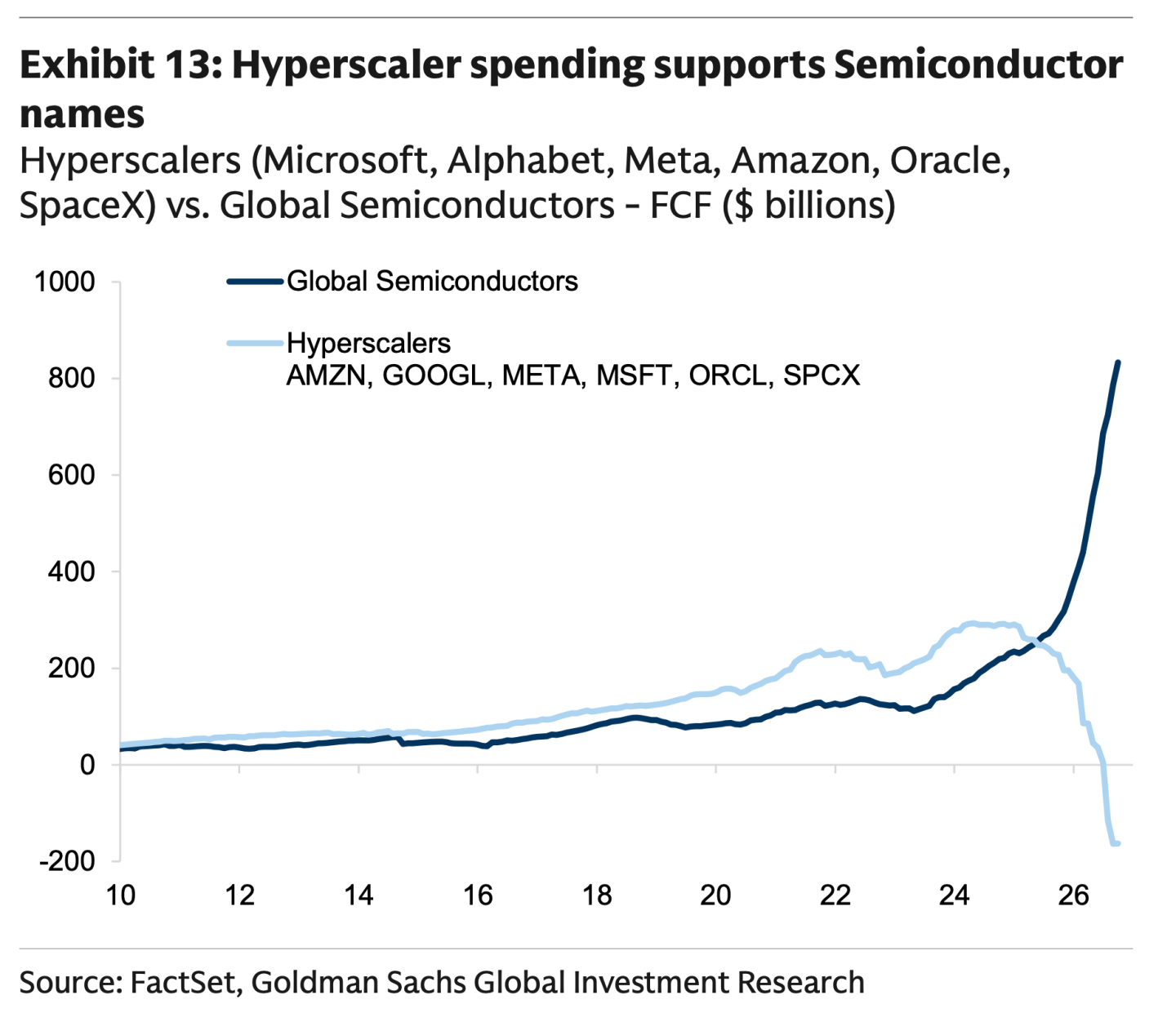
This elegant chart from Guillaume Jaisson at Goldman Sachs shows what appears to be a direct transfer of free cash flow from AI hyperscalers to the semiconductor makers they rely on. AI capex will reach around $800 billion in 2026 and $1.2 trillion in 2027, he estimates.
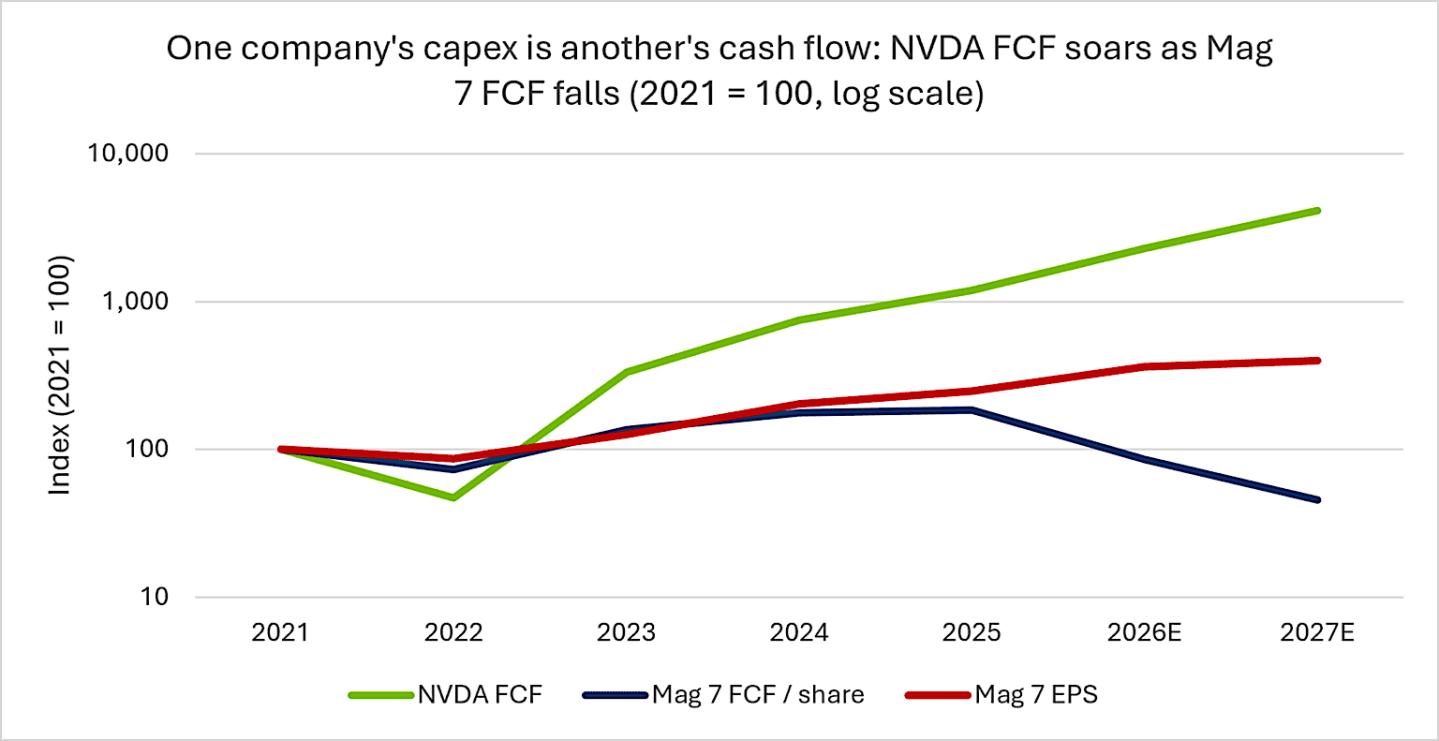
Even within the Magnificent Seven tech stocks, there are winners and losers when it comes to free cash flow, according to Tom Dalrymple at Aubrey Capital Management
“When a hyperscaler goes and buys chips from Nvidia, it capitalizes this cost and thus recognizes the expense over several years through depreciation, with most hyperscalers assigning useful lives of 5-7 years. This helps to dampen the impact on earnings from the investment,” he said in an email to Fortune. “Nvidia recognizes the revenue immediately upon delivery. This creates an earnings powerhouse, but the true cost shows up in the hyperscalers’ free cash flow.”
So what?
“The same mechanism can just as easily reverse. Should capex stall, suppliers such as Nvidia would feel it immediately, while the hyperscalers would still be carrying years of depreciation on equipment already bought,” Dalrymple says.
CHARTS OF THE DAY
As the “misery index” rises, global central banks usher in a new era of expensive money
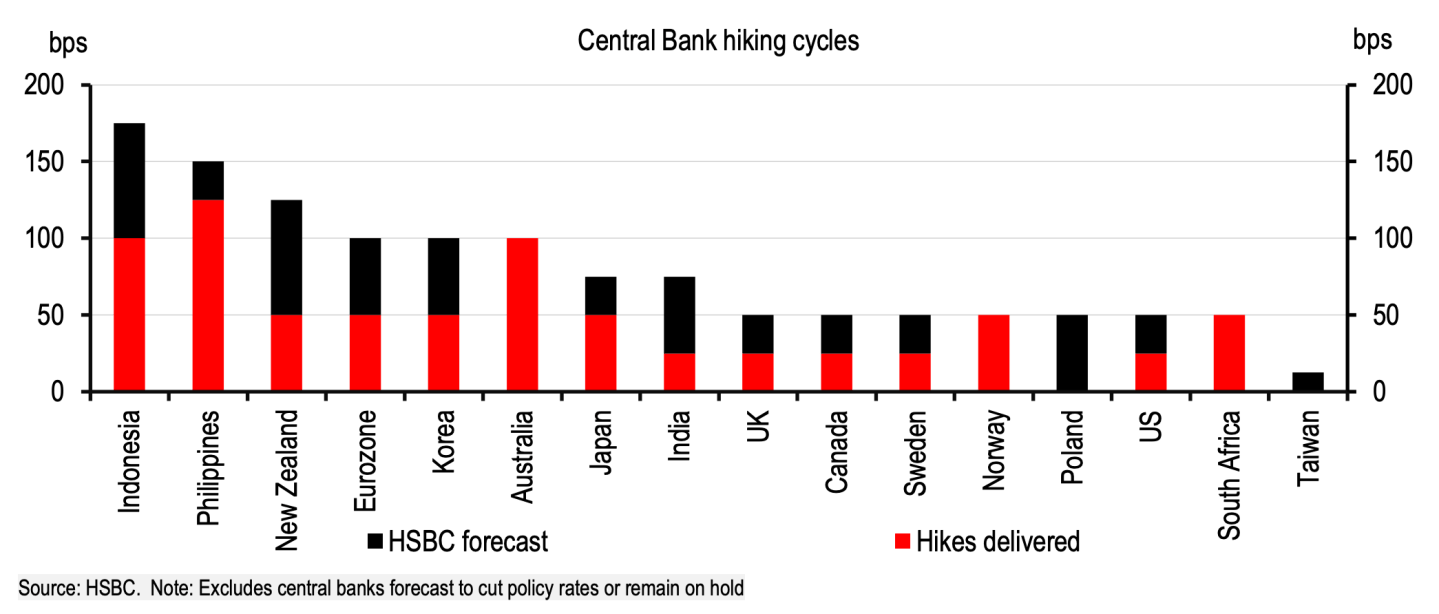
Central banks the world over have taken their gloves off when it comes to inflation, as this chart from James Pomeroy and Bethan Ellis at HSBC shows. “With the [Bank of England] raising rates in November, almost all of the hiking cycles we expect to see are now underway,” the pair said in a note.
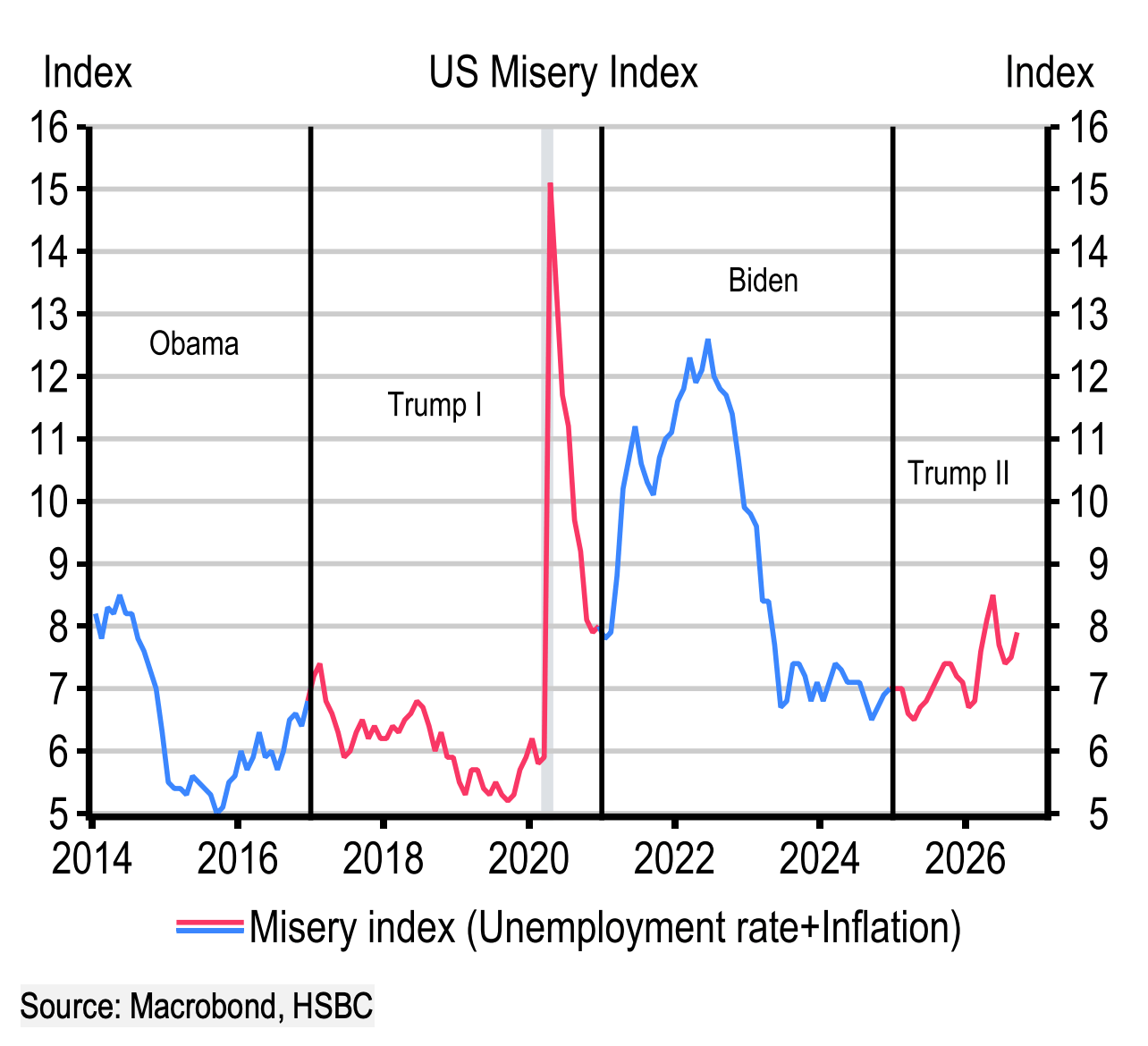
One of the reasons the Fed and its foreign brethren are acting is because the “misery index” has started going up. The MI is the inflation rate plus the unemployment rate—which is on the rise in the U.S.
QUOTE OF THE DAY
“Until they put a face on the robot, and eyes, patients didn’t want the device in their ward or in their room, but as soon as they added the face, they were much more accepting of it.”
—John Healy, vice president of the Industrial and Robotics Division of Intel, describing how robots made by Italy’s Oversonic Robotics can become more effective at handling health care for the elderly. “What they didn’t expect was that the patients respond far more willingly and openly to the robot than they did to the human practitioner,” he told Fortune at Web Summit in Lisbon.
“When the robot asked questions about, you know, what the patient could remember or their recognition of the day of the week or anything that was sort of testing their current level of awareness, they had no shame responding to the robot. Whereas we believe that they may hold back in responding to the same questions to a human.”
THE FRONT PAGES TODAY
Russian diesel exports double after Trump lifts sanctions, but US gets none – FT
Elon Musk says it would be an ‘honor’ to hire Nvidia’s Jensen Huang – CNBC
Outgoing Trump foe Massie forces new Epstein files showdown – Axios
United Airlines Is Banning AI Bots From Booking Flights – WSJ
US Envoys Arrive for Putin Talks as Zelenskyy Sees Opportunity – Bloomberg
In Major Upset, Scott Colom, a Democrat, Wins Mississippi Senate Seat – NYT
ONE MORE THING
This Cisco exec will terminate a meeting if you use baffling corporate acronyms
So you’ve heard of KPI, ROI, and EBITDA. But use the wrong acronym in front of this Cisco president and your meeting could be killed—especially if it’s one that nobody outside the building understands. “I don’t like acronyms, especially Cisco-manufactured acronyms,” Cisco’s president and chief product officer Jeetu Patel told Fortune at a small roundtable dinner.
“If there’s a meeting and there’s acronyms that are used, there are times that I’ve just terminated the meeting.”
- ➡️ Would you like to sponsor this newsletter? Contact advertising@fortune.com for details.
- ➡️ If you would like to receive this information in your inbox every morning before the markets open in New York, sign up here.
Disclaimer : This story is auto aggregated by a computer programme and has not been created or edited by DOWNTHENEWS. Publisher: fortune.com